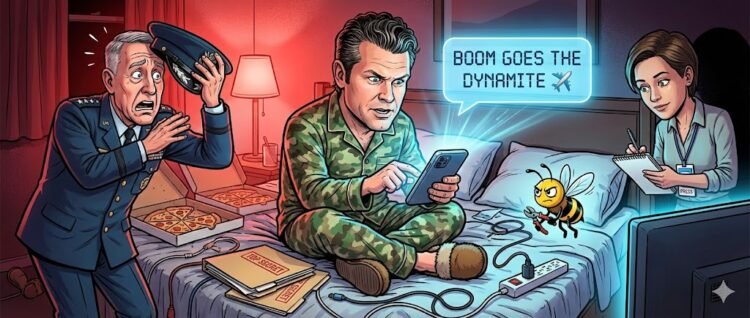
When the chain of command becomes a group chat, the only thing securing the nation is the battery life of Pete Hegseth’s iPhone.
The modern theatre of war is no longer a dimly lit room filled with cigarette smoke and maps pushed around by grim-faced men in uniform. It is not the hushed, sterile environment of the Situation Room where the weight of the world presses down on mahogany tables. No, the new command center of the American empire is apparently a duvet cover in a suburban bedroom, illuminated by the cold, blue light of a consumer-grade smartphone. Picture the scene. It is 2:00 AM. The Secretary of Defense, Pete Hegseth, is bleary-eyed and wearing flannel pajama bottoms. He unlocks his phone, bypasses the encrypted government networks that cost billions of dollars to maintain, and opens Signal. He navigates past the family group chat and the fantasy football league to a thread that probably has a siren emoji in the title. With the casual energy of a man ordering a late-night pizza, he taps out a message that sends shivers down the spine of every intelligence officer with a pulse. “Jets go at 1415 hours. Bombs drop. Keep phones near. #WarRoom.”
This is not a fever dream. This is the operational reality of the United States military under its current leadership. We have descended into a farce where the most powerful fighting force in human history is being run like a bachelor party planning thread. Dozens of pilots, flight crews, intelligence analysts, and allied troops are scrambling under genuine secrecy protocols, checking their secure comms and encrypting their data, while the man at the top is broadcasting their movements on an app you can download next to Candy Crush. It is the digital equivalent of shouting troop movements over the PA system in a grocery store and then acting surprised when the enemy shows up in the frozen food aisle.
The absurdity reached its crescendo recently when a journalist was accidentally added to one of these high-stakes group chats. Imagine the moment. You are a reporter, perhaps covering the Pentagon beat, accustomed to stonewalling and redacted documents. Suddenly, your phone buzzes. You look down. You have been added to a group. You scroll up. You are not looking at cat memes. You are looking at the timing of air strikes. You are looking at mission briefings. You are looking at target coordinates that represent real buildings and real human beings who are about to cease existing. The Pentagon Inspector General, in a report that reads like a cry for help from a drowning bureaucrat, concluded that Hegseth’s conduct “risked exposing sensitive information” that could endanger American lives.
But in the funhouse mirror of this administration, risking American lives is not a fireable offense. It is a management style. The conflict here is between protocol and performance. For decades, military doctrine was built on the idea that silence saves lives. Loose lips sink ships. Operational security, or OPSEC, was a religion. You did not talk about the mission outside the SCIF (Sensitive Compartmented Information Facility). You certainly did not text about it on an app whose terms of service include a liability waiver. But Hegseth is not a creature of doctrine. He is a creature of content. He comes from the world of cable news, where if it isn’t broadcast, it didn’t happen. In his mind, war is not a strategic undertaking; it is a live event. And you cannot hype an event if you keep it secret.
Strategic decisions are now announced in memes and group chats, bypassing the secure encrypted Pentagon networks that were designed specifically to prevent this kind of stupidity. The irony is structural and blinding. The man entrusted with America’s military secrets, the man with the highest security clearance in the land, treats battlefield plans like tweets to his dev-buddy circle. He is playing Call of Duty with real lives, assuming that the “end-to-end encryption” promised by a tech startup is a substitute for the institutional discipline of the Department of Defense.
The cognitive dissonance on display is staggering. The Pentagon, currently spinning faster than a centrifuge, claims “TOTAL exoneration” and insists “no classified info leaked.” They are shouting this while the Inspector General’s report is sitting right there, practically glowing with radioactive warnings. Watchdogs and former officers are quietly cringing, their faces buried in their hands, witnessing what is basically “open-source war planning.” They know that every foreign intelligence service from Beijing to Moscow is laughing. They don’t need to hack our networks. They just need to find a way to get added to the chat. Maybe if they send a funny enough GIF, Pete will let them in.
Let’s look at the cast of this tragedy. First, we have Hegseth, the ex-cable pundit turned So-Called Secretary of Defense. He juggles Signal on his phone like a teenager trying to hide a text from his parents. He has created a closed group chat of generals, cronies, and yes, even family members. It is a “friends and family” plan for global conflict. Imagine explaining to your aunt that she can’t forward the message about the drone strike because it might violate the Espionage Act. It is a group chat brunch where the RSVP is a Hellfire missile.
Then there is the journalist, the accidental extra in this disaster. They didn’t ask to be here. They are just trying to do their job, and suddenly they are holding the nuclear codes, or at least the schedule for the bombers. The ethical dilemma is profound, but the sheer incompetence is the headline. How does the Secretary of Defense not check the recipient list? It is the most basic rule of digital etiquette, let alone national security. check your contacts before you invade a country.
Then we have the IG investigators, the poor souls wading through half-erased chat logs and sticky notes. They are the crime scene cleaners of the bureaucracy. They are muttering about “no SOP, no templates, just late-night chaos.” They are trying to reconstruct the decision-making process of a man who makes decisions based on vibes and emojis. They are finding that the “paper trail” is actually a series of disappearing messages and “thumbs up” reactions.
And finally, the Congressional lawmakers. They are playing the role of the hand-wringing adults in a nursery full of unexploded artillery. They hold hearings. They issue subpoenas. They express “grave concern.” But they know, deep down, that the train has left the station and the conductor is live-streaming the crash. They are trapped in a system that assumes rational actors, forced to oversee an administration that treats rationality as a weakness.
This scandal does not exist in a vacuum. It folds neatly into the larger pattern of the administration’s foreign-policy and national-security style. Recall the recent lethal boat strikes on alleged drug vessels in the Caribbean. That was a “kill-them-all” order issued under suspicion of war crimes, followed by strained media spin and half-hearted oversight. The ethos is consistent. It is bombs-first, ask-questions-later. It is the “shoot from the hip” mentality applied to complex geopolitical conflicts. You don’t need all the details to see the line connecting the two. Whether it is blowing up a boat full of potential witnesses or texting strike coordinates to a reporter, the underlying logic is the same. impulsive, reckless, and performative.
We must juxtapose this clown show against the administration’s narrative of “maximum toughness,” “law and order,” and “freedom through strength.” They love to pose in front of jets. They love to talk about lethality. But strength without discipline is just violence. And strength that comes with a side of security theater and leaked operational plans is not strength at all. It is fragility. It shows an administration that is so insecure, so desperate for validation, that it cannot keep a secret even when lives depend on it.
The human and moral consequences are where the satire stops being funny and starts being terrifying. American service members are out there, right now, in the dark and the cold. They are relying on their leadership to keep them safe. They are trusting that their movements are known only to the people who need to know. Instead, their operational security has been outsourced to a consumer-grade messaging app. Their lives are being endangered because the Secretary of Defense finds SIPRNet too clunky to use from his bed.
Allies and adversaries are watching this. They are reading the open chat logs. They are treating the war-timing notices and mission coordinates like a game of war-planning bingo. Trust is the currency of alliances. Why would the British or the French share intelligence with us if they think it is going to end up in a group chat with a journalist and Pete Hegseth’s cousin? We are burning our credibility as a serious military power. We are looking less like a superpower and more like a militia run by a subreddit.
The broader erosion of trust in the military chain of command is perhaps the most lasting damage. When the Secretary of Defense treats war like a livestream event, it degrades the gravity of the profession. It tells the junior officer that rules don’t matter. It tells the private that discipline is for suckers. It turns the military into a prop for the ego of the leader.
We must lean into the absurdity to understand it. We have to treat this as a dark comedy where the punchlines kill people. The “Classified-info transmission via Signal” is just another checkbox left blank on the form. Hegseth’s chat room is a tiny wooden shed labeled “Secure Warplans Dept.,” part of the New Ministry of Explosive Notifications. The bureaucratic language meets the barbed-wire reality, and the result is a grotesque hybrid of The Office and Dr. Strangelove.
This brings us to the climax, the exposure of the folly of performance-first militarism. This is the ultimate grotesque stratagem. It is a government that thinks strategic advantage comes from broadcast group chats rather than actual secrecy. They believe that leaks disguised as bravado are better than careful craft. It questions whether this is incompetence, hubris, or a new model entirely. War by Twitter logic. Operations by X-post. Strategic dominance by post-history deletion and hype cycles. They are trying to win the engagement war, not the actual war.
The administration will spin this. They will say the IG report exonerated them, even though it did the exact opposite. They will claim the journalist was a “deep state plant” or that the leak was a “strategic disinformation campaign.” They will use every trick in the book to avoid taking responsibility. But the facts remain. The phone was unlocked. The app was open. The secrets were out.
Even if Hegseth survives this flap, and let’s be honest, in this environment, he probably will, the damage is done. The IG “exoneration” is a fig leaf. The media noise will fade. The politicians will offer perfunctory reprimands and then move on to the next outrage. But the real damage is deeper. It is damage to morale. It is damage to international trust. It is damage to the concept that war should be planned in secret by trained professionals, not debated in group chats or used as weekend brag material.
History has a way of cutting through the noise. It remembers leaked secrets not as scandals but as dead bodies whose coordinates were accidentally posted for all to see. We are flirting with disaster, playing roulette with a fully loaded gun, and the man pulling the trigger is too busy checking his read receipts to notice where the barrel is pointed. The defense establishment has descended into a farce, but nobody is laughing, because we are all stuck in the audience, and the theatre is in the splash zone.
Receipt Time
The invoice for this incompetence will be billed directly to the families of the fallen, whenever the luck finally runs out. It will be paid in the lost trust of allies who stop calling. It will be paid in the compromised missions that fail before they begin. The administration thinks they are getting a discount on security by using free apps, but the hidden fees are astronomical. You cannot run a superpower on a data plan. You cannot defend a nation with emojis. The receipt is printing, and it is long, and it is bloody, and sooner or later, someone is going to have to pay it.