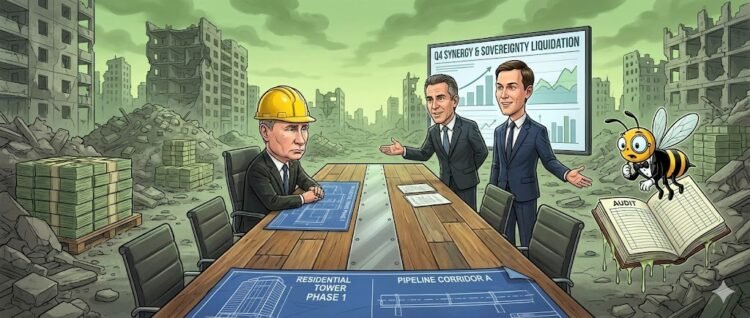
The latest diplomatic envoy to Moscow didn’t bring a treaty. He brought a term sheet.
Last Tuesday, a U.S. delegation led by Steve Witkoff—a New York real estate developer whose diplomatic credentials consist largely of owning buildings that don’t fall down—landed in Moscow for a high-stakes sit-down with Vladimir Putin. He was joined by Jared Kushner, the prince regent of Middle East private equity. Their stated mission was to pitch a “revamped” peace plan for Ukraine. But let’s be clear about what was actually happening in that ornate Kremlin conference room. This wasn’t a diplomatic summit. This was a foreclosure auction.
The press has been dutifully reporting on the multipoint plan as if it were a serious geopolitical framework. They discuss demilitarized zones and neutrality, parsing the language of statecraft. But they are missing the central, screaming question that should be plastered on every chyron in America: Who gets paid if the war stops? Because if you squint at the details of this peace plan, it doesn’t look like a roadmap to sovereignty. It looks like a liquidation sale. It is a “peace through business” arrangement being hawked by envoys who act less like neutral arbiters and more like commission-hungry real estate agents standing inside a burning house, telling the homeowner that the smoke damage is actually a “value-add” for the right investor.
This is your instruction manual for the outrage you should be feeling. This is not a conspiracy theory; it is a balance sheet.
Let’s start with the messengers. In a normal administration, you send career diplomats to negotiate peace. In this administration, you send guys who know how to structure a mezzanine loan. Steve Witkoff is not a statesman. He is a landlord. His primary qualification for negotiating the future of Eastern Europe appears to be his decades-long history of swimming in Russian money. This is a man who, back in 2013, reportedly wrote a character reference for an indicted Russian mobster to help him get into a luxury condo. Now he’s the special envoy conducting solo walks in Moscow parks with Kirill Dmitriev, the head of Russia’s sovereign wealth fund.
Picture that scene: The U.S. representative and Putin’s money man, strolling through Zaryadye Park like two partners finalizing a strip mall acquisition, discussing how to carve up a sovereign nation. Witkoff reportedly didn’t even bring a U.S. government translator to some of these meetings; he used the Kremlin’s. Why bring a witness when you’re cutting a side deal? Then there’s Jared Kushner, whose private equity firm is sitting on billions in Saudi cash. Jared is there to ensure the investment vehicles are road-ready. When these two walk into the Kremlin, they aren’t seeing a geopolitical adversary; they’re seeing a distressed asset with a motivated seller in Kyiv and a strategic partner in Moscow who just needs a little liquidity injection.
The core of the plan—the part that has corporate lobbyists salivating—is the reconstruction fund. The proposal on the table involves a massive fund financed by frozen Russian assets. But here’s the kicker: the plan calls for this fund to be controlled by the U.S., with profits flowing back to Washington. It’s a reconstruction racket. They want to turn the rebuilding of Ukraine into a U.S.-managed hedge fund. This isn’t aid. It’s a hostile takeover of Ukraine’s future. The plan envisions a peace where U.S. companies get first dibs on the contracts to rebuild the cities Russia destroyed. It’s the broken-window fallacy writ large: Putin breaks the windows, and Witkoff’s friends get the exclusive contract to sell the glass.
This is why you’re seeing reports of private meetings in Miami Beach where American and Russian businessmen charted a path to reopen Russia’s economy to U.S. firms ahead of European rivals. The goal isn’t to stop the dying; it’s to beat the Germans to the Russian market. It’s a “Make Money Not War” sticker slapped on a tank.
Follow the money to the energy sector. While the U.S. is currently tightening sanctions, the peace plan dangles the carrot of reopening Russian energy markets. Who benefits? The U.S. energy giants and service companies who have been lobbying to get back into the Arctic LNG game. And let’s not forget Mike Pompeo. The former Secretary of State has been penning op-eds promoting a Trump Peace Plan that involves massive lending programs for Ukraine. It just so happens that Pompeo sits on the board of Kyivstar, Ukraine’s largest telecom operator. When the guy pushing for a lend-lease program for weapons is ghostwriting with a weapons lobbyist, and the guy pushing for investment is on the board of a major infrastructure target, you don’t need a degree in ethics to smell the rot. They aren’t advocating for Ukraine’s defense; they are advocating for their own quarterly earnings.
The most sophisticated part of the grift is the sanctions arbitrage. The freeze on the war is essentially an amnesty for assets. Right now, billions in Russian assets are frozen. If the war ends on these terms, those assets don’t just go back to Russia, and they don’t just go to Ukraine. They go into this trust or fund structure. This creates a massive market for legal and financial engineering. Law firms—the kinds that specialize in sanctions compliance—are already lining up to handle the special purpose vehicles that will manage this money. It’s a trick that turns a punitive measure into a timed financial reprieve. The oligarchs get to keep their money, provided they invest it in the right projects—projects managed, coincidentally, by the very people negotiating the peace. It’s a wash cycle for dirty money, with the peace treaty serving as the receipt.
For the envoys themselves, this is the ultimate reputation laundering operation. Steve Witkoff gets to trade his “developer with mob ties” bio for “Peacemaker.” Jared Kushner gets to add “Global Statesman” to a resume that currently reads “Son-in-law/Saudi Beneficiary.” Peace is the ultimate re-branding exercise. If they pull this off, nobody will remember the conflicts of interest. They will only remember the signing ceremony.
And where is Congress in all of this? Nowhere. These meetings are happening in the dark. There is no Senate confirmation hearing for Special Envoy Witkoff. There is no oversight of the private meetings in Miami. The entire process has been carved out of the normal diplomatic machinery and privatized. It’s the geopolitical equivalent of a pop-up store. It appears overnight, sells its inventory, and disappears before the regulators can check the permits.
The scandal is not just that this plan favors elites. It’s that it treats sovereignty as a negotiable line item. It converts geopolitical deterrence into a corporate risk assessment. It asks democracy to bless a privatized peace without a public conversation. So, be enraged. Be amused. But mostly, be observant. Because when the peace is finally announced, you need to look past the handshake.
The Final Ledger
This is not a peace plan; it is a venture capital term sheet. The asset is a distressed Ukraine. The buyer is a consortium of Russian oligarchs and U.S. private equity sharks. The broker is Steve Witkoff, commission pending. And the terms are simple: Russia keeps the land, U.S. firms get the contracts, and Ukraine gets a neutrality clause that leaves it defenseless but “open for business.” Imagine the signing ceremony: Putin, a champagne bottle labeled ‘Reconstruction Fund,’ a ribbon cut by a private-equity partner, and a smiling Steve Witkoff reading the investor prospectus aloud while calling it “peace.”