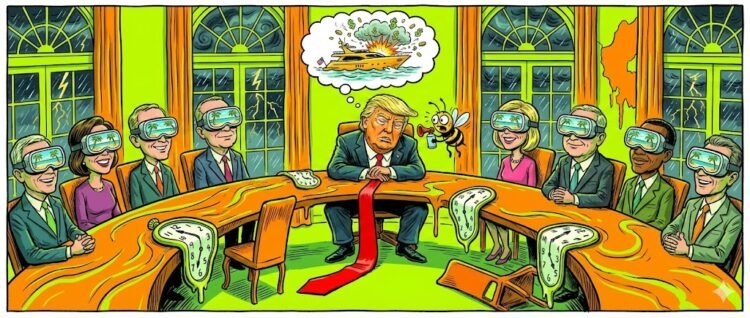
When the President invents eighteen trillion dollars and then falls asleep, you know it’s Tuesday.
The federal government has always been, at its core, a theater of the absurd, but the last seventy-two hours have transcended mere farce and entered the realm of avant-garde performance art. We just witnessed a Cabinet meeting that functioned less as a deliberative body and more as a stress test for the concept of objective reality. For nearly three hours, President Trump held court in a room filled with people whose job descriptions theoretically involve keeping the country running, but whose actual function appeared to be nodding while the commander-in-chief reinvented the laws of economics, geography, and time. It was a spectacle so densely packed with falsehoods that fact-checkers are likely filing for worker’s compensation en masse.
The centerpiece of this chaotic stage play was the President’s spontaneous filibuster of hallucinated facts. He claimed, with the confidence of a man selling a monorail to Springfield, that grocery prices are “down,” a statement that will come as a surprise to anyone who has purchased an egg in the last six months. He declared that drug prices have been reduced by “200%, 300%, 900%,” percentages that suggest he believes mathematics is a negotiation rather than a science. He insisted that he “stopped inflation in its tracks,” a claim that collides violently with the actual economic data showing prices continuing their upward march. But why let data get in the way of a good story?
Then came the grandest fabrication of them all: the assertion that he has secured eighteen trillion dollars in new investments for the United States. Eighteen. Trillion. To put that in perspective, the entire GDP of the United States is roughly twenty-seven trillion. The President essentially claimed he found two-thirds of the American economy in the couch cushions over the weekend. It is a number so preposterously large it stops being a lie and becomes a prose poem about abundance. The Cabinet members sat there, frozen, their faces masks of polite terror, knowing that to correct him would be treason and to agree would be madness.
Amidst this torrent of fiction, there was a moment of quiet that was perhaps louder than any shout. Reporters confirmed that at one point, the President appeared to doze off. For nearly a minute, his head drooped, his eyes closed, and the machinery of state ground to a halt while its operator took a unauthorized reboot. He then startled awake and resumed his monologue mid-sentence, as if he had simply been downloading a new firmware update of grievances. It wasn’t slapstick; it was a stark reminder of the biological reality underneath the bluster. We are being led by a man who is literally falling asleep at the wheel, while shouting that he is the only one who knows how to drive.
But the show must go on, and the script required villains. So we returned to the tariffs. The President repeated his favorite economic fairy tale: that “other countries pay” the tariffs. This is a lie so durable it should be used to pave roads. Tariffs are taxes paid by importers, which means they are paid by companies like Costco, which is currently suing the administration for refunds. The gulf between the rhetoric—China writing a check to the Treasury—and the reality—Americans paying more for rotisserie chickens—is now being litigated in federal court. It is a perfect encapsulation of modern governance: the leader insists gravity doesn’t exist while the citizens are busy falling.
The narrative then swerved into the realm of action-movie fantasy with the discussion of the fentanyl boat strikes. The President claimed that blowing up “alleged drug boats” in international waters saves “25,000 lives each.” This number is, to use a technical term, made up. There is no evidence these boats carried fentanyl. The Caribbean is not a primary fentanyl route. Yet here we have a policy of extrajudicial maritime destruction being justified by a metric that exists only in the President’s imagination. A senior admiral is now preparing to brief Congress, likely sweating through his uniform as he tries to explain why the Navy is sinking vessels based on vibes.
This brings us to the structural irony of the week: the President claiming to have “ended eight wars”—including several that never existed—while potentially starting a few real ones by accident. He declared that China “doesn’t have gasoline,” a statement so baffling it defies categorization. Is it a lie? A confusion? A metaphor? Or just the random firing of synapses in a brain that has been running hot for too long? It doesn’t matter. In the Trump era, truth is just whatever gets the loudest applause in the room.
Senator Mark Kelly, a man who has flown combat missions and lived in space, watched this spectacle and offered a diagnosis that felt surgically precise. He warned that the Pentagon is now being run by “unserious people making serious decisions.” It is a haunting contrast: the astronaut who understands the unforgiving nature of a vacuum versus the cable-news warriors who think reality can be bent with enough shouting. Kelly’s critique cuts through the noise because it isn’t partisan; it is professional. He knows what happens when you ignore the warning lights.
The juxtaposition with World AIDS Day was particularly jarring. This carnival of falsehoods occurred immediately after a global health observance that the President largely ignored. On one side, we have the slow, patient work of science and public health, fighting a virus that doesn’t care about politics. On the other, we have a Cabinet meeting where the President claims to have solved murders in DC (there are zero, he says, falsely) and fixed the electric car market by claiming Biden mandated them (he didn’t). It is a symbolic vacuum where performative governance has completely displaced the actual work of keeping people alive.
And then there is the cruelty. While the President was inventing eighteen trillion dollars, his administration was blocking the distribution of congressionally approved SNAP administrative funds. This isn’t just bureaucratic friction; it is a direct attack on the machinery that feeds poor people. They are celebrating fictional “low grocery prices” while making it harder for vulnerable families to actually buy groceries. It is a policy of starvation wrapped in the language of fiscal responsibility, a gaslighting so intense it could heat a small city.
Meanwhile, in a parallel plotline that seems borrowed from a spy novel written by a golden retriever, Trump’s envoys were in Moscow. Steve Witkoff and Jared Kushner, men with zero diplomatic standing but extensive real estate portfolios, were meeting with Putin to push a “peace plan.” This negotiation is happening without State Department oversight, outside formal channels, and involves individuals with significant business conflicts. It is the foreign policy equivalent of hiring your neighbor to do open-heart surgery because he once watched Grey’s Anatomy. The plan itself reportedly resembles previous Russian talking points, raising the question of who, exactly, is writing the script.
To cap off this marathon of absurdity, the President set a personal record on Truth Social, posting 150 times in a single day. One hundred and fifty posts. That is not leading the free world. That is being a moderator of a subreddit gone rogue. It illustrates a leader who is governing from inside his own narrative greenhouse, permanently logged into a feedback loop of adulation and grievance. He isn’t talking to the country; he is talking to the algorithm.
We are living in a meta-spectacle. The federal government is operating like a reality show marathon where the plotlines contradict each other, the audience is captive, and the protagonist keeps rewriting the script in real time. One minute we are solving non-existent wars, the next we are bombing boats to save imaginary lives, all while the man in charge nods off and wakes up screaming about electric cars. It would be funny if the consequences weren’t so terrifyingly real.
This isn’t just chaos. It is a stress test for the concept of truth itself. When the President can stand in the Cabinet Room and invent an entirely new economic reality, and the people around him just nod, we have crossed a threshold. We are no longer debating policy. We are debating whether we all live in the same universe.
The “unserious people” Mark Kelly warned about are now in charge of the nuclear codes. They are in charge of the food supply. They are in charge of the military. And they are treating it all like content for a social media feed. The danger isn’t just that they are wrong. It is that they don’t care what is right. They have replaced governance with performance, and we are the unwilling extras in their production.
The Price of admission
The bill for this theater comes due not in dollars, but in the erosion of our shared reality. We are exhausting our institutions, burning out our civil servants, and confusing our allies, all to service the ego of a man who invents numbers to feel big. The quiet fear is that we are getting used to it. We are scrolling past the lies, shrugging at the naps, and accepting the chaos as the new baseline. Attention is becoming a form of consent. We watch the spectacle, we tweet about the spectacle, and in doing so, we validate the spectacle. The lights are flickering, the captain is asleep, and the ship is sailing on a sea of imaginary trillions.