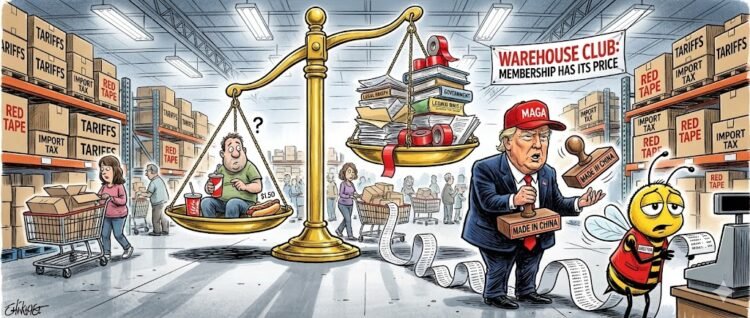
When the “patriotic squeeze” becomes a bureaucratic stranglehold, and the only thing getting squeezed is the American wallet.
The latest episode of the great tariff soap opera has arrived, and it is a masterpiece of economic slapstick. It features a plot twist so absurd that if you put it in a screenplay, a studio executive would reject it for being too on-the-nose. Costco—yes, the warehouse club where you go to buy a fifty-five-gallon drum of mayonnaise and a kayak you definitely don’t need—has joined a frantic, growing parade of companies suing the Trump administration. Their goal? To preserve their eligibility for refunds if the Supreme Court decides that the president’s sweeping tariff authority is, in legal terms, imaginary.
This is the moment where the populism hits the pavement. We were sold a narrative of hard-nosed sovereignty, a story where tariffs were a weapon wielded by a strongman to punish foreign bad actors. We were told that we were squeezing China, Mexico, and Canada until they cried uncle. Instead, we are watching a bureaucratic scramble to protect corporate cashflows. The “patriotic squeeze” has turned into a desperate claw-back, with American retailers frantically trying to ensure that if the courts flush this policy, they don’t get flushed along with it.
It is a perfect satire of modern governance. The administration trumpets tariffs as a restoration of national dignity, a way to make the world respect the red, white, and blue. Meanwhile, the actual mechanism of the policy is being litigated by the people who sell you rotisserie chickens. The disconnect between the rhetoric and the reality is so vast that you could park a container ship in it. And speaking of container ships, they are currently sitting in ports, laden with goods that are about to get more expensive because the guy in the Oval Office thinks “tariff” is a magic word that makes money appear out of thin air.
Layer on top of this the president’s repeated, almost compulsive claim that “other countries pay the tariffs.” This is a rhetorical conjuring trick that rewrites elementary trade economics into a morality play. in this version of reality, America is both the avenger and the victim, standing tall while foreign nations write checks to the U.S. Treasury. It is a comforting fairy tale. It is also a lie. Tariffs are taxes collected at the border. They are paid by U.S. importers. That means Costco pays them. That means the small business owner importing parts pays them. And ultimately, that means you pay them, either in higher prices or in the degraded quality of the goods you can afford.
The administration knows this. Their economists know this. But legal reality is an inconvenient footnote in the Trump era. The point is not the economics; the point is the performance. The tariff policy is a stage prop, a way to look tough for the cameras while the actual cost is outsourced to American workers and shoppers. It is a feedback loop of populist bullying billed as protectionism. We are being told that we are winning a trade war while we are standing in the checkout line, paying extra for the privilege of being used as leverage.
The lawsuit from Costco is significant not because it changes the legal arguments—dozens of state attorneys general and small businesses have already hauled the policy into trade court—but because it shatters the illusion of the “elite” versus the “people.” Costco is not a boutique firm selling luxury goods to coastal liberals. It is the supply chain for the American middle class. When Costco is panicking, it means the policy is hitting the bone. They are not suing because they hate America; they are suing because they can do math. They know that if the Supreme Court voids the president’s authority, there is going to be a chaotic free-for-all to get that money back, and they want to be at the front of the line.
The legal basis for the president’s emergency powers is currently being untangled by lawyers and judges who are trying to figure out if the International Emergency Economic Powers Act (IEEPA) actually allows the executive branch to rewrite the tax code on a whim. The administration argues that national security demands it. The plaintiffs argue that the Constitution sort of frowns on the president acting like a king. It is a high-stakes constitutional showdown that is playing out against a backdrop of Black Friday sales and supply chain anxiety.
The farce is political as much as it is fiscal. We are watching a government that prefers performative toughness to constitutional process. They would rather issue an executive order and fight about it in court than go through the messy, boring work of legislation. It is governance by decree, followed by governance by lawsuit. And while the lawyers bill their hours and the judges write their opinions, the uncertainty hangs over the economy like a wet blanket. Businesses cannot plan because they don’t know if the price of their inventory is going to jump twenty percent tomorrow. Investors are skittish. And the consumer is left holding the bag, wondering why the price of everything keeps creeping up.
This is the new American exceptionalism: the ability to turn a trade policy into a reality TV show where the plot holes are filled with your money. The president tweets about “billions” flowing into the treasury, and for a certain segment of the electorate, that is enough. The truth doesn’t matter. The receipts don’t matter. The fact that the “billions” are coming from their own pockets is a detail too complex to fit on a bumper sticker.
But the receipts do matter to Costco. They matter to the toy companies like Learning Resources, who are also suing because they make educational toys, not geopolitical statements. They matter to the farmers who are watching their export markets dry up in retaliation. The economy is not a vibe. It is a ledger. And right now, the ledger is bleeding.
The “morality play” aspect of this is perhaps the most insidious. By framing tariffs as a punishment for “bad” countries, the administration turns consumption into a loyalty test. If you complain about the prices, you are siding with the enemy. If you point out that the policy is hurting American businesses, you are a globalist shill. It silences dissent by equating economics with treason. It is a brilliant, cynical strategy that insulates the policy from criticism by wrapping it in the flag.
Meanwhile, the state attorneys general are trying to protect their constituents from the fallout. They are the ones who have to deal with the factory closures and the budget shortfalls when the trade war hits home. They are filing briefs and making arguments about federalism and the separation of powers, concepts that feel quaint in an era of “I alone can fix it.” They are trying to use the courts to put the genie back in the bottle, but the bottle has been smashed and the genie is currently running a reelection campaign.
The frantic race to preserve cash-flow positions is the tell. It reveals that the corporate world does not believe the hype. They are not banking on the tariffs working; they are banking on them being illegal. They are hedging their bets against their own government. That is not a sign of a healthy economy or a stable political system. It is a sign of a system in deep distress, where the rules of the game are subject to change without notice.
We are living in a moment where the instruments of the state are being used to settle scores and perform for an audience of one. The tariff authority is just one example. We see it in the way the Justice Department is deployed, in the way regulatory agencies are weaponized. But the tariff fight is unique because it hits everyone. You cannot opt out of the economy. You cannot unsubscribe from inflation.
The “bureaucratic scramble” described in the news is the unsexy underbelly of populism. It is the paperwork that piles up when you try to run a 21st-century economy on 19th-century ideas. It is the thousands of exclusion requests, the endless litigation, the confusion at the ports. It is the friction that slows everything down and makes everything cost more. And it is entirely self-inflicted.
There is a grim irony in Costco being the face of this resistance. This is a company famous for its $1.50 hot dog and soda combo, a price point they have maintained through wars and recessions. They are the guardians of value, the champions of the consumer surplus. If they are saying the policy is broken, you should listen. They are the canary in the coal mine, but the canary is the size of a warehouse and it sells bulk toilet paper.
The feedback loop is complete. The administration breaks the system with tariffs. The costs go up. The base gets angry about inflation. The administration blames foreign countries and corporate greed. The base cheers for more tariffs. The costs go up again. It is a perpetual motion machine of grievance and economic illiteracy. And the only people who get rich are the lawyers.
So here we are, watching the Supreme Court decide if the president can tax us whenever he feels like it, while our favorite bulk retailer tries to get a refund on the taxes we already paid. It is a perfect encapsulation of the Trump era: chaotic, expensive, and legally dubious. The “squeeze” is on, alright. But don’t look at China. Look at your receipt.
Receipt Time
The bill for this theatrical production is astronomical. It includes the higher prices at the register, the legal fees for the endless lawsuits, the lost contracts for American exporters, and the chaos in the supply chain. But the biggest cost is the erosion of the rule of law. When we allow a president to use emergency powers to rewrite trade policy on a whim, we are paying with our institutional stability. We are trading the certainty of law for the caprice of a ruler. And unlike a Costco membership, this policy does not come with a satisfaction guarantee. You can’t return a broken democracy for store credit.