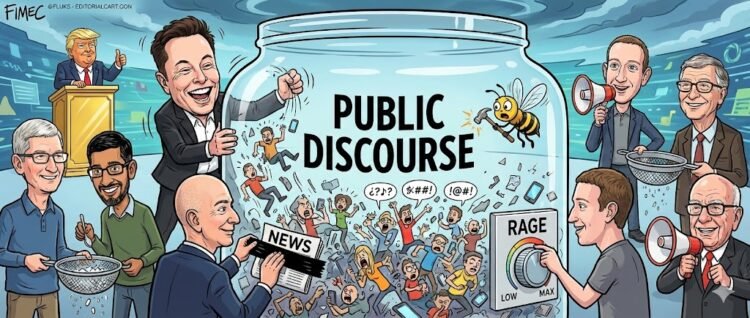
We operate under a shared and comforting delusion that the “public square” is a real place. We imagine it as a civic commons, a dusty but noble agora where ideas clash, truth eventually rises to the top like cream, and the collective will of the people is forged in the fires of debate. This is a lovely story. It is the kind of story you tell children to help them sleep at night, right before you check under the bed for monsters. But the monsters are not under the bed. They are in the boardroom, and they have just completed a leveraged buyout of the human perception of reality.
It is time to retire the quaint, twentieth-century concept of the “Mainstream Media.” That term implies a diverse ecosystem of competing voices, editorial boards, and ethical standards. It implies a messy, chaotic, but ultimately democratic struggle for the narrative. That ecosystem has been paved over. In its place stands a monolithic, globe-straddling consortium masquerading as a set of unrelated tech companies. It is a cartel of seven men—Elon Musk, Larry Ellison, Jeff Bezos, Bernard Arnault, Sergey Brin, Larry Page, and Mark Zuckerberg—who have realized that it is far more efficient to own the pipes, the filters, the screens, and the algorithms than it is to merely buy a few ads.
These men do not just own the news. They own the nervous system of the planet. They hold the patent on the delivery mechanisms for truth. They control the social feeds where we scream at each other, the search engines where we ask our most private questions, the cloud servers where our history is stored, and the luxury narratives that define what success looks like. They have turned democratic discourse into an algorithmic terrarium, a glass-walled enclosure where they control the temperature, the lighting, and the oxygen levels, watching us scurry around inside while they decide whether to shake the jar.
The Portfolio of the Gods
To understand the scope of this capture, we have to look past the individual fiefdoms and see the map of the empire. This is not a collection of tech CEOs. It is a vertical integration of the human experience.
Elon Musk, the jester king of this new order, bought Twitter not as a business investment but as a geopolitical weapon. He controls the “For You” page, the digital assignment desk that decides what the political class talks about every morning. He has turned a platform for breaking news into a megaphone for his own id, a place where conspiracy theories are given the same weight as AP wire reports, provided the conspiracy theory flatters the right people.
Jeff Bezos, the merchant prince, owns the logistics of our survival via Amazon and the logistics of our democracy via the Washington Post. For years, we viewed his ownership of the paper as a vanity project, a billionaire buying a civic toy. We were wrong. It was a strategic asset. When he intervened to kill the paper’s endorsement of Kamala Harris, he revealed the true purpose of the asset. It was not to speak truth to power. It was to signal compliance to power. It was a peace offering to a potential administration that controls the Blue Origin contracts and the antitrust regulators.
Mark Zuckerberg, the data architect, owns the social fabric itself. Meta—Facebook, Instagram, WhatsApp—is the lens through which billions of people see their friends, their families, and their world. After years of pretending to be a neutral utility, Zuckerberg has pivoted. He has tweaked the dials to de-emphasize “political content,” a euphemism for “news that makes people angry at the status quo.” By flooding the zone with AI slop and lifestyle content, he creates a sedative effect, a digital soma that keeps the user base docile while the world burns.
Larry Ellison, the silent partner, owns the backend. Oracle is the database of the surveillance state. While we argue about TikTok, Ellison is quietly hosting the data. His alignment with the MAGA movement is not a flirtation; it is a marriage. He represents the fusion of high-tech surveillance and authoritarian governance, the man who once pitched a national ID database after 9/11 and now sees a path to implementing it.
Sergey Brin and Larry Page, the absentee landlords of Alphabet, control the library of Babel. Google Search and YouTube are the primary gateways to information for the entire species. Their recent shifts—the suppression of certain search terms, the sanitization of YouTube recommendations, the push for AI-generated answers that prioritize “safety” over hard truths—are not glitches. They are editorial decisions made by algorithms that are programmed to avoid friction with the state.
And Bernard Arnault, the emperor of taste, controls the aspirational layer. LVMH is not just a handbag company. It is a media company that sells the aesthetic of wealth. Through his ownership of French media outlets and his massive advertising spend, he shapes the global definition of “success.” He reinforces the hierarchy. He validates the idea that the ultra-rich are not policy failures, but cultural heroes.
Together, these seven men hold the keys to the castle. They can change the lighting. They can change the soundtrack. They can change the plot. And the terrifying reality is that they have all decided to change the channel to the same station.
The Cordial Alignment
The most unnerving plot twist in this season of American Oligarchy is the convergence. For a long time, we were sold a narrative of rivalry. We were told that Silicon Valley was a bastion of libertarian innovation that stood apart from the old-world corruption of Washington. We were told that these men were competitors, fighting for market share.
That was a lie. They are not competitors. They are colleagues. And they have all drifted into a cordial, comfortable alignment with Donald Trump.
This is not a conspiracy in the sense of men smoking cigars in a back room (though they probably do that too). It is a convergence of interests. It is a realization that democracy is expensive, messy, and unpredictable, while autocracy offers stability, tax cuts, and a streamlined regulatory environment.
Even the ones who once distanced themselves have bent the knee. Bezos, who was once the target of Trump’s rage, is now making congratulatory phone calls. Zuckerberg, who once banned Trump from his platforms, is now calling the former President’s reaction to an assassination attempt “badass.” Musk has gone full surrogate, turning his platform into a campaign arm and jumping around on stage at rallies like a hype man for the end of the republic.
They have formed a loose constellation of billionaires who realize that the next administration offers them something money can’t buy: immunity. They want immunity from antitrust laws. They want immunity from labor regulations. They want immunity from the social consequences of their technologies. And they know that Trump is a transactional leader. He openly seeks loyalty. He rewards flattery. He punishes dissent.
The oligarchs look at Trump and they do not see a threat to democracy. They see a business partner. They see a man who understands that everything—justice, truth, governance—is for sale. And they are the only ones with enough cash to buy the premium package.
The Mechanism of Assistance
The way they use their media empires to help Trump is not always as blunt as a Fox News chyron. It is subtler. It is systemic. It is the soft power of the algorithm and the hard power of the kill switch.
Take the Washington Post non-endorsement. It wasn’t just about silencing one editorial. It was a signal to the entire newsroom. It was a signal to the entire industry. It said, “We are pre-obeying.” It established a perimeter of permissible discourse. It told reporters that there are limits to how hard they can push, not because of editorial standards, but because the owner has a contract pending with the Department of Defense. It creates a chilling effect that is far more effective than direct censorship.
On X, the assistance is loud and chaotic. Musk has dismantled the trust and safety teams, reinstated the white supremacists, and tweaked the algorithm to boost right-wing influencers. He has personally engaged in spreading disinformation about voting machines and immigration. He has turned the “town square” into a rally for the far right, all while hiding behind the shield of “free speech.” He has given the MAGA movement a global megaphone and muted the microphones of its critics.
On Meta, the assistance is passive. By deprioritizing news and politics, Zuckerberg effectively suppresses the information that voters need to make informed decisions. He creates a vacuum of hard news, which is quickly filled by memes, disinformation, and vibes. In an information vacuum, the loudest, simplest narrative wins. And the MAGA narrative is nothing if not loud and simple. By refusing to police the lies, he validates them. By treating “both sides” as equal, he normalizes the side that is trying to overthrow the government.
Google’s role is perhaps the most insidious because it is the most invisible. We trust the search bar. We assume it is neutral. But if the search results for “economy” or “crime” are subtly weighted to favor the narratives of decline, or if the YouTube algorithm funnels young men down a pipeline of anti-woke radicalization, the game is rigged before it begins. The tech giants have realized that engagement is higher when the user is angry, and the Trump movement is a perpetual motion machine of anger. They are monetizing the destruction of social cohesion.
This is not accidental. It is a business model. And it just so happens that this business model aligns perfectly with the political goals of a movement that thrives on chaos, distrust, and the fragmentation of truth.
The Rented Reality
The implications of this are profound. We are living in a world where our shared reality is effectively rented. We are tenants in a building where the landlord can turn off the heat whenever he wants.
When we wake up in the morning and check our phones, we are not seeing the world as it is. We are seeing the world as these seven men want us to see it. We are seeing a curated feed designed to keep us scrolling, keep us clicking, and keep us docile. We are seeing a version of events that has been scrubbed of anything that might threaten the bottom line of the shareholder class.
The public seems to have accepted this with an eerie quiet. We know, on some level, that the game is rigged. We know that the algorithm is manipulating us. We know that the billionaires are pulling the strings. But we feel powerless to stop it. We are addicted to the convenience. We are addicted to the dopamine. We are trapped in the terrarium, and we have forgotten what the weather feels like outside the glass.
This acceptance is the ultimate victory of the Oligarchic Information Complex. They have convinced us that this is normal. They have convinced us that information is a product, not a right. They have convinced us that the “marketplace of ideas” is actually just a marketplace, and like any marketplace, it is owned by the people with the most capital.
We are watching the privatization of the public sphere. The civic space where democracy happens—the space for debate, for protest, for consensus—has been sold off. It is now private property. And the owners have posted a “No Trespassing” sign for anyone who doesn’t agree with the new management.
The Pivot from Critics to Collaborators
The most striking aspect of this new order is the shamelessness of the pivot. Men who once positioned themselves as visionaries, as futurists, as the architects of a better world, have revealed themselves to be nothing more than robber barons with better PR.
Jeff Bezos once wrote “Democracy Dies in Darkness” on the masthead of his paper. He has now become the one turning off the lights. He proved that his high-minded rhetoric about the importance of a free press was just a branding exercise, easily discarded when it conflicted with his business interests.
Elon Musk once claimed he wanted to save humanity by making us a multi-planetary species. Now he seems content to ruin this planet by amplifying the voices of division and hate. He has traded the mantle of the visionary for the role of the troll king, realizing that it is easier to get attention by breaking things than by building them.
Mark Zuckerberg once wrote a manifesto about “connecting the world.” Now he is building a metaverse where we can all isolate ourselves in digital pods while the real world falls apart. He has washed his hands of the mess he helped create, retreating into a fortress of indifference.
These men are not ideologues. They are opportunists. They have looked at the rising tide of authoritarianism and decided that it is better to be on the boat than in the water. They have calculated that a second Trump term will be good for their stock prices, good for their tax rates, and good for their regulatory headaches. And if the price of that prosperity is the erosion of democracy, well, that is a cost they are willing to let us pay.
The Strange Comfort of the Oligarchs
There is a strange, unsettling comfort in the way these oligarchs interact with the incoming administration. They are not afraid. They do not seem worried about the threats of retribution, the talk of “enemies from within,” or the promise of using the military against citizens.
Why? Because they know they are exempt. They know that in an oligarchy, the rules apply to the little people. They know that Trump needs them. He needs their platforms to reach his base. He needs their money to fund his operations. He needs their technology to build his surveillance state.
They are partners in the enterprise. They are the new peerage. They are the dukes and barons of the MAGA court, holding vast estates in the cloud and tithed by the digital serfs who work in their data mines.
This comfort should terrify us. It signals that they believe the transition is already complete. They believe that the republic is dead, and the empire has arrived. And they are positioning themselves to be the viceroys of the new order.
The Algorithm of Complicity
The mechanism of their control is the algorithm. It is the invisible hand that shapes our thoughts. It decides what we see and what we don’t. It decides who is a hero and who is a villain. It decides what is a crisis and what is a distraction.
By tweaking the code, they can shift the national mood. They can amplify fear or manufacture consent. They can turn a minor incident into a culture war or bury a major scandal under a pile of cat videos.
In the run-up to the election, and in the transition to the new administration, this power is being used with devastating effect. The algorithm is being tuned to favor the regime. The “For You” page is becoming a state-run media outlet, curated not by a censor in a basement, but by a machine learning model optimized for compliance.
We are being nudged, gently but persistently, toward acceptance. We are being trained to see the chaos as normal. We are being desensitized to the outrage. We are being fed a steady diet of distraction and division, keeping us too busy fighting each other to notice that the walls of the terrarium are getting thicker.
The Silence of the Frogs
We are the frogs in the pot, and the seven men are holding the knob of the stove. They are turning up the heat so slowly that we don’t even notice we are boiling. We think the water is just getting cozy. We think the bubbles are entertainment.
But the water is boiling. The press is being captured. The truth is being privatized. The public square is being foreclosed.
We have to ask ourselves: what happens when the only news we get is the news that Larry Ellison wants us to see? What happens when the only history we know is the history that Elon Musk approves? What happens when our reality is determined by a vote of seven men in a boardroom?
The answer is simple. We stop being citizens. We become consumers. We consume the reality they sell us. We pay the rent on our own perceptions. And we thank them for the privilege of living in their world.
This is the end state of the “tech titan” mythology. We thought they were building tools to liberate us. We thought the internet would democratize information. We were wrong. They were building a cage. A shiny, high-speed, fiber-optic cage. And now, they are handing the keys to a man who has promised to lock the door.
The eerie quiet with which the public accepts this is the silence of surrender. It is the silence of a people who have forgotten that they have the right to their own reality. We have outsourced our critical thinking to the cloud. We have outsourced our memory to the search engine. We have outsourced our community to the social network.
And now, the bill is due. The landlords are coming to collect. And the currency they demand is not crypto or cash. It is our consent.
Receipt Time: The Terms of Service
The terms of service have changed. We didn’t read them, but we clicked “Accept.” We agreed to live in a world where truth is a variable and power is the only constant. We agreed to let seven men decide what is real. We agreed to trade our democracy for free shipping and faster downloads.
The “Magnificent Seven” are not unrelated titans. They are a consortium. They are a monopoly on the mind. And they are currently in the process of merging with the state. The result will be a hybrid entity, a corporate-state leviathan that is immune to elections, immune to regulation, and immune to shame.
We are witnessing the hostile takeover of the American experiment. And the scariest part isn’t that it’s happening. The scariest part is that we are watching it happen on their screens, using their apps, over their networks, and we are still waiting for them to tell us how to feel about it.