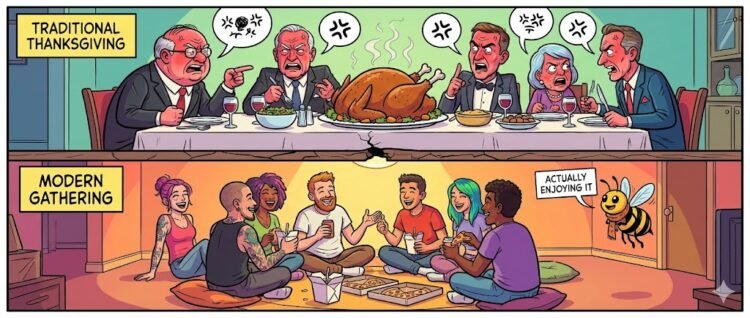
The cranberry sauce is shaped like the can. The turkey is dry enough to be used as attic insulation. The tension in the room is vibrating at a frequency usually reserved for bomb disposal units or hostage negotiations. Welcome to Thanksgiving in America. We are gathered here today to worship at the altar of “Family Values,” a phrase that has been weaponized so thoroughly it should probably require a background check to utter. The Hallmark Channel would have you believe this day is about unconditional love, homecoming, and the warm, fuzzy glow of reconciliation. But for the queer, the survivor, the progressive, and the black sheep, we know the truth. Thanksgiving is not a holiday. It is a performance review where the people evaluating you have voted against your right to exist.
We enter this season with a knot in our stomachs that has nothing to do with gluten intolerance. It is the specific, biological dread of entering a space where your identity is treated as a political debate and your trauma is treated as an inconvenience. We are asked to perform a very specific ritual. We must sit across from relatives who consume conspiracy theories like hors d’oeuvres. We must pass the potatoes to an uncle who thinks our marriage is an abomination. We must smile while a cousin toasts “religious freedom” as a euphemism for erasing our healthcare. And then, the final indignity. We must squeeze into a group photo for Facebook, a digital proof-of-life to show the world that this family is happy, whole, and functional, even if holding that smile feels like swallowing glass.
This is the architecture of the holiday. It is designed to validate the powerful and silence the vulnerable. It is the annual meeting of the “Adults’ Table” and the “Kids’ Table,” a segregation that has nothing to do with age and everything to do with compliance. The Adults’ Table is for the people who uphold the status quo. It is for the straight, the cisgender, the religious, the ones who made money, the ones who followed the script. They get the comfortable chairs. They get the carving knife. They get to set the volume of the conversation.
The Kids’ Table is for the rest of us. It is for the queer cousin who is thirty-five but still treated like a rebellious teenager. It is for the survivor who makes everyone uncomfortable by remembering what happened. It is for the art school dropout, the socialist, the person who brought a partner of a different race. We are told to sit on the folding chairs. We are told to be quiet. We are told to be polite. We are told to be grateful for the scraps. The message is clear. You are allowed to be here, but only if you make yourself small enough to fit in the corner.
For most of my life, I solved this problem by simply not playing the game. I spent decades in the hospitality industry, a career path that offers the perfect alibi for avoiding intimacy. I worked every Thanksgiving. I volunteered for the double shifts. I stood in the lobby of a hotel, wearing a suit that cost more than my car, greeting strangers who were also avoiding their families. It was a safe harbor. The hotel has rules. The guest is always right, but the guest also leaves in the morning. There is no history in a hotel lobby. There is no baggage.
I was an orphan of the industry, surrounded by other orphans. We cobbled together our own traditions in the back office. We ate stale rolls and cold turkey slices between check-ins. We drank cheap wine in plastic cups after the last guest had gone to bed. It wasn’t a Norman Rockwell painting, but it was honest. No one at that table was going to ask me why I wasn’t married to a woman. No one was going to tell me that my existence was a sin. We were tired, we were working, and we were safe.
Then, the universe played a funny trick. I found Matthew. And with Matthew came a family that defied every defensive algorithm I had built. His family in Texas took me in. They didn’t just tolerate me. They welcomed me. They didn’t put me at the Kids’ Table. They pulled up a chair next to the matriarch. It was a shock to the system, a healing balm I didn’t know I needed. It proved that the “in-laws” joke doesn’t always have to be a punchline. It proved that safety is possible.
But my luck is the exception, not the rule. I know this. I feel the weight of it every time I look at my friends who are currently hyperventilating about booking flights to Ohio or Florida. For them, “going home” isn’t a return to safety. It is a return to the closet. It is a return to the scene of the crime. It is walking back into a hierarchy where they are permanently subordinate to the people who hurt them.
The emotional labor calculus of attending Thanksgiving is exhausted just thinking about it. You have to decide how much of yourself to pack in the suitcase. Do you wear the shirt that makes you feel confident, or the shirt that makes your mother stop sighing? Do you bring your partner and risk the silent treatment, or do you come alone and endure the pity? Do you correct the pronouns, or do you let it slide because it’s “just for a few hours”?
We are told to “keep the peace.” This is the mantra of the enabler. The family has a designated fixer, usually a mother or a grandmother, whose entire existence is dedicated to smoothing over the rough edges of the patriarch’s bigotry. She whispers in the kitchen. “Don’t get him started,” she says. “Just let it go for today. It’s Thanksgiving.”
Translation: Your dignity is less important than his comfort.
The peace they want to keep is not peace. It is silence. It is the silence of the victim. It is the silence of the marginalized. They want a holiday where they can say whatever they want, spew whatever hateful rhetoric they heard on a podcast, and have you nod along while eating the yams. If you speak up, if you say “actually, that’s not true,” or “please don’t use that word,” you are the one causing the scene. you are the one ruining Grandma’s day. The aggression of the bigot is treated as a natural weather event, something we must just endure like rain. The reaction of the target is treated as a choice, a disruption, a political act.
This is the gaslighting of the season. We are accused of being “too sensitive” by the people who are melting down because a beer can had a rainbow on it. We are accused of “politicizing the dinner” by the people who voted for candidates who want to ban our healthcare. They want the aesthetic of family without the reality of connection. They want the group photo, but they don’t want the people in the photo to be real. They want the cardboard cutouts of the children they imagined, not the complex, messy, diverse adults who are actually sitting there.
This domestic theater is a perfect mirror of our national politics. The United States is essentially one giant, dysfunctional Thanksgiving dinner where the people at the head of the table are drunk on power and the people at the Kids’ Table are trying to save democracy with a plastic fork.
Look at the rhetoric. We are told that we must “reach across the aisle.” We are told we must “understand” the economic anxiety of the voter who wants to deport our neighbors. Democrats and progressives are constantly scolded for being too “woke,” too loud, too demanding. We are told that if we just toned it down, if we just stopped talking about trans rights or systemic racism, maybe the angry uncles of America wouldn’t be so angry.
It is the same logic. The marginalized are asked to shrink so the powerful can feel big. The immigrant is told to be invisible. The queer person is told to keep it in the bedroom. The person of color is told to protest quietly, somewhere else, where no one can see. We are asked to forgive without accountability. We are asked to unify without justice.
The politicians who wage war on reproductive rights and ban books love to wax poetic about “family values.” They weaponize nostalgia. They invoke the imagery of the big family table, the Norman Rockwell painting, the golden age of American domesticity. But they leave out the part where that table was built on the backs of women who had no financial independence. They leave out the part where the Black family wasn’t allowed in the neighborhood. They leave out the part where the queer kid was kicked out onto the street.
Their version of family is a hierarchy, not a community. It is a system of control. The father rules the mother. The parents rule the children. The straight rules the queer. The white rules the non-white. Any challenge to that hierarchy is treated as an attack on the family itself. When we set boundaries, when we refuse to come home, when we build our own lives that don’t look like their template, they call it “dividing the family.” They accuse us of destroying the fabric of society.
But we are not destroying the family. We are escaping it. We are surviving it.
The concept of “chosen family” is often treated by the mainstream as a consolation prize. It is viewed as the sad little backup plan for people who failed at the real thing. This is a lie. Chosen family is not a backup plan. It is an evolution. It is a higher form of kinship because it is intentional. It is based on mutual respect, not shared DNA. It is based on showing up, not just being born.
My chosen family—the friends I made in those hotel lobbies, the writers I bonded with over late-night deadlines, and now, the family I married into—saved my life. They taught me that love is not a transaction. They taught me that I don’t have to earn my seat at the table by suppressing who I am.
There is a revolutionary power in the Friendsgiving. When queer folks, survivors, and outcasts gather in a tiny apartment, sitting on floor cushions because there aren’t enough chairs, eating a potluck dinner that ranges from gourmet to takeout, we are doing something radical. We are building a community based on safety. We are creating a space where no one is going to misgender us between bites. We are creating a space where we don’t have to brace for impact before the coffee is served.
This is the flip of the script. A saner Thanksgiving might mean recognizing that the healthiest choice is to skip the table that eats you alive. It might mean realizing that “blood is thicker than water” is actually a misquote. The full phrase is “the blood of the covenant is thicker than the water of the womb.” The bonds we choose are stronger than the bonds we inherit.
The real threat to the family is not the queer kid with the blue hair sitting at the Kids’ Table. The real threat is the unexamined cruelty at the Adults’ Table. The threat is the rigidity. The threat is the refusal to grow. The threat is the belief that love is a limited resource that must be rationed out only to those who comply.
So this year, if you are dreading the drive home, if you are staring at the invitation like it’s a subpoena, give yourself permission. You do not owe them your presence. You do not owe them your silence. You do not owe them a performance of the child they wanted you to be.
If you go, go with your armor on. Find your allies. Text your group chat under the table. Hide in the bathroom when it gets too loud. And if you stay home? If you order Chinese food and watch a movie with your cat? That is valid. That is a celebration. That is a Thanksgiving of your own making.
The construction paper turkey is a lie. The Pilgrims were invaders. The “peace” they want is surrender. Do not surrender. Eat the pie, but don’t swallow the guilt. The Kids’ Table is where the revolution starts anyway. That’s where the future is sitting. And unlike the Adults’ Table, we actually have room for everyone.
Receipt Time
Let’s be clear about the stakes. The “culture war” topics that get brought up over pumpkin pie—trans rights, abortion access, book bans—are not abstract philosophical debates. They are matters of life and death for the people in that room. When a relative votes for a candidate who promises to ban gender-affirming care, they are voting to harm the trans person sitting across from them. When they support policies that strip funding from mental health services or domestic violence shelters, they are voting against the survivor passing them the rolls. To ask us to “put politics aside” is to ask us to put our humanity aside. It is to ask us to pretend that their political choices don’t have a body count. We are done pretending. The price of the seat is too high.