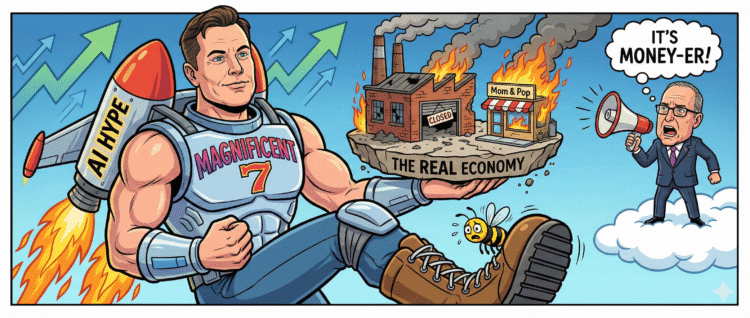
If you have glanced at a financial headline in 2025, you might be under the impression that the American economy is roaring like a lion. The S&P 500 is up more than 12 percent!1 The Nasdaq is printing money! Larry Kudlow is on Fox Business inventing words like “growthier” and “money-er” to describe the sheer, unadulterated majesty of our prosperity!2
But if you peel back the curtain on this “strong” market, you don’t find a robust engine of commerce. You find Nvidia, Microsoft, and five other tech demigods standing on each other’s shoulders, wearing a trench coat, and desperately hoping no one notices that the other 493 companies in the index are currently hiding in the bathroom.
We are not living in a bull market. We are living in a hostage situation where the entire U.S. economy is strapped to the back of a graphics card manufacturer.
The numbers are stark enough to make a forensic accountant weep. The S&P 500’s gains this year are almost entirely the result of the “Magnificent Seven”—Apple, Microsoft, Alphabet, Amazon, Nvidia, Meta, and Tesla.3 These companies have gone nearly vertical, turbocharged by an AI gold rush that has investors throwing billions at anything that promises to automate a poem.
Meanwhile, the “S&P 493″—the companies that actually make things, employ normal people, and sell goods to humans who don’t live in a server farm—are limping along with flat or negative returns.4 Manufacturing is battered by tariffs. Retail is suffocating under high interest rates. Regional banks are holding onto their balance sheets like they are life rafts in a hurricane.
Nvidia alone has become a gravitational black hole. At one point this year, it accounted for more than 7 percent of the entire S&P 500. We have reached a point of absurdity where a single earnings report from a chipmaker can swing the retirement savings of a schoolteacher in Ohio from “green” to “red” in twenty minutes. The market isn’t reacting to economic data; it’s reacting to Jensen Huang’s leather jacket.
The Tariff Roulette Wheel
While the tech giants party in the stratosphere, the companies in the Russell 2000—the small and mid-cap stocks that are supposed to be the backbone of the economy—are flashing signs of deep malaise.5 They are being squeezed by what can only be described as a policy of “rotating tariffs.”
The administration’s trade strategy seems to be modeled on a roulette wheel. One month it’s a 10% baseline tariff on everyone. The next month it’s a “reciprocal” 50% hit on countries that looked at us funny. For a small manufacturer in Wisconsin trying to import steel screws, this isn’t “protectionism”; it’s a nightmare. They can’t afford the AI arms race, they can’t afford the borrowing costs, and they certainly can’t afford to guess which ally we are going to trade-war with next Tuesday.
Capital expenditures for these non-AI companies are flat. They aren’t building new factories. They aren’t hiring. They are hunkering down, trying to survive the “crosswinds” of deglobalization while the media tells them to look at the stock chart and smile.
The “Money-er” Economy
This disconnect has birthed a new genre of gaslighting, best exemplified by the administration’s surrogates. When Larry Kudlow goes on television and claims that “total household net worth is about $180 trillion” and that 135 million Americans are “sharing” in the stock market gains, he is technically telling the truth, in the same way that I am “sharing” a planet with Elon Musk.
The message to the average worker is clear: Be grateful for your “paper wealth.” Sure, your grocery bill is up 30%, and your rent is eating half your paycheck, and you can’t afford a car loan, but have you seen what Nvidia did today? You’re rich! (Terms and conditions apply; wealth valid only if you liquidate your 401(k) immediately and don’t account for inflation).
It is the “Let Them Eat Stocks” era of economic messaging.
The Bubble With a Binary Switch
The terrifying part isn’t just the inequality; it’s the fragility. Analysts at Bank of America and central bankers across the globe are starting to sound the alarm about an AI bubble that looks suspiciously like 1999 with better graphics.6
The BofA report warns of a “binary risk.” Either the AI companies hit their wild revenue targets and become monsters that eat the rest of the economy, or they don’t, and they become an “enormous financial sinkhole.” There is no middle ground. We are pouring hundreds of billions of dollars into data centers and chips on the bet that ChatGPT will eventually figure out how to be profitable.
If that bet fails—if the “AI CAPEX cycle” turns out to be a incinerator for cash rather than a generator of value—the pop will be heard from space.
We are told this is a “broad-based rally.” It is not. It is a pyramid scheme built on GPUs. The economy isn’t growing; it’s hallucinating. And right now, we are all just passengers on seven very expensive rockets, hoping the fumes last long enough to pay the rent.