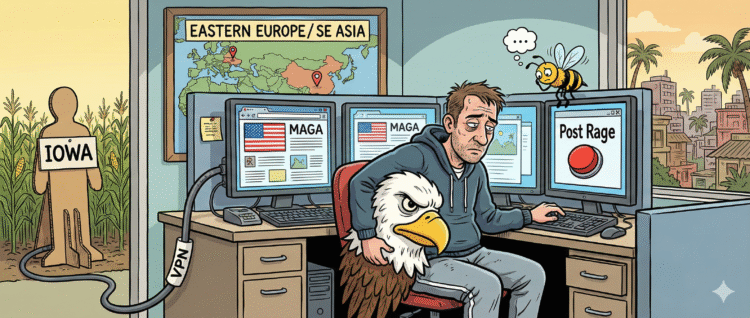
There is a specific kind of schadenfreude that tastes like champagne mixed with battery acid, and on November 20, 2025, the internet drank deep from the cup. For years, we have been told that the “silent majority” is rising, that the roar of the MAGA movement is the organic, thundering voice of the forgotten American working class. We were told that the “PatriotEagle2024” accounts with the American flag in their bio were real steelworkers from Ohio, concerned moms from Arizona, and cattle ranchers from Texas. Then, in a moment of sublime, accidental transparency, Elon Musk flipped a switch on X’s new “About This Account” feature, and the lights turned on in the cockroach motel.
It turned out that the loudest, most aggressively “red-blooded American patriots” screaming about border security and the sanctity of the republic were actually posting from laptops in Lagos, server farms in St. Petersburg, and internet cafes in Thailand.
The rollout of the “country of origin” feature was meant to be a minor transparency update, a way to show users where their information was coming from. Instead, it functioned as a mass unmasking event for the digital right. Within minutes, users watched in real-time as the geolocation data loaded next to the most viral MAGA accounts, revealing a geopolitical comedy of errors. The “America First” movement, it seems, is being outsourced to the lowest bidder.
But the comedy didn’t last. It curdled into something darker and more cynical almost immediately. After a brief panic where the feature was yanked offline due to “technical limitations,” the lights came back on. But this time, the feature had been subtly, crucially altered. It no longer displays the inconvenient truth of where an account was created. That data point, which revealed the Nigerian and Russian birthplaces of the “MAGA Nation” accounts, has been scrubbed. In its place, we now have “Last Location.”
And just like that, the Great American Masquerade Ball began.
The United States of Everywhere Else
The initial reveal was a massacre of credibility. Accounts like “MAGANationX,” which posts exclusively about the need to seal the southern border to protect American jobs, was revealed to be operating out of Vietnam. “IvankaNews,” a fan page dedicated to the former First Daughter and the aesthetic of American royalty, was pinging from a registered address in Morocco. The “Dark Maga” accounts, with their ominous laser-eye aesthetics and calls for retribution against the deep state, turned out to be a loose confederation of operators in Russia and Belarus.
Perhaps the most delicious irony was reserved for the Tom Homan fan pages. Homan, the hardline border czar, is the patron saint of “closed borders.” Yet the accounts dedicated to amplifying his message were broadcasting from open WiFi networks in India and the Philippines. The digital soldiers of the deportation force are literally immigrants, or at least foreign nationals, working remotely to stoke xenophobia in a country they do not live in.
Liberal posters like Harry Sisson began posting long, devastating threads of receipts, screen-shotting the “Patriot” accounts before they could scramble to hide their tracks. It was a digital walk of shame. We saw “TexasMom4Trump” revealed as a male university student in Eastern Europe. We saw “VeteranVoice” exposed as a click farm in Bangladesh. The “grassroots” movement was revealed to be Astroturf laid down by international gig workers.
But then came the pivot. The panicked removal of the feature was the tech equivalent of a magician accidentally sawing the lady in half and then quickly closing the curtain while shouting “Ta-da!” When the curtain reopened with the “Last Location” update, the magic trick was restored.
The VPN Diaspora: Gentrifying the IP Address
The immediate result of the switch to “Last Location” is the sudden, hilarious gentrification of American IP addresses. The “TexasMom4Trump” account, which yesterday was revealed to be operating out of a basement in Tbilisi, is now proudly broadcasting from a data center in Dallas. The “FloridaPatriot1776” account, previously pinging from a click farm in Bangladesh, has miraculously relocated to a server rack in Miami.
We are witnessing the rise of the VPN Patriot. These are the brave soldiers of the culture war who fight for the soul of the republic while hiding their true location behind a layer of encryption that costs $3.99 a month. They are digital carpetbaggers, putting on the costume of American citizenship to sell rage bait to a domestic audience that is too angry to check the metadata.
The shift to “Last Location” is a masterclass in malicious compliance. It technically answers the demand for transparency while rendering the answer useless. “Last Location” does not tell you who the person is. It tells you where their computer pretends to be. It is like asking a fugitive where they are, and they send you a picture of a postcard from the Grand Canyon while sitting in a safe house in Zurich.
This change essentially legitimizes the bot farms. It gives them a path to respectability. Before, the “Nigeria” tag was a stain they couldn’t wash off. Now, with a simple software toggle, they can wash it away. They can become “local.” They can blend in. The platform has handed them the keys to the city and told them which door to use so the neighbors don’t get suspicious.
The “Socialism is Communism” Loop
I know this reality intimately because I live in it every day. It does not matter what I post on this platform. I could tweet a nuanced analysis of the Federal Reserve’s interest rate policy. I could tweet a review of Wicked. I could tweet a picture of a particularly disappointing bagel. The response is always the same. Within seconds, I am bombarded by accounts with names like “FreedomLover1776” and avatars of bald eagles wearing sunglasses.
Their replies are disjointed, repetitive, and contextually oblivious. “Socialism is communism,” they scream at my bagel. “Democrats are destroying the country,” they reply to my movie review. “What about the border?” they ask my interest rate analysis.
For a long time, it felt like gaslighting. Am I crazy? Why are these people so obsessed? But the geolocation reveal confirms what many of us suspected: I am not arguing with a person. I am arguing with a script. I am arguing with a quota. I am interacting with a digital serf in a click farm who has been given a spreadsheet of talking points and a daily engagement target. The phrase “Socialism is communism” is not a political belief for them; it is a macro key on their keyboard.
This is the “Dead Internet” theory brought to life. We are screaming into a void, and the void is answering back with automated agitprop designed to maximize dwell time and ad impressions. The “discourse” is a simulation. The anger is manufactured. And the “voice of the people” is actually a text-to-speech algorithm running on a server in a basement halfway around the world.
The Great Outsourcing of Hate
The broader implication of this is both hilarious and terrifying. The American right wing has spent the last decade screaming about globalism. They rail against the outsourcing of jobs. They demand that we “Buy American.” They view the international community with deep suspicion. Yet, their entire online ecosystem—the brain of their movement—is a globalist enterprise.
The memes that Uncle Jerry shares on Facebook about how “nobody wants to work anymore” were likely created by someone who is working very hard in a time zone twelve hours ahead. The viral outrage about “foreign caravans” is being amplified by foreign click farms. The “America First” movement is being powered by the very global labor market they claim to despise.
It drives home the absurdity of the moment. We have a political movement that screams about the sanctity of the border while its digital borders are completely wide open. They are terrified of immigrants coming in to pick crops or build houses, but they are perfectly happy to let foreign actors build their political reality. They have outsourced their anger. They have offshored their ideology.
The irony is structural. The “closed border” movement is being powered by the most open, porous border in human history: the internet. The “Last Location” loophole allows for the ultimate freedom of movement for propaganda, even as the movement itself calls for the restriction of movement for people.
The Complicity of the Platform
We must recognize that this is not an accident. The “technical limitations” excuse used to justify the brief removal of the feature was a lie. The “VPN loophole” is not a bug; it is a feature. The platform relies on this traffic. It relies on the inflated user numbers. It relies on the heat generated by the friction between real people and fake patriots.
By switching to “Last Location,” the platform has entered into a tacit agreement with the bad actors. It has said, “We will give you a way to hide, if you promise to keep posting.” It is a protection racket. The platform protects the bots from scrutiny, and the bots protect the platform from irrelevance.
Under Musk’s stewardship, X fired the trust and safety staff who used to hunt these networks. They turned on creator payouts that reward engagement above all else. They allowed verification to become a paid status symbol rather than a proof of identity. This created a perfect economic engine for fraud. If you are a savvy operator in a country with a low cost of living, and you realize that American political rage is the most valuable commodity on the internet, you start farming. You set up a dozen accounts. You use Grok—Musk’s own AI—to generate inflammatory copy about “the invasion at the border” or “the Epstein cover-up.” You buy a blue check for eight dollars. And then you sit back and watch the ad revenue roll in as Americans scream at each other in the replies.
This environment allows for a terrifying efficiency in disinformation. In 2016, the Russian interference campaign required significant manpower and tradecraft. In 2025, it just requires a subscription to X Premium and an LLM. One operator can run a dozen “Ohio grandma” accounts that all tweet the same talking points about the border and Epstein at once, each with a distinct voice generated by AI, each verified, each amplified.
The Lived Reality of the “Patriot”
Consider the psychological toll on the actual “America First” believer. Somewhere in a rural county, there is a real person who believes deeply in the MAGA cause. They log onto X to commiserate with like-minded patriots. They interact with “CattleRancher88” and “PatriotMomUSA.” They feel a sense of community. They feel like they are part of a massive, rising tide.
But “CattleRancher88” is a script. “PatriotMomUSA” is a guy in Lagos trying to make rent. The community is a simulation. The solidarity is a lie. The real American is shouting their fears into a digital canyon, and the echo coming back is synthetic. They are being emotionally manipulated by a machine that doesn’t care if they live or die, only if they click.
This is the ultimate betrayal of the populist movement. Populism is supposed to be about the people. It is supposed to be the voice of the forgotten. But on X, the “people” are code. The “voice” is data. And the movement is just another content vertical for the global ad-tech industry.
The Conclusion We Cannot Write
There is no neat bow to wrap around this package. The internet is broken. The political discourse is poisoned. And the platform that claims to be the bastion of free speech is actually the world’s largest laundromat for foreign propaganda. The “About This Account” feature was a glitch in the matrix, a brief moment where the code became visible.
We can try to unsee it. We can try to go back to arguing with the eagles. But the knowledge is there now. We know that the noise is imported. We know that the rage is manufactured. And we know that when the next viral outrage cycle begins, when the next “caravan” is spotted or the next “scandal” breaks, the first people to tweet about it will likely be checking the exchange rate of the dollar against their local currency before they hit send.
The “red-blooded American patriot” is dead. Long live the “verified content creator” in Zone 4. The “Last Location” isn’t a place; it’s a tactic. And right now, it’s the only place on the map that matters.
The Part They Hope You Miss
The most dangerous implication of the “Last Location” pivot is that it provides cover for domestic bad actors as well. It isn’t just foreign farms using VPNs. It is domestic astroturf firms, political action committees, and corporate shills who can now bounce their location around to target specific swing states. A consultant in D.C. can use a VPN to appear as a “concerned voter” in Pennsylvania. A lobbyist in New York can pose as a “farmer” in Iowa. The tool that was meant to expose the “foreign” threat has actually democratized the ability to lie about geography for everyone. It has turned the entire internet into a swing state where no one actually lives, but everyone is campaigning. The “Last Location” isn’t just a lie; it’s the venue for the election.