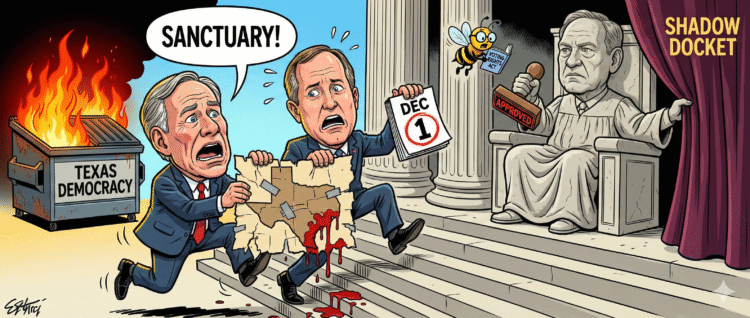
The frantic energy currently radiating from the Texas Governor’s Mansion is not the result of a grid emergency or a sudden concern for the welfare of the state’s foster children. It is the specific, high-pitched frequency of political desperation. On November 20, the state’s leadership, spearheaded by Governor Greg Abbott and Attorney General Ken Paxton, formally hit the panic button. They have rushed to the United States Supreme Court with a filing that reads less like a legal argument and more like a hostage note, begging Justice Samuel Alito for an emergency administrative stay. Their goal is simple and brazen. They want the High Court to resurrect a mid-decade congressional map that a three-judge federal panel in El Paso just declared illegal, unconstitutional, and racially discriminatory.
The timeline of this fiasco is a masterclass in manufactured chaos. Texas Republicans, at the explicit prodding of Donald Trump, decided that the decennial census was merely a suggestion and that they were entitled to redraw the lines whenever they felt their grip on power slipping. They produced a map designed to net the GOP up to five extra House seats, a margin that would effectively decide the control of Congress before a single ballot was cast in 2026. The problem, as the federal panel pointed out with stinging clarity, is that they achieved this partisan miracle by surgically dissecting Black and Latino communities, diluting their voting strength with the precision of a butcher who knows exactly where the bone is.
Now that a court has told them to stop, Texas is crying foul. Their application to Justice Alito is a monument to cynical reasoning. They insist that the map is simply a product of “hard-nosed partisan redistricting,” a phrase that acts as a legal magic spell in the post-Rucho Supreme Court era. The argument is grimly simple. They are telling the justices that they did not target these voters because they are Latino. They targeted them because they are Democrats. The fact that in Texas these two identities are demographically inseparable is, to the state’s lawyers, a convenient coincidence that the courts should ignore.
They are accusing the lower court of overstepping its authority by second-guessing the motives of the legislative line drawers. This is a bold claim considering the evidence presented at trial included emails, demographic data, and a Trump-era Department of Justice letter that explicitly pushed lawmakers to redraw districts based on race. The “motives” were not hidden in a lockbox. They were written in 12-point font and sent via government email servers. Yet, Abbott and Paxton are banking on the hope that Samuel Alito, the court’s most reliable partisan warrior, will look at a map that erases minority political power and see only a healthy exercise of state sovereignty.
The filing warns of imminent “chaos” if the new districts are not restored before the December 1 candidate filing deadline. This is the classic arsonist’s defense. Texas waited until the last possible minute to pass the map, invited the inevitable lawsuit, dragged out the proceedings, and is now screaming that there is no time to fix the mess they created. The “chaos” they fear is not administrative disorder. It is an election where they have to compete on fair terms. They are asking the Supreme Court to freeze the clock, to suspend the finding of racial discrimination, and to let them run one more election on a rigged map because fixing it would be too much paperwork for the filing clerks.
This appeal to Alito is not just a procedural maneuver. It is a stress test for the American legal system. The question before the Court is no longer just about the Voting Rights Act or the intricacies of the Equal Protection Clause. It is about how far a state can go in disguising a racial gerrymander as a partisan one before the justices finally tell them to put the crayons down. Texas is betting that the conservative supermajority is so committed to Republican political dominance that they will ignore the factual findings of a federal trial court. They are betting that the “shadow docket”—the emergency rulings issued without full briefing or oral argument—is the perfect place to bury the voting rights of four million Texans.
The broader context of this legal brawl is the 2025 redistricting war, a conflict that has turned the House of Representatives into a prize to be won in courtrooms rather than at the ballot box. Texas is not acting in a vacuum. California is engaging in its own retaliatory mapping, and states across the country are watching closely. If Alito grants this stay, if he allows Texas to use a map that a court has already deemed illegal, he is signaling that the mid-decade map grab is open for business. He is telling every state legislature controlled by a single party that they can rewrite the rules of the game every two years, provided they claim they are only trying to screw the opposition party and not a specific race.
The distinction between “partisan” and “racial” gerrymandering has always been a legal fiction, a way for the courts to pretend that stripping power from minority communities is acceptable as long as the intent is political survival. But in Texas, where voting patterns are racially polarized to an extreme degree, the distinction is nonexistent. You cannot target Democrats in the Rio Grande Valley without targeting Latinos. You cannot target Democrats in Houston without targeting Black voters. The state’s argument relies on the Supreme Court pretending not to know how Texas works. It relies on a willful blindness that Justice Alito has historically been more than happy to provide.
The plaintiffs in this case, a coalition of civil rights groups and individual voters, are arguing that the only chaos here is the chaos of injustice. They point out that reverting to the 2021 lines—a map that was already heavily gerrymandered but at least legally operative—is a simple, clean solution. It requires no new drawing. It requires no complex administrative gymnastics. It simply requires Texas to accept the status quo rather than forcing through a new, illegal advantage. But for a party that views power as a birthright and demographic change as an existential threat, the status quo is unacceptable. They need the extra five seats. They need the insurance policy against a changing electorate.
The urgency of the filing reveals the fragility of the Republican position. If they were confident in their ideas, if they believed their platform appealed to the growing diverse population of Texas, they would not need to slice up cities and dilute votes. They would campaign. The rush to the Supreme Court is an admission of weakness. It is a declaration that they cannot win a fair fight, so they must ask the referee to change the rules in the middle of the bout.
Donald Trump’s fingerprints are all over this filing. The push for a mid-decade redistricting was his brainchild, a strategy born of his obsession with loyalty and his desire to mold the House GOP into a wholly owned subsidiary of his campaign. The map was designed to purge the last remaining moderates and install loyalists who would not hesitate to do his bidding. By fighting to save this map, Abbott and Paxton are not just defending Texas; they are defending the MAGA conquest of the legislative branch. They are fighting to ensure that the 2026 midterms are a coronation rather than a contest.
The role of the three-judge panel in El Paso cannot be overstated. These judges looked at the hard data. They saw the “surgical precision” with which the lines were drawn. They saw how a district that was performing for a Latino coalition was suddenly cracked into three pieces, its voters submerged in a sea of white rural voters hundreds of miles away. They called it what it was. Now, Texas is asking the Supreme Court to ignore those facts. They are asking the justices to prioritize the political comfort of the Republican Party over the constitutional rights of citizens.
If the Supreme Court grants the stay, it will be a green light for chaos. It will tell states that they can violate the Constitution with impunity, provided they do it close enough to an election. It will validate the strategy of “run out the clock.” It will turn the federal judiciary into a partisan tool, used to lock in advantages that cannot be won democratically. The Supreme Court has already gutted the preclearance requirement of the Voting Rights Act. It has already declared that partisan gerrymandering is non-justiciable. If it now allows racial gerrymandering to slide under the guise of “partisan hardball,” there will be nothing left of the concept of fair representation.
The cynic in me looks at the composition of the court and the track record of Justice Alito and sees the writing on the wall. There is a very real chance that the emergency stay will be granted. There is a chance that Texas will get its way, that the illegal map will be used in 2026, and that the five seats will flip. But we should not let the legalisms obscure the reality. This is a theft. It is a theft of power from the people to whom it belongs. It is a theft of the future from communities that are growing and changing the face of the state.
The December 1 deadline is a fake cliff. The courts move deadlines all the time. Primaries can be delayed. Filing windows can be reopened. The only thing that cannot be fixed is an election held on an unconstitutional map. Once those representatives are seated, once the laws are passed, the damage is done. Texas knows this. That is why they are rushing. That is why they are begging. They know that if the light of scrutiny is allowed to shine on this map for one moment longer, it will disintegrate. They need the darkness of the shadow docket to save them.
We are watching the final stages of a strategy that relies on the exhaustion of the electorate and the complicity of the courts. Texas officials are banking on the idea that the public is too tired to care about district lines, and that the Supreme Court is too partisan to care about the law. They are playing a dangerous game with the foundations of the republic, treating the right to vote as a loophole to be closed rather than a sacred trust to be protected. The application to Justice Alito is not a legal brief. It is a confession that they have given up on democracy and are now relying entirely on geometry and judicial favors to stay in power.
The Part They Hope You Miss
The most insidious part of the Texas argument is the claim that the lower court “second-guessed” the legislature. This phrasing is designed to make judicial review sound like an insult. But the entire point of the federal judiciary is to second-guess the legislature when the legislature violates the Constitution. That is the job. By framing oversight as “interference,” Paxton and Abbott are pushing a theory of legislative supremacy that would leave minority voters with absolutely no recourse. They are arguing that once a majority wins an election, they have the absolute right to rig the next one to ensure they never lose again. They are asking the Supreme Court to codify the idea that winning once grants you the right to rule forever, regardless of what the voters—or the Constitution—have to say about it.