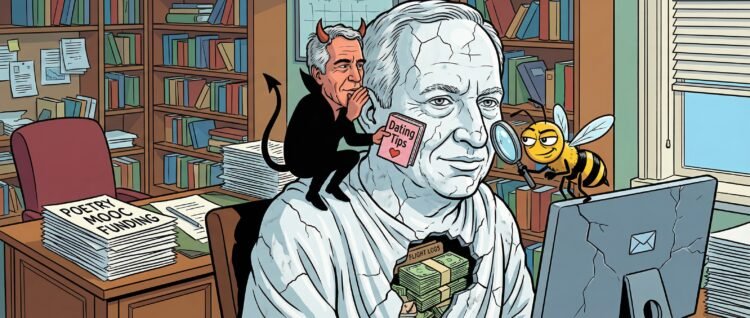
For decades, Larry Summers has functioned less as a human being and more as a sentient institution, a kind of granite monument to the neoliberal consensus that simply refuses to erode. He is the man who is always wrong but never fired, the failing up champion of the Western world who managed to wreck the deregulation of the banks, fumble the response to the Great Recession, and infuriate half the population of Harvard, only to be rewarded with a permanent seat at the high table of global power. He was the “smartest man in the room,” a title bestowed upon him by people who confuse arrogance with intellect and bullying with leadership.
But gravity, it seems, has finally found the one crack in the monument that no amount of endowment money can Spackle over.
The recent release of roughly 2,300 emails by the House Oversight Committee has done what the 2008 financial crash, the Cornel West debates, and the revolt of the Harvard faculty could not do. It has exposed Larry Summers not as a misunderstood genius, but as a man whose judgment was so catastrophic, so fundamentally broken, that he spent years treating Jeffrey Epstein—a registered sex offender and known predator—not just as a donor, but as a “wingman.”
The Wall Street Journal’s deep dive into this correspondence is not just a news story; it is an autopsy of the elite immune system. For more than a decade, Summers shrugged off concerns about his relationship with Epstein. He leveraged his massive institutional clout and his reputation as the Democratic Party’s favorite economic oracle to skate past the early disclosures. When asked, he offered the usual vague non-denials, the “I met him at conferences” defense, relying on the assumption that he was simply too important for anyone to check the receipts.
The receipts, however, have arrived. And they are devastatingly, humiliatingly specific.
We are not talking about a few polite handshakes at a Davos mixer in 2005. The emails cover the period from 2013 to 2017. This is a crucial timeline because by 2013, Jeffrey Epstein was not a mysterious financier. He was a convicted sex offender. He was a man who had already served time in Florida for soliciting a minor. He was radioactive to anyone with a moral compass or a basic survival instinct. Yet, during this exact window, Larry Summers was trading dozens of messages with him that read less like professional correspondence and more like the desperate texts of a lonely undergraduate trying to impress the coolest, creepiest guy in the dorm.
The content of these emails reveals a dynamic that is almost impossible to square with the image of a serious statesman. Summers wasn’t just asking for money for a new economics wing. He was soliciting donations for his wife, Elisa New, to fund her “poetry MOOC” (Massive Open Online Court) and other Harvard-linked projects. Let that sink in. The former Treasury Secretary, the man who once held the global economy in his palm, was hitting up a known pedophile to underwrite online poetry classes. It is a level of banality that makes the corruption feel somehow worse. It wasn’t a grand conspiracy for world domination; it was a hustle for a humanities grant.
But the emails get darker. They reveal Summers treating Epstein as a personal confidant, a sounding board for his personal life. In one particularly excruciating exchange, Summers discusses a secret romance with a younger woman he code-named “Peril.” He explicitly asked the registered sex offender for advice on “pursuing” her. It is a moment that shatters the “great man” myth forever. Here is the supposed architect of the modern economy, a man whose brain is insured by the Aspen Institute, asking a man who ran a sex trafficking ring for dating tips. It suggests a void of emotional intelligence so vast it could swallow a central bank.
The reaction to this data dump has been a frantic, coordinated scramble for the lifeboats. The institutions that spent years polishing Summers’s reputation are now racing to scrub his name from the masthead. Harvard, which had previously treated inquiries into the Summers-Epstein connection with the enthusiasm of a teenager asked to clean their room, has suddenly announced it is “reopening” its investigation. This is the administrative equivalent of “we saw the PDFs and realized we can no longer lie about this.”
Summers himself has gone into the kind of retreat usually reserved for deposed monarchs. He has taken leave from teaching. He has stepped down from leading the Kennedy School’s Mossavar Rahmani Center for Business and Government. And then came the cascade of resignations from the high-prestige gigs that collect around men like Summers like barnacles on a hull. He is out at OpenAI. He is out at Bloomberg. He is out at the Center for Global Development. The board seats are evaporating.
It is fascinating to watch these organizations act shocked. OpenAI, a company theoretically building the most advanced intelligence in human history, apparently lacked the search engine capability to Google “Larry Summers Jeffrey Epstein” until last week. Bloomberg, a media empire built on information, was seemingly blind to the relationship until the House Oversight Committee did the reading for them. This is not a sudden discovery of ethics. It is a sudden discovery of liability. These institutions were perfectly happy to have a man with Epstein ties on their letterhead as long as those ties were abstract, whispered about at cocktail parties but never printed in bold font.
The backlash, described by outlets like the AP, The Guardian, and Business Insider, has been swift, but the critique from long-time antagonists cuts deeper. Senator Elizabeth Warren and Cornel West—two people who agree on almost nothing else besides the fact that Larry Summers is a disaster—have pointed out the structural rot. The real scandal is not just that a powerful economist asked a predator for philanthropy tips. The scandal is that Harvard, Wall Street, Democratic administrations, and even the new gods of AI governance kept rehiring and platforming him long after his Epstein ties were first documented.
They treated the concerns as a nuisance. They treated the victims’ advocates as shrill. They treated the journalists asking questions as rude. The system protected Summers because Summers was the system. He was the embodiment of the idea that if you are smart enough, and rich enough, and have enough friends in the White House, the rules of decency simply do not apply to you. He was the ultimate test case for the theory that meritocracy is a lie we tell poor people to keep them working.
The “Peril” emails are the smoking gun, but the weapon was loaded years ago. The fact that Summers felt comfortable emailing Epstein about his love life in 2016 suggests a level of comfort and intimacy that completely belies his earlier “barely knew him” defense. You do not ask a casual acquaintance for advice on how to manage a secret affair. You ask a “wingman.” You ask a partner.
What makes this particularly galling is the sheer arrogance required to maintain the relationship post-conviction. Summers knew who Epstein was. Everyone knew. But Summers clearly believed that his own brilliance provided a kind of force field. He thought he could extract the money for the poetry class, take the private jet rides, enjoy the ego stroking, and never pay the price. He viewed Epstein not as a monster, but as a utility—a wallet with a private island attached.
The “Poetry MOOC” detail is destined to become the “Let them eat cake” of the neoliberal era. It captures the total detachment of the elite class. While the world was grappling with the reality of Epstein’s crimes, while victims were fighting for a shred of justice, Larry Summers was worried about funding a digital syllabus on Emily Dickinson. It reduces the suffering of countless women and girls to a line item in a fundraising pitch.
Now, the firewall has collapsed. The emails make it impossible to keep pretending that one of the world’s most influential economists happened to keep bumping into the most infamous sex trafficker on earth by accident. The “coincidence” defense is dead. We are left with the naked reality of a transaction: validation and money in exchange for access and legitimacy.
This is the end of Larry Summers as a public intellectual. The speaking fees will dry up. The op-ed pages might finally find a new number to call. But we must not let the individual immolation of one man distract us from the machinery that built him. Larry Summers did not create himself. He was tenure-tracked by Harvard. He was appointed by Clinton. He was empowered by Obama. He was feted by the media. He was courted by Silicon Valley. All of these entities looked at a man who failed upward for forty years and decided he was the indispensable man.
They looked at his record of deregulation that set the stage for the 2008 crash and called it “experience.” They looked at his clashes with Cornel West and called it “rigor.” And they looked at his friendship with Jeffrey Epstein and called it “private business.”
The reckoning is not just for Summers. It is for the culture of impunity that allowed him to thrive. It is for the boards of directors who rubber-stamped his appointment without a background check. It is for the university administrators who silenced dissenters. It is for a political party that kept looking to him for answers on how to fix the economy he helped break.
Summers is currently in the wilderness, stripped of his titles, watching his legacy dissolve into a series of creepy PDFs. But the system that produced him is still humming along. The next Larry Summers is already being groomed in a seminar room in Cambridge, learning that as long as you bring in the endowment money, you can text anyone you want.
The Poetry of the Fall
There is a grim, literary justice in the fact that it was the poetry project that helped bring him down. For a man who built a career on hard numbers, cold efficiency, and the ruthless application of market logic, to be undone by a quest to fund the liberal arts is almost too perfect. It suggests that the universe does have a sense of humor, however dark.
The emails reveal a man who thought he was writing a biography of a titan, only to realize too late that he was actually writing a tragedy of a fool. He thought he was using Epstein. In reality, Epstein was collecting him, just like he collected every other compromised powerful man, adding him to the shelf of trophies to be used as insurance.
The insurance policy has finally paid out, but not in the way Summers hoped. The exposure is total. The “smartest man in the room” was, in the end, just another mark. He traded his reputation for a little bit of cash and some advice on a girl, and he did it all in writing, on a server that eventually found its way to Congress. It turns out that for all his economic modeling, he failed to calculate the one variable that matters most: the cost of selling your soul to the devil is that eventually, the devil gets subpoenaed.