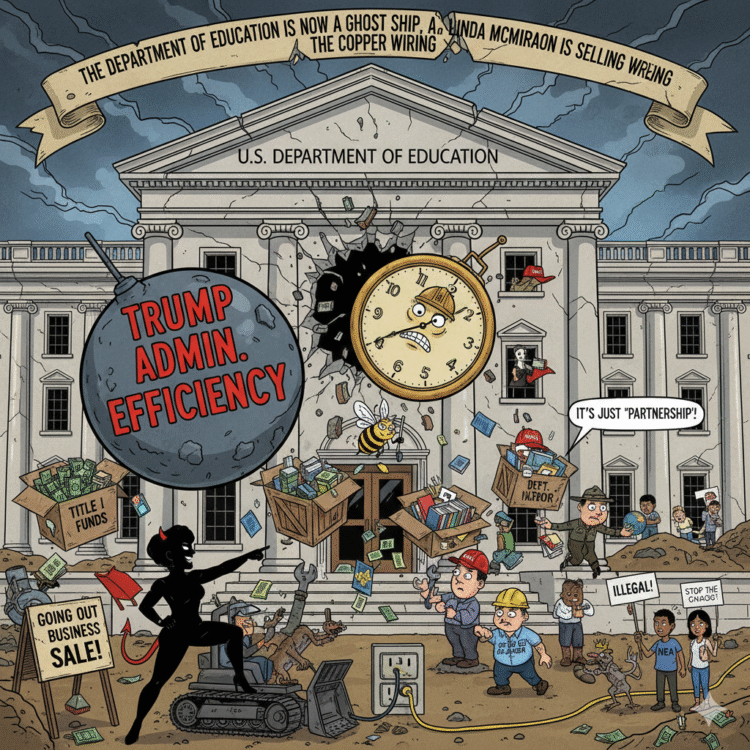
The federal government has always been a bit of a Rube Goldberg machine, but typically the people in charge try to hide the duct tape. On November 18, 2025, Education Secretary Linda McMahon decided to rip the tape off, dismantle the machine, and sell the parts to the neighbors. In what can only be described as the bureaucratic equivalent of an estate sale conducted by arsonists, the Trump administration announced six “interagency agreements” that effectively gut the U.S. Department of Education. The plan hands off billions of dollars in core K–12 and higher education grant programs to agencies that have as much expertise in pedagogy as a fish has in bicycle repair.
This is the administration’s “most aggressive step yet” toward their long-promised goal of closing the department, a promise that has now moved from the realm of campaign rally red meat to the dull, terrifying reality of federal contracting law. McMahon, presumably between takes of filming videos about how “the clock is ticking” for her own workforce, announced that roughly $18 billion a year in Title I funds—the absolute lifeblood for low-income schools—will no longer be managed by education experts. Instead, it will be shipped over to the Department of Labor.
Yes, the Department of Labor. The agency best known for calculating the unemployment rate (when they aren’t canceling it) and regulating overtime pay is now in charge of ensuring your first-grader learns to read. One assumes the new curriculum will focus heavily on “workforce readiness” for six-year-olds and the proper ergonomic lifting techniques for heavy backpacks.
The Great Outsourcing of American Potential
The scale of this transfer is breathtaking. It isn’t just Title I. The agreements also hand off teacher training grants, English learner support, and TRIO college access programs to Labor. Meanwhile, Native American education programs are being punted to the Department of the Interior, presumably because in the administration’s worldview, Indigenous students are indistinguishable from national parks or grazing permits. International education programs are being shipped to the State Department, which is at least thematically consistent, though one worries that foreign language grants will now come with a side of diplomatic immunity.
The Washington Post, AP, and NPR have all correctly identified this for what it is: outsourcing. The administration has effectively hollowed out the Office of Elementary and Secondary Education and most of the Office of Postsecondary Education, leaving behind a “skeleton crew” at the Department of Education. This remnant exists solely to preserve the legal fiction that the agency still “oversees” the work, a necessary lie to avoid the pesky reality that Congress—and only Congress—has the authority to abolish a federal department.
It is a shell game played with the future of the nation’s children. The Department of Education technically still exists, much like a Blockbuster Video sign still exists on an empty storefront in 2025. But inside, the shelves are bare, the staff has been cut in half by mass layoffs, and the person at the counter is just there to tell you that your student loan interest is compounding and that if you have a civil rights complaint, you should leave a message after the tone.
A “Partnership” Made in Hell
McMahon frames this demolition as a “partnership” designed to “return education to the states.” This is a fascinating euphemism. In practice, “returning education to the states” appears to mean “making it impossible for states to get their federal money.” State chiefs like Rhode Island’s Angélica Infante-Green are already sounding the alarm, noting that this isn’t about efficiency; it’s about chaos. Infante-Green, who has been dealing with the administration’s funding freezes for months, warned that “fragmenting responsibilities erodes the unified supports” that schools rely on.
She is being polite. What she means is that when you take complex grantmaking processes that require deep institutional knowledge of education law and hand them to a Department of Labor bureaucrat whose previous job was auditing forklift certifications, things are going to break. Money will be delayed. Vulnerable students—those with disabilities, those learning English, those living in poverty—will fall through the cracks. The “concierge-level service” promised by administration officials is likely to resemble the service you get at the DMV on a Friday afternoon during a power outage.
Senator Patty Murray was even more blunt, calling the move an “outright illegal effort.” And she has a point. Congress explicitly located these offices inside the Department of Education for a reason. They passed laws saying “The Secretary of Education shall administer…” not “The Secretary of Labor, or whoever is free after lunch, shall give it a shot.” The administration is relying on the Economy Act of 1932 to justify this shuffle, a legal theory so thin it’s practically transparent. They are betting that by the time the courts figure out whether a president can hollow out a cabinet department by contract, the damage will be irreversible.
The Skeleton Crew and the Legal Fiction
The absurdity is heightened by what remains at the Department of Education. Federal student loans, the $1.6 trillion albatross around the neck of the American economy, are staying put. Apparently, the administration is fine with the government acting as a bank, just not as an educator. Special education funding (IDEA) and the Office for Civil Rights (OCR) also remain, technically. But with the department’s workforce slashed and its leadership openly hostile to the agency’s mission, one has to wonder what “enforcement” will look like.
If you are a parent of a child with a disability, or a student facing discrimination, you are now relying on an agency that has been told to prepare for its own funeral. The civil rights advocates warning that this will weaken enforcement of equity rules are understating the case. It is hard to enforce equity rules when the office responsible for them is being packed into cardboard boxes.
The administration is spinning this as a victory for “bureaucratic efficiency.” They claim that the 43-day government shutdown proved the department was unnecessary because “students kept going to class.” This logic is impeccable, provided you ignore the fact that schools are funded by state and local taxes for day-to-day operations, and that federal funds are for the long-term supports that prevent the system from collapsing. It’s like saying you don’t need a fire department because your house isn’t currently on fire, so you might as well sell the trucks.
The Court Battle to Come
We are now heading for a massive, messy court battle. The NEA, civil rights groups, and Democratic attorneys general are already drafting the lawsuits. The core question is whether the executive branch can unilaterally dismantle a structure created by the legislative branch simply by refusing to staff it. It is a constitutional crisis disguised as an HR restructuring.
But while the lawyers argue, the chaos will be real. Grant cycles will be missed. Guidance will be contradictory. States will be left guessing whether they need to report to the Department of Education, the Department of Labor, or a guy named Steve at the Department of the Interior. The “return to the states” will actually be a return to the Wild West, where the only rule is that there are no rules, and if you want a quality education for your child, you better hope you live in a zip code that can afford it without federal help.
Linda McMahon may view this as a “final mission” to streamline government. But to the millions of families who rely on Title I schools, or the first-generation college students in TRIO programs, it looks a lot less like efficiency and a lot more like abandonment. The Department of Education is being sold for parts, and the only thing the administration is “returning” to the states is the bill.
Receipt Time
The administration’s spin that this is about “efficiency” collapses the moment you look at the details. Transferring $18 billion in Title I funding to an agency (Labor) that has zero statutory authority or experience with K-12 curriculum standards is not efficient; it is negligent. The move to send Native education to the Interior Department treats Indigenous students as land management issues rather than learners. And the decision to keep the student loan portfolio while gutting the offices that support higher education access proves that this isn’t about helping students; it’s about keeping the revenue streams while cutting the services. As Angélica Infante-Green noted, this “abrupt decision” was made “without explanation,” a hallmark of an administration that views governance not as a duty, but as a demolition derby.