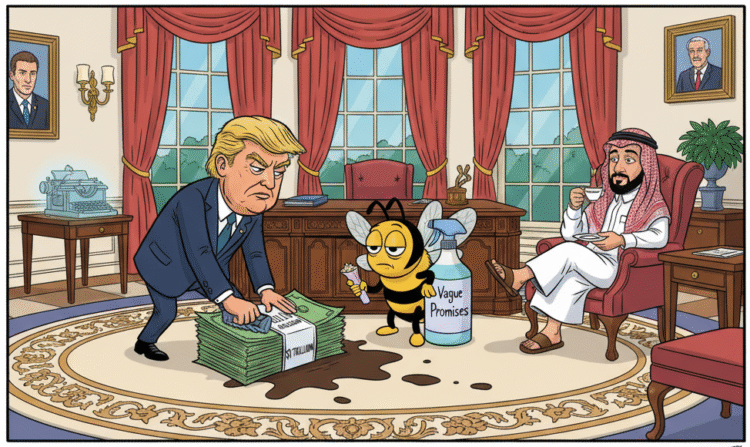
The moral arch of the universe does not bend toward justice. It bends toward the highest bidder, and on November 18, 2025, the gavel finally came down on the sale. The rehabilitation of Saudi Crown Prince Mohammed bin Salman was completed not in a shadow court or a backroom deal, but under the bright, unforgiving lights of the Oval Office, where President Donald Trump hosted the autocrat for his first visit since the 2018 murder of Jamal Khashoggi. The meeting was a masterclass in the banality of evil, a spectacle where the confirmed assassination of a U.S. resident and Washington Post columnist was reduced to a casual, shoulder-shrugging aphorism that will likely haunt the American conscience for decades.
“Things happen,” the President said.
Two words. A simple subject and a simple verb. It is the kind of phrase one might use to describe a fender bender in a parking lot, a spilled cup of coffee, or a rain delay at a golf tournament. It is a phrase of exoneration through vagueness, a way of stripping an event of its agency, its horror, and its victim. When Donald Trump uttered those words while sitting next to the man the CIA concluded ordered the dismemberment of a journalist with a bone saw, he did not just dismiss a murder. He announced the official liquidation of American moral authority. The presidency has become a storefront where history is negotiable, and the price of admission is a vague promise of investment and a willingness to flatter the landlord.
The atmosphere in the room was thick with the specific tension that arises when powerful men decide that reality is an inconvenience to be managed. The press pool, usually a chaotic scrum, was momentarily stunned into silence by the sheer velocity of the normalization. But it was ABC News reporter Mary Bruce who broke the spell, committing the cardinal sin of remembering the past. She asked the question that hung in the air like smoke, inquiring about the killing that had made MBS a pariah in the civilized world for seven years.
The President’s reaction was immediate and visceral. He did not answer the question. He attacked the questioner. He berated Bruce for “embarrassing our guest,” a rebuke that framed the confrontation not as a matter of human rights, but as a breach of etiquette. In Trump’s world, the crime is not the state-sponsored murder of a dissident; the crime is bringing it up in polite company. The inversion of values was total. The man who ordered the killing was the victim of rudeness, and the woman asking about it was the aggressor. It was a stark display of the administration’s operational philosophy: power is never having to say you’re sorry, and absolute power is making everyone else apologize for noticing your crimes.
The Crown Prince, for his part, sat with the quiet confidence of a man who knows he has won. He did not need to defend himself because the President of the United States was doing it for him. Trump went on to praise the autocrat’s human rights record as “incredible,” a descriptor that is technically accurate only in the sense that the record is literally not credible. It was a moment of gaslighting so intense it threatened to suck the oxygen out of the room. To look at a regime known for public executions, the suppression of women activists, and the silencing of dissent, and call it “incredible” is not a diplomatic nicety. It is a declaration that words no longer have meaning.
But the rehabilitation was not free. It came with a price tag, or at least the illusion of one. The transaction at the heart of this moral surrender was a new, shiny number: one trillion dollars. This was the figure Trump cited as the target for Saudi investment in the United States, a convenient upgrade from the previously touted $450 billion and $600 billion figures that were bandied about in the immediate aftermath of the murder. The number has inflated with the years, a sort of blood-money interest rate.
The specifics of this investment remain, as always, a “concept.” There were no binding contracts, no detailed prospectuses, just a vague, non-binding promise to pour money into sectors that sound good in a press release. It effectively traded the memory of a murdered American resident for a rebranding tour that prioritized “jobs” over justice. The cynicism of the exchange is breathtaking. We are asked to believe that the hypothetical construction of a few factories is worth the tangible destruction of the First Amendment. We are asked to accept that the safety of journalists, dissidents, and critics is a commodity that can be bartered away if the counter-offer is high enough.
This meeting was the final nail in the coffin of the idea that U.S. intelligence findings matter to the Commander-in-Chief. The CIA’s conclusion regarding Khashoggi’s murder was not ambiguous. It was high-confidence. It was supported by intercepts, audio, and a clear chain of command. By dismissing it with “things happen,” Trump signaled to every global dictator, strongman, and junta leader that the vast, expensive apparatus of American intelligence is irrelevant. If you can get to the President, if you can flatter him, if you can dangle a large enough number in front of the cameras, the facts do not matter. The dossier can be burned. The tapes can be erased. The truth is just another deal point to be negotiated away.
The message sent to the rest of the world is catastrophic. It tells the leaders of North Korea, Russia, China, and beyond that there is no red line the United States will not cross for the right price. It tells them that human rights are a rhetorical cudgel used only against enemies, never against friends. It creates a permissive environment for transnational repression, where autocrats feel safe reaching across borders to silence their critics because they know the White House will look the other way. If “things happen” to a Washington Post columnist, what happens to a nameless activist in a basement in Riyadh or Tehran? The answer is: whatever the regime wants.
The tragedy of November 18, 2025, is not just that a killer was feted in the Oval Office. It is that the American public was told to applaud it. We were told that this is what “winning” looks like. We were told that morality is a luxury we can no longer afford, and that the only currency that matters is the dollar. But there is a cost to this kind of winning. It is paid in the erosion of our standing, the hollowing out of our values, and the quiet despair of those who look to America for protection and see only a “For Sale” sign.
The spectacle of Trump defending MBS from a reporter’s question is the defining image of this era. It captures the essential dynamic of a leadership style that values strength over decency and loyalty over law. It was a moment of pure, distilled transactionalism, stripped of any pretense of higher purpose. The President looked at a man who ordered a journalist to be strangled and dismembered, and he saw a partner. He looked at a reporter doing her job, and he saw an enemy. And in that gaze, the future of American foreign policy was revealed: a cold, hard place where the only thing that matters is the deal, and everything else—truth, justice, life itself—is just overhead.
The Receipt for a Soul
The final insult of the visit was not the handshake or the photo op, but the impermanence of the promise. The one trillion dollars will likely never materialize in full. It is a phantom sum, a headline number designed to survive the news cycle and then fade into the mist of unfulfilled diplomatic pledges. But the damage done to the concept of accountability is permanent. We have established a precedent that murder has a statute of limitations measured not in time, but in capital.
When the history of this administration is written, the phrase “things happen” will serve as its epitaph. It is the ultimate abdication of responsibility. It is the sound of a leader washing his hands of the world’s blood. We are left now to wonder what other “things” will be allowed to happen in the name of partnership. What other atrocities will be waved away with a shrug? The bar has been lowered so far it is buried in the earth. The rehabilitation of the Crown Prince is complete, but the stain on the carpet of the Oval Office will never wash out. It is there, invisible and indelible, a reminder that on a Tuesday in November, the United States decided that the truth was too expensive to keep.