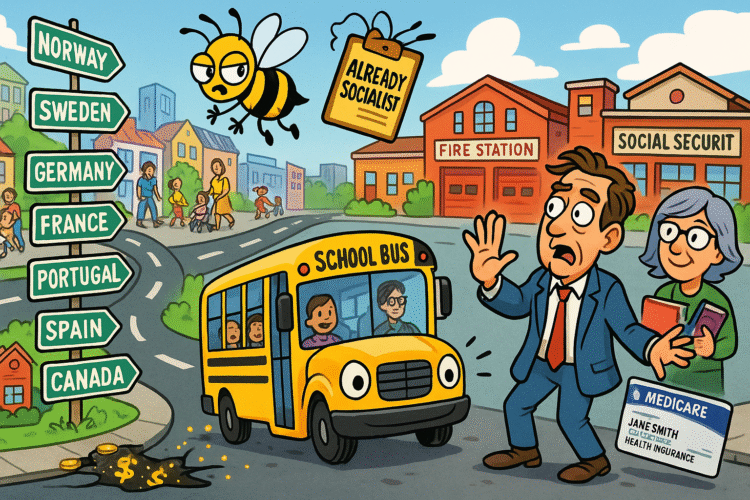
There is a particular genre of American political conversation that resurfaces every election cycle, usually somewhere between the moment a Democrat mentions healthcare and the moment a Republican begins sweating like someone asked him to define “GDP.” The conversation goes like this. One person suggests the United States might benefit from policies similar to those in democratic socialist countries, and another person, usually wearing a polo shirt tucked aggressively into jeans, shouts that socialism is communism, communism is Venezuela, and the next stop is bread lines and state mandated shoe distribution. At no point does anyone define anything. At no point does anyone confirm that they have left the country. At no point does anyone acknowledge that Norway exists.
So let us take a tour, a calm and methodical journey into the world of democratic socialism, the difference between socialism and communism, and the little inconvenient truth that America has been practicing democratic socialism for almost a century without bursting into flames.
And let us do it with grace, precision, mock seriousness, and the kind of dry sarcasm you reserve for someone who insists the fire department is tyranny because they once received a bill for an ambulance ride.
We begin with the world.
Norway. Sweden. Denmark. Germany. France. Portugal. Spain. Canada. New Zealand.
Places where the streets are not paved with gold, but they are paved, repaired, and maintained, something that alone qualifies these nations as utopias compared to parts of the American interstate system.
These countries all practice some form of democratic socialism, a political philosophy that combines market economies with robust social programs funded by taxation. The goal is not the abolition of capitalism. The goal is to stop capitalism from eating its young.
Norway has universal healthcare, free college, paid family leave, and the Sovereign Wealth Fund, a national savings account so enormous it has its own gravitational pull. Sweden has publicly funded childcare, low student debt, long parental leave, and a rail system that does not require piñata style beating to stay operational. Denmark offers free college, healthcare, elder care, and unemployment insurance that treats humans like a shared responsibility rather than a personal moral failure. Germany has universal healthcare, tuition free universities, worker representation on corporate boards, and trains that run at such reliable intervals that Americans assume the news reports are propaganda. France has universal healthcare, subsidized childcare, pensions that allow people to retire before their kneecaps disintegrate, and strikes that appear mandatory by cultural tradition. Portugal and Spain have public healthcare, strong worker protections, subsidized education, and transportation systems that do not crumble under the weight of a Tuesday morning. Canada has universal healthcare that Americans alternately worship and fear depending on which cable network they watched last. New Zealand has public healthcare, strong labor protections, child allowances, and leadership that once behaved like public service was supposed to be a public service.
These countries practice democratic socialism. Not communism. Not authoritarianism. Not the end of capitalism. Democratic socialism simply means the government functions like a co parent in national life, making sure the essential foundations are there so citizens do not fall through a trapdoor every time they get sick, lose a job, or drive over a pothole large enough to qualify as a minor canyon.
This brings us to the ancient American confusion between the words socialism and communism, a confusion so common that politicians depend on it like a business model. Socialism is an economic philosophy. Communism is a political and economic system that historically involved one party rule and state ownership of everything from factories to media to antidepressants. Socialism is a spectrum. Communism is a destination. Democratic socialism sits on that spectrum, closer to Scandinavia than Stalin, and is built on elections, markets, and the belief that the government should prevent poverty rather than study it.
Communism says the state owns everything. Democratic socialism says the people own the government and the government helps provide basic services. Communism removes markets. Democratic socialism regulates markets so they do not become casinos run by men who say “bro” professionally. Communism suppresses political opposition. Democratic socialism thrives on it. If communism is a cage, democratic socialism is a cushion. If communism is a hammer, democratic socialism is a toolbox. If communism is the entire meal being prepared in one state run kitchen, democratic socialism is the public agreeing to fund the oven so no one freezes to death in the dark.
Now let us turn the mirror back on America, a country that insists socialism is evil while carefully avoiding eye contact with its own socialist programs sitting openly on the national coffee table like decorative coasters.
Public schools are democratic socialism. Taxpayer funded education for every child, even the ones who draw lopsided dinosaurs and insist two plus two is five. No one waits in line outside a public school screaming that reading is tyranny. Public schools are so deeply accepted that even people who oppose government spending still send their children there while complaining about curriculum choices on Facebook.
Roads are democratic socialism. Highways. Bridges. Public transportation. Potholes, although not maintained with socialist spirit in some states, are still part of the publicly funded infrastructure. No one demands a private corporation pave their street by subscription model. No one argues that pothole repair should be crowdsourced among neighbors with GoFundMe links. The very foundation of modern American movement is one giant socialist project with asphalt.
Medicare is democratic socialism. A federal program that provides healthcare to seniors, beloved by the very demographic that routinely votes against socialism while insisting that Medicare be expanded, protected, and defended from anyone who might tweak the premium structure. If you want to watch cognitive dissonance in action, attend a town hall where voters hold signs saying “Keep your government hands off my Medicare.”
Medicaid is democratic socialism. Publicly funded healthcare for low income individuals, children, disabled citizens, and elderly people in long term care. It functions quietly, efficiently, and without ideological debate until a legislature decides to punish vulnerable populations for political sport.
Social Security is democratic socialism. Workers pay into a public pension system that they receive upon retirement. It is literally the government redistributing money across time. It is so widely loved that even the most libertarian leaning senator will soften his rhetoric when confronted with the possibility of being blamed for Grandma’s lost rent money.
The fire department is democratic socialism. Tax funded emergency response. No one stops their house from burning to the ground with rugged individualism. No one demands privatized fire hoses. The entire concept is collectivist. The fire department proves that Americans already accept socialism when flames are involved.
Public libraries are democratic socialism. Government funded buildings full of free books, free internet, free literacy programs, free community events. They are temples of egalitarianism. The only people who oppose libraries are those who fear literacy because it creates voters.
Public parks are democratic socialism. Green spaces maintained by public funds for communal use. No one pays an entrance fee to walk on grass. No one receives a bill for sitting under a tree.
The United States is already a partially socialist country pretending it is allergic to socialism. Americans enjoy socialist programs feverishly while insisting the word itself is unholy. It is political performance art, a national identity crisis wrapped in a budgeting contradiction.
When Americans say they fear socialism, what they often fear is helping people they imagine as strangers. What they cherish, however, is socialism for people they know. Public school for their child. Medicare for their parents. Social Security for their grandparents. Roads for themselves. Airports for everyone. Stadium subsidies for billionaires they pretend are job creators. Farm subsidies for districts that vote red. Tax incentives for corporations that relocate factories to places with cheaper scenery. It is socialism, redistributing wealth to maintain a functioning society, but selectively acknowledged.
Democratic socialism is not a threat to freedom. It is a threat to cruelty. It is a threat to scarcity thinking. It is a threat to the idea that people must suffer for moral purity. It is a threat to austerity politics. It is a threat to the narrative that the rich are morally superior and the poor are personally defective. It says a society should operate like a team, not a bar fight.
This is why the countries listed earlier consistently rank high on happiness, education, healthcare outcomes, life expectancy, and general societal satisfaction. They treat citizens as investments, not burdens. They treat public goods as national rights, not rewards for surviving the labor market. They treat infrastructure as a collective responsibility rather than a political bargaining chip.
If the United States adopted more democratic socialist policies, what would happen? Children would attend school without drowning in debt. Families would take parental leave without fearing job loss. Healthcare would not be tied to employment. Seniors would retire without panic. Public transportation would work. Infrastructure would be less embarrassing. Poverty would decrease. Wages would increase. People might trust the government at least as much as they trust their dentist.
The greatest secret in American politics is that democratic socialism is not foreign. It is familiar. It is already baked into the national architecture. It is woven through daily life like a quiet utility line. Americans depend on socialism every day while swearing they oppose it. The contradiction is the joke. The joke is the system. The system is the satire. And the satire is the country itself.
Democratic socialism is not the enemy. It is the scaffolding that prevents societies from collapsing under the weight of unregulated capitalism. It is the idea that the public deserves dignity. It is the belief that citizens are more than economic units. It is the recognition that life is unpredictable and governments exist to buffer shocks, not amplify them.
The world has embraced this truth. Norway. Sweden. Denmark. Germany. France. Portugal. Spain. Canada. New Zealand. They live in modernity while America debates whether insulin is a luxury item.
In the end, democratic socialism is not radical. It is rational. It is practical. It is the political equivalent of wearing a seatbelt. It does not eliminate risk. It reduces unnecessary suffering. It makes life less chaotic. It asks people to consider the collective good without demanding personal sainthood.
America can keep pretending this is dangerous ideology. Or it can acknowledge the truth. Democratic socialism is already here. It works. It saves lives. It props up the very people who swear they do not want it. It is the quiet backbone of American prosperity.
And if the country stopped panicking long enough to notice, it might even realize that collective investment is not tyranny. It is adulthood.