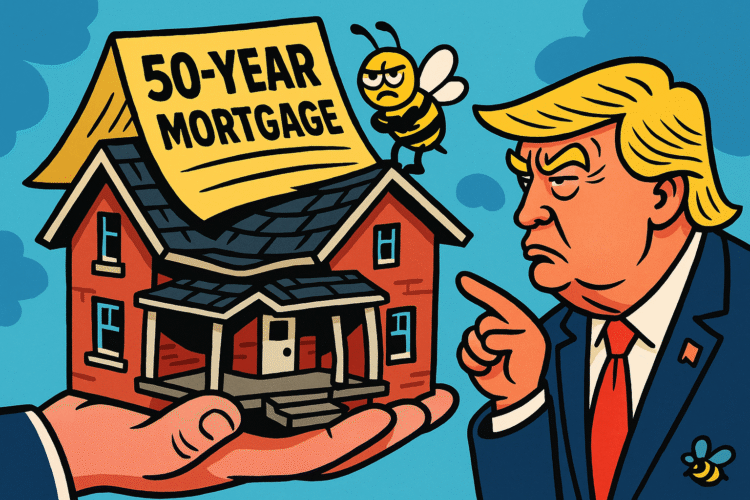
When vibes based housing policy meets compound interest and everyone pretends it is fine
There comes a moment in every collapsing empire when someone proposes an idea so astonishing, so unintentionally revealing, that it deserves to be preserved in a glass case next to the artifacts of past civilizations that also tried financial innovation instead of fixing their infrastructure. For us, that moment arrived the instant Donald Trump decided the cure for America’s housing crisis was a fifty year mortgage. Not zoning reform. Not building homes. Not stabilizing rents. No. He wants to stretch amortization so far into the future that your grandchildren will be paying down your principal between their remote shifts in whatever gig job robots have not yet claimed.
The fifty year mortgage is pitched as a gift. A patriotic gesture. A benevolent act of economic wizardry from a man who once declared bankruptcy with the enthusiasm of a child pulling a fire alarm. But when you strip away the vibes, you are left with math. And the math is not cute. It is not empowering. It is not “helping young families.” It is the financial equivalent of offering someone a cheaper monthly car payment by extending the loan until the vehicle reaches its eighteenth birthday and asks to vote.
To understand the insanity, picture this. A five hundred thousand dollar home loan at a common fixed rate. On a thirty year mortgage, you will pay interest that already feels like buying a second house made entirely of regret. But stretch it to fifty years and you are looking at hundreds of thousands more, paid slowly, relentlessly, with the grace and speed of a tectonic plate. Your monthly payment dips slightly and your lifetime cost explodes like a slow motion grenade. You do not own the house. You receive weekend visitation rights while the bank raises the child.
That is the core trick behind the product. The payment feels smaller. The debt becomes eternal. You will spend a decade paying off interest so passive aggressive that the principal barely moves. You are buying a house that won’t belong to you until it is old enough to qualify for Medicare.
This is not a mortgage. It is a lease with paperwork.
The Pros, Because Even a Bad Product Has Kindling
Let us be fair. There are pros. Slight ones. The kind of pros you list on a grant application when you are trying to hide how bad your data looks.
First, monthly payments drop a little. Enough to help some first time buyers qualify. Enough to give multigenerational households breathing room. Enough to shave off a little default risk in recessions because smaller payments lead to fewer delinquencies.
And if the loans are assumable, there is a theoretical world where your child inherits your low rate, your half finished mortgage, and your sagging roof. It is the financial version of passing down family heirlooms but with more mildew.
These are not nothing. But they are not a solution. They are the equivalent of lowering the bar on a limbo contest by giving everyone kneepads instead of fixing the floor.
The Cons, The Bad, and the Structurally Catastrophic
Now we arrive at the part of the mortgage that looks like it was written by a financial villain in a dystopian novel.
A fifty year loan dramatically increases the total cost of credit. Dramatically. Not “wow that is steep.” More like “why does this amortization schedule look like a geological survey.”
The longer the term, the slower the principal drops. When prices flatten or fall, equity can go negative for years. If the roof needs replacing or the foundation cracks or the plumbing decides to reenact a waterpark attraction, the homeowner is stuck. They cannot sell. They cannot refinance. They cannot even pretend the home is an investment. They are caretakers of a depreciating asset that will not belong to them until they are old enough to qualify for senior discounts on their own property taxes.
And if the home becomes functionally obsolete, which is very likely over half a century of technological change, the borrower becomes the proud owner of a relic bolted to an enormous lien. Imagine paying a mortgage until 2076 on a floor plan designed for 2010 internet speeds and 2020 appliance codes. It is like inheriting a closet with emotional baggage.
Meanwhile property taxes continue creeping upward. Maintenance accumulates. Climate costs rise. Insurance premiums spike. And through it all you are making payments on a building that is constantly trying to return to the earth.
This is debt peonage disguised as a homeownership accelerator.
The political incentive here is obvious. If you cannot fix housing supply, you can pretend to fix affordability by distorting debt. It is like giving someone a bigger straw instead of adding more water to the glass.
Who Wins: Spoiler Alert, Not You
In this brave new fifty year landscape, there are winners.
Lenders win. They harvest interest for decades.
Builders win. They can charge more because payments, not prices, become the metric.
Securitizers win. Longer duration pools produce more consistent returns.
Investors win. They can sell MBS backed by loans that behave like annuities.
But households? They get fifty years of maintenance, repairs, system replacements, special assessments, and the privilege of funding the interest income of people who will never visit the neighborhood.
This is not a housing plan. It is a transfer of wealth from wage earners to debt holders wrapped in a ribbon that reads “monthly payment.”
The Market Plumbing: The Part They Hope You Ignore
Long amortization mortgages change everything under the hood.
MBS duration risk explodes. Prepayment behavior collapses because people will not refinance if there is no equity to escape with. Convexity gets weird. Hedging pipelines become a nightmare. Bank balance sheets absorb long dated exposure that becomes toxic the minute unemployment rises. And if refinances vanish, servicing income shifts while capital requirements tighten.
The entire system becomes more fragile.
This is why most countries do not do this. This is why regulators do not encourage this. This is why the phrase fifty year mortgage sounds like a joke until you realize the person suggesting it still believes covfefe was a profound policy idea.
The Legal Spine: You Cannot Just Vibes Your Way Into a Mortgage Product
There are laws. Guardrails. Entire federal agencies whose job is to keep predatory lending at bay.
CFPB ability to repay rules exist for a reason.
Qualified mortgage standards exist for a reason.
FHA and VA program limits exist for a reason.
Servicing restrictions and prepayment penalty bans exist for a reason.
Usury caps exist for a reason.
Fifty year loans do not slide neatly into this ecosystem. They crash into it like a self driving car that mistook a fire hydrant for a break in the sidewalk.
There will be lawsuits. There will be enforcement. There will be challenges. Because extending amortization that far out skews default risk, obscures total cost of credit, and pushes the boundaries of what consumer protection law was designed to handle.
Borrower Survival Kit: What You Would Need To Know Before Signing Your Life Away
If someone is offered a fifty year mortgage, they need a list. A real list. A survival list.
Start with APR, not rate. Because APR will reveal the cost that marketing tries to hide.
Calculate total interest paid versus thirty years. The difference will feel obscene.
Check points, teaser periods, and balloon risks.
Check assumability. It matters more than ever.
Check prepayment penalties because desperate lenders love to sneak them in.
Check mortgage insurance timelines because PMI on a fifty year schedule is basically a subscription box you never ordered.
Check your DTI at real expenses, including student loans and childcare.
Check flood exclusions, wind exclusions, and whether your future home is located in a climate zone that will still exist in fifty years.
Check HOA solvency. A fifty year loan paired with a bankrupt HOA is a horror film.
Run a stress test at two hundred or three hundred basis points because rates will rise again. They always do.
Macro: The Shell Game Exposed
Long term mortgages without supply reform inflate demand. They push prices up. They make bidding wars worse. They widen the price to income gap. They trap renters. They raise homelessness risk because homes with no equity cannot exit foreclosure pipelines.
They also create a generational mess. Parents could die before the mortgage does. Children could inherit both the home and the loan. And if the home depreciates faster than the principal amortizes, generational wealth becomes generational paperwork.
The Near Term Tests: The Only Part That Actually Matters
Will the proposal include guardrails or will it be the financial equivalent of leaving a toddler in charge of a blender?
Will the GSEs be told to buy these loans or quietly reject them?
Will states cap loan terms or leave residents to fend for themselves?
Will builders and private equity firms unveil turnkey fifty year subdivisions with cheerful brochures hiding the fine print?
Will the media tell the truth that this can be a lifeline or a trap depending entirely on who regulates it?
A fifty year mortgage is not a plan. It is an admission. An admission that the people proposing it have no intention of building homes, funding public housing, strengthening tenant rights, or reforming zoning. It is a political sleight of hand, a distraction, a debt spell cast over a crisis that requires actual solutions.
In a housing shortage, a fifty year mortgage is not empowerment. It is surrender. It is the moment a government stops trying to build and starts trying to rebrand debt as opportunity.
And the only people who win are the ones counting the interest instead of the votes.