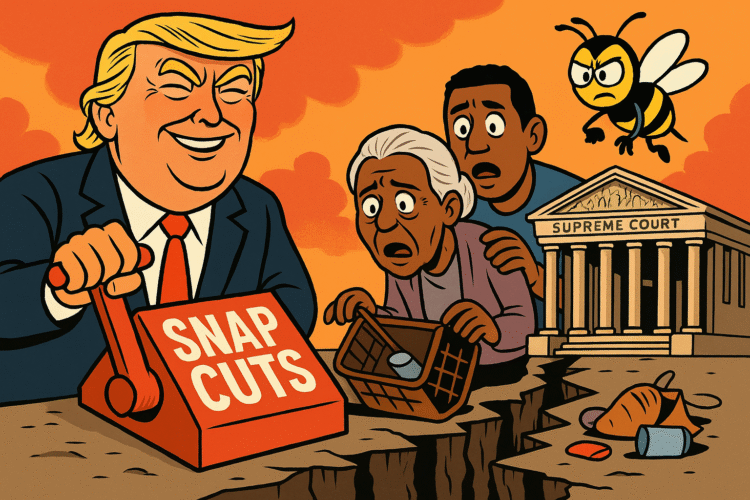
When the most powerful man in the world fights for the right to starve his own people
There are many ways a civilization can measure its decline. Breadlines. Infrastructure decay. Reality-TV personalities winning office. But there is something uniquely cursed about a United States president who refuses to pay out SNAP benefits during a shutdown, gets dragged into court and told the law requires feeding people, defies the order by only paying half, gets told again that feeding people is not optional, and then sprints to the Supreme Court begging for permission to keep 42 million Americans hungry.
This is not symbolism. This is not subtext. This is not messaging. This is policy by cruelty, governance by tantrum, and constitutional law as performance art.
Verified reporting shows that Justice Ketanji Brown Jackson issued an administrative stay that temporarily pauses a district court order requiring full November SNAP payments during the shutdown, handing the Trump administration a brief window to argue that it cannot lawfully use Section 32 and other reserves. Meanwhile, plaintiffs point out that 42 million people were told first to prepare for no benefits at all, then to prepare for half benefits, then to wait as the government ping-ponged between guidance memos like a malfunctioning slot machine.
The question before the courts, stripped of legal ceremony, is simple. Does the United States government have the right to manufacture a hunger cliff and call it procedure.
The Timeline of Manufactured Chaos
To understand how grotesque this moment is, we start in Rhode Island, where a federal judge read the Food and Nutrition Act, noticed the part that says SNAP is an entitlement program, and calmly ruled that the government has to fund it. This was not judicial activism. This was reading comprehension.
The Massachusetts court echoed the same conclusion. The law requires full benefits. USDA has the reserves. The shutdown does not erase statutory obligations. The government cannot decide on a whim that millions of people will fast for November.
But the administration had already parked itself squarely on a different narrative. First, USDA suggested zero benefits. That alone would have been historic, unprecedented, and catastrophic. Then, when lawyers and human beings objected, USDA pivoted to half benefits. When courts objected, USDA claimed its hands were tied by accounting structures no one in the building had mentioned until five minutes earlier.
After the Rhode Island order came down, the administration began filing emergency motions like confetti. And late at night, Justice Jackson issued an administrative stay. This is a procedural pause, not a merits ruling. But it effectively kicked the question to the First Circuit.
The agency guidance whiplash that followed was instant. States were told to stand down. Then to stand by. Then to anticipate clarifications. Then to wait for new clarifications about the clarifications. Some states had already loaded full EBT benefits. Some had loaded partial benefits. Some were halfway through transmission. Some were waiting for instructions that changed before they arrived.
It is hard to run a national food program when the White House treats grocery access like a light switch. It is impossible when the courts must intervene simply to remind the executive that people cannot eat procedures.
The Legal Spine, or What the Law Actually Says
The Food and Nutrition Act is not experimental literature. It is direct. It says eligible households shall receive benefits. Not maybe. Not partially. Shall. The entitlement structure is central. Congress appropriates. USDA administers. Shutdowns do not repeal statutes.
The Administrative Procedure Act forbids arbitrary and capricious agency action. You cannot swing from zero benefits to half benefits to whatever the mood of the moment dictates. Agency decisions require rational explanations, evidence, and consistency. Not vibes.
The Antideficiency Act does not prohibit the use of reserves Congress explicitly authorized. It does not force USDA to starve people. It does not erase contingency funds simply because a president would like a political bargaining chip.
And the emergency stay standard exists to prevent irreversible harm. You would think nationwide hunger qualifies. Apparently the administration believes the possibility of feeding people is the greater threat.
The Human Ledger Behind the Legal Papers
Forty two million people is not a statistic. It is an entire country’s worth of groceries. It is working parents trying to plan meals. It is seniors choosing between heat and food. It is disabled Americans who rely on SNAP not as a luxury but as the difference between stability and collapse.
When the president attempted zero benefits, panic seized the system. Food banks projected record surges. Grocery stores braced for demand shocks. Governors drafted emergency plans. Some states began exploring backfill strategies even before the courts stepped in.
Then came the half benefit posture. Households recalculated everything. EBT processors scrambled to build split disbursement patches. Vendors feared system failures. Administrators braced for calls from families who would see numbers that did not match their budgets.
All of this because the administration wanted leverage in a shutdown fight over health insurance policy.
People say the cruelty is the point. But in this case the cruelty is the tool. The point is power.
The Supreme Court Pause and What It Means
An administrative stay is not a decision. It is a breath. A space. A delay. But delays in food programs have consequences. Every day without clarity is a day when families hesitate at grocery checkouts, states hesitate on EBT transmissions, and food banks absorb the shock.
The First Circuit now holds the next move. And the administration is arguing with a straight face that it cannot lawfully use funds Congress created for emergencies during an emergency that the administration itself created.
The courts must now decide if hunger can be treated as a procedural preference.
The States Caught in the Middle
Some states, knowing the law, simply loaded full benefits. Their systems are already executed. If USDA later claims clawbacks are needed, it will face the logistical equivalent of building a time machine. You cannot claw back EBT dollars already spent on Tuesday dinners.
Other states waited for guidance. They now stand in informational limbo. Their residents sit in anxiety limbo. And USDA staff sit in bureaucratic limbo where policy is dictated by legal filings instead of statutes.
The country is watching the world’s largest food assistance program twist under political pressure. And the courts are being asked to decide whether millions of Americans eat based on the definition of a reserve account.
The Press and the Soft Language of National Harm
Coverage sometimes frames this as a funding dispute. Or a procedural tangle. Or a complex administrative conflict. But that framing is as misleading as it is gentle.
This is not a procedural tangle. It is a hunger cliff deliberately manufactured as leverage.
This is not a complex funding dispute. The reserves are real. The statute is clear.
This is not a shutdown inevitability. SNAP has survived every shutdown until now.
The press should say plainly: the White House tried to stop food benefits. Courts intervened. The administration responded by fighting for permission to keep the cuts.
There is no weather pattern here. There is only decision making.
The Next 48 to 96 Hours
These are the checkpoints that will reveal whether the administration intends to govern or to gamble.
First: Will USDA use available reserves during the appeal. They can. They know they can. They have used reserves before. If they refuse, it is not law but strategy.
Second: Will the First Circuit narrow or lift the stay. If it lifts it, benefits flow. If it narrows it, some payments flow. If it leaves it untouched, families continue waiting for the government to decide whether groceries count as optional.
Third: How will states handle benefits already sent. Clawbacks are a fantasy. Millions cannot unspend food. Courts know this. States know this. USDA knows this.
Fourth: Will any major outlet tell the truth that the case is not about accounting technicalities but whether the law still requires the United States to feed the people entitled to be fed.
Because the real stakes are not hidden. They are sitting in refrigerators and pantry shelves and checkout lines across the country.
-The Hunger Cliff in Plain English
The United States is facing a test of whether the rule of law still reaches the dinner table. A president tried to use starvation as leverage. Courts stopped him. He ignored them. Courts stopped him again. He is now appealing to the highest court in the land so he can keep 42 million Americans one procedural step away from empty plates.
The administration claims its hands are tied. But the law says otherwise. The reserves exist. The entitlement exists. The benefits must be paid.
This moment is not about complexity. It is about will.
Not about accounting. About priorities.
Not about shutdown logistics. About whether the White House believes feeding the country is mandatory or discretionary.
And the only question left, as the courts prepare to decide again, is whether this country still recognizes that the groceries in a family’s cart are not bargaining chips for political wins, but a legal right promised by the government that now fights to withhold them.