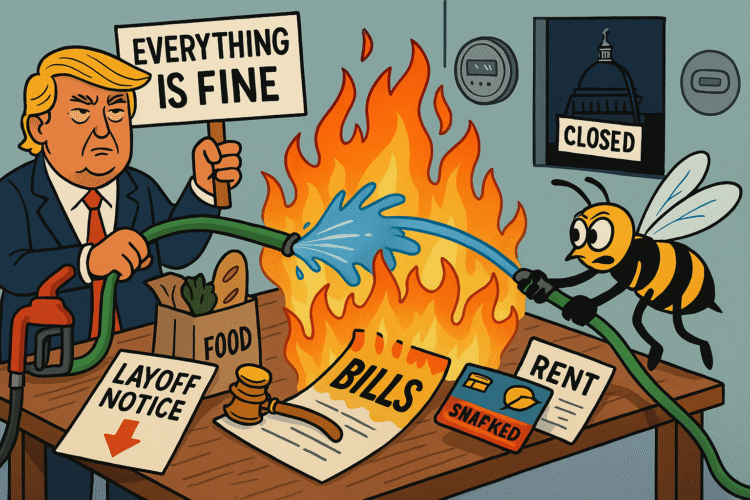
When reality raises the bill, you can gaslight the country or govern for it. Doing both is not a plan.
The country knows the difference between a sales pitch and a receipt. We have been stuck in the pitch again, the kind where a leader tries to hypnotize prices into behaving by announcing that they already have. The script is familiar because we just watched another president try it. He said the numbers were strong, the charts were trending, the vibes would catch up. The public checked the mailbox, opened the utility email, swiped the debit card at the grocery scanner, and learned that vibes do not reduce a bill. Now the new guy is running the same script louder, insisting the economy is fine while the cost of living keeps stepping on throats. The only thing cheaper is the respect for people living inside the numbers.
What makes this version worse is the contradiction at the center. You cannot claim victory over price spikes while presiding over a shutdown that chokes basic services and wages for millions of workers. You cannot call food affordable while your lawyers sprint into court to block nutrition benefits. You cannot promise a better tomorrow while companies announce another round of layoffs and the labor market looks like a game of musical chairs with fewer chairs each month. The mismatch is not just spin. It is contempt for arithmetic.
Let us start with the shutdown, because nothing inflates a price like breaking the machine that pays people on time. A real government is not a content feed. It sets the rules for how the economy moves, pays the people who keep it from grinding, and makes sure that when families need help the help is not a rumor. When the paychecks stop, contractors burn through savings, airports slow to a crawl as stressed controllers and screeners hang on, SNAP households stare at a calendar instead of a fridge, and small businesses that rely on federal customers wonder which bill to skip. Families do not care who started the fight. They care who ends it. If you want to claim competence, the minimum viable product is opening the doors and funding the obligations.
Then there is the food. Everyone who has shopped for a week of groceries understands the difference between a headline about easing inflation and the math at the register. Even as overall inflation softens in some categories, food remains stubborn. Year over year, the climb still eats raise after raise. You can find a few items that dip in price, and you should be honest about that, but the average basket is not a fantasy. People feel it in their bodies, and when the White House tells them prices are down, what they hear is that someone thinks they cannot count. There is no communications strategy that survives that insult.
Energy is not the villain every month, but it has returned to the rotation. Gas climbs, falls, then climbs again, and a two week dip is not a relief when the next fill up eats the savings. Electricity is worse in many places because the grid is absorbing new demand without a plan that keeps households whole. The bills now come with numbers that do not care about politics. You can blame data centers, global markets, or transitions that should have been paced with more respect for consumers, and you would not be wrong. But the person in the kitchen looking at a total due does not care about the footnotes. They care that the price says the quiet part out loud. The system is hungry and it is eating them.
Rent is the slow violence that never leaves the news cycle because it never leaves the living room. The official measures move like molasses, but anyone who has moved in the last few years knows the jump. Landlords spread increases across renewals to keep churn low, which means the pain stays visible for longer. Families respond like they always do when a fixed cost expands to take over the month. They stop buying things that feel optional, then things that are not optional, then they borrow time. That is not an economy with a cold. That is an economy that has decided shelter is a luxury and is shocked when society behaves like it has a fever.
Layer layoffs on top and you get the definition of precarity. Companies that breathed in cheap money for years are now exhaling workers to satisfy the quarterly gods. Some claim it is restructuring for a new era of automation and AI. Some admit it is cost cutting because investors prefer a myth of efficiency to the truth of a tight margin. Either way, the news hits households the same way. Income disappears while the bills refuse. That would be a challenge in a calm policy environment. In the middle of a government shutdown and a fight over nutrition benefits, it is a dare.
Here is the part that insults the intelligence. The administration keeps saying everything is fine. On television, at rallies, through surrogates who seem convinced they can audition the nation into believing its own eyes are liars. Prices are down, they say. The charts agree, they say. You are better off than you feel, they say. It is the most expensive sentence in American politics, and it always boomerangs. When a leader tells a tired public to feel better, the public learns to feel worse about the leader. So why repeat the mistake. Because admitting that things hurt would require a plan that costs political capital, and political capital is the only currency this version of the presidency hoards.
The SNAP fight is the purest window into the priorities. A normal government in a normal country would treat food benefits as a floor. Not charity. Not a bargaining chip. A floor. It is the policy that keeps families from tumbling through the cracks in a recession, a shutdown, or a simple bad month. When you march into court to block payments during a funding crisis, you are telling people that the cruelty is not a bug. You are telling a parent that feeding a child is an indulgence that can wait while men posture. You are telling grocery stores in fragile communities to prepare for a sudden drought of customers. You are telling everyone else that words like pro family are slogans pressed onto plastic signs.
The result is a politics that cannot be rescued by better lines. You cannot spin the cost of ground beef. You cannot spin a utility shutoff notice. You cannot spin a landlord’s notice taped to a door. You cannot spin the numbers on a gas pump that click like a metronome. You cannot spin a layoff email that reads like a breakup written by a lawyer. The only antidote to those realities is the boring work of real relief. The only argument that survives is the one that points to something concrete you made cheaper, to a service you made faster, to a check you protected. Anything else is sermonizing with a sound system.
What would it look like to govern the problem instead of narrating it. It starts with reopening the government because a closed government is not a negotiating tactic, it is a tax on the entire country. It moves quickly to emergency action to protect nutrition benefits while courts finish their theater. It convenes utilities and regulators with a simple instruction, no ambush bills without notice, and a plan to meter increases in a way that does not collapse high usage months into eviction months. It takes the energy load problem seriously by refusing to pretend that new demand will manage itself, and it builds capacity where the jobs are moving instead of forcing households to bankroll the gaps. It tells landlords through action that rent relief is not a campaign promise. It is a formula with rules and money. It treats layoffs like a signal that corporate incentives are broken and rewrites those incentives so short term cuts stop riding on public patience.
It also tells the truth at a podium. Not rhetoric about how the numbers are being unfairly interpreted. Not nostalgia for a time when the country loved the president more. The truth that many households live on too fine a margin to absorb even small increases, that the run up from the last few years has not unwound in ways people can feel, and that in places where prices fell, fees climbed to replace them. Airlines did not lower fares because fuel eased. Landlords did not roll back rents because mortgage rates bumped. Telecoms did not decide that a stable price justified a happier customer. We live in an economy that captures relief quickly and distributes pain slowly. Pretending otherwise reads as complicity.
The comparison to the previous White House attempt at optimism is useful only if it changes behavior. The last round failed because people heard the song and then saw their paycheck stretched thinner. It failed because the gains were real on paper and not felt in the kitchen. It failed because the message asked people to trust a story that did not include them. The current version is failing for the same reason while adding a layer of intentional harm. It is one thing to insist that the economy is strong while you try to make it stronger. It is another to insist that the economy is fine while you put your weight on the neck of policies that make it survivable.
Some will argue that the economy is complicated and that averages tell a better story than anecdotes. True, but when the median is still higher than the comfort of most households, averages are a dodge. Others will argue that inflation has cooled and that year over year trends look less terrible. Also true, and useless to a person who just signed a lease at a higher rent or opened a power bill that reflects a market no one taught them to navigate. Still others will insist that this is all the fault of the last administration or the next one. Blame is cheap, and the meter is running.
If the administration wanted a message that did not collapse on contact, it could try humility and urgency. Tell the country that the cost of living is still hurting, that you hear it, that you have a checklist and a schedule. Show daily progress on basics, not with ribbon cuttings and influencer campaigns, but with the kind of updates that change a day. We funded the benefit checks. We pressured the agency to release the letters of credit that keep providers afloat. We moved discretionary levers to stop surprise fees. We created a hotline that works and staffed it with people who can fix a problem, not apologize for one. We punished the corporation that broke a promise. We stopped the rent court from moving cases without counsel. We set a floor under the essentials while we negotiate the rest.
The economy is not a mood. It is a distribution of pain and profit decided by policy and pressure. Right now, the distribution still flatters investors and scolds the rest of us for noticing. The people who feel it most are the ones who already learned to live with quiet desperation. They do not need a sermon about patience. They need a government that shows its work. The president can continue to claim victory in a monthly address that will age like milk. Or he can decide that the job is not to seduce a chart, it is to move it.
There is a test coming that will not be graded by cable news. If the shutdown drags and nutrition aid remains a pawn, if electricity bills keep rising without guardrails, if rent remains a punishment for breathing near a city, if layoffs are treated as natural weather, the public will do what it always does. It will ignore the sales pitch and look for someone with a toolbox. Parties that refuse to learn this lesson get replaced, not because the country loves the replacement, but because the country cannot afford to wait for self respect to grow on a podium.
You cannot govern by telling people their pain is a misunderstanding. You cannot lead by pretending that checks and balances are a detail when your lawyers are in court trying to shrink the check and remove the balance. You cannot threaten the safety net and expect the rope to hold. You cannot keep a straight face while insisting that prices are down when families keep bringing home smaller bags. You can try. You will fail. The economy is not as bad as the loudest voices say in some indicators, and it is worse in the places where it matters. The numbers will eventually catch up with the speech. They always do.
What The Cameras Did Not Show
A shutdown turned the country’s daily operations into collateral. Food benefits became a courtroom exhibit. Layoffs spiked. Electricity costs climbed with demand and bad planning. Rent stayed high and sticky. Gas prices refused to sit still. Through it all, the president pretended the kitchen table had not noticed. The fix is not a better pitch. It is reopening the government, protecting SNAP without drama, managing utility shocks with regulators who work for the public, putting a floor under rent pressure, and confronting the reasons companies shed workers while executives cash out. Stop telling people the water is warm while they are standing in the cold. Turn on the heat and hand them the bill you just cut in half.