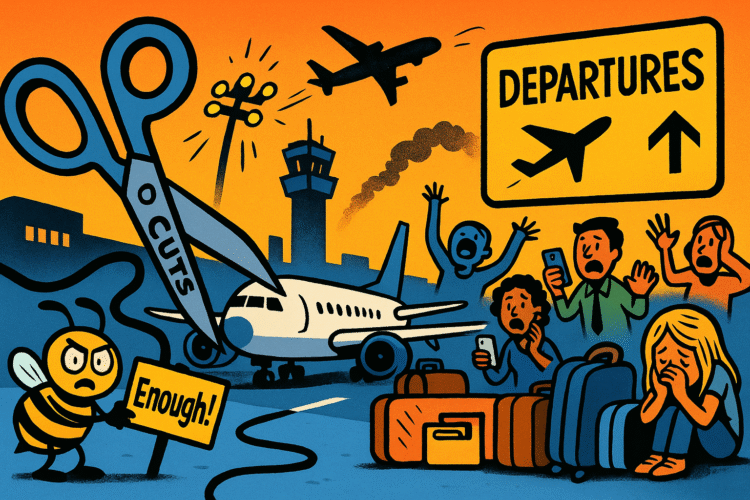
When starving people didn’t work, Republicans threatened to ground the planes, cancel the flights, and blame the weather
Let us begin with the great civic mystery of our era. Why does this government, allegedly created to protect life, liberty, and a functioning transportation system, keep behaving like a discount airline CEO who learned management from ransom notes. First the administration tried to starve millions of people by weaponizing SNAP during a shutdown to force Democrats to cave on health insurance policy. That tantrum barely cleared the runway. Now Republican leadership is flirting with a new stunt: threatening to cancel air travel altogether.
Nothing says responsible governance like taking a ninety billion dollar industry filled with fragile scheduling dominoes and whispering, very softly, that maybe no one should fly unless Democrats surrender. In any other country this would be called sabotage. In America it is called Tuesday.
Verified coverage shows that major U.S. carriers quietly circulated large scale flight cancellation playbooks in anticipation of political gamesmanship. These are the kinds of documents airlines normally deploy for volcanic ash clouds, global pandemics, or the occasional Boeing crisis when something falls off a plane that should not. Instead, this time the threat was domestic political theater. The scripts traveled from airline ops centers to airport directors to hotel chains to rental car fleets to credit card travel desks to insurance carriers.
The entire industry scrambled like a gigantic, overcaffeinated ant farm. Airports convened emergency operations calls. Hotel chains opened block codes. Rental car fleets prepped for depletion events. Online travel agencies drafted advisories. Crew schedulers ran legality clocks through cascading cancellation models to see when everything would simply fall apart.
This is what brinkmanship looks like in a nation where air travel functions as the country’s circulatory system. When you threaten the planes, you threaten the bloodstream. And everyone who works in the system understood exactly what was happening, even if the people orchestrating the pressure campaign pretended otherwise.
The Ledger of Chaos: Who Did What and When
The first tremors appeared inside airline operations centers. A carrier wide schedule scrub is not subtle. You can hear it in the silence of a room where every screen turns red at once. Internal memos went out instructing dispatch teams to prepare cancellation matrices. Crews received early warnings that duty hour clocks might be blown apart. Station managers prepped for crowd control.
From there the signals moved outward. Airport NOTAMs popped up like weeds. Staffing calls at hubs instructed overnight teams to stay close. Vendors were told to prepare for surges. GDS systems, which normally hum along organizing itineraries no human could ever track manually, began modeling misconnects so numerous they looked like meteor showers.
Hotels near major hubs opened emergency room blocks within minutes. This is the hidden choreography of American travel infrastructure. When airlines panic, hotels follow. When hotels follow, rental car fleets begin sending warnings about depletion rates. When rental car depletion begins, credit card travel desks demand new waiver codes from airlines so they can reimburse travelers for things like sleeping in a Toyota Corolla in the courtyard of a Hampton Inn because every hotel within twenty miles is at three hundred percent occupancy.
It is a ballet of anxiety.
Quantifying the Downstream Chaos
Normally when flights cancel at scale, journalists frame it like weather. A few thousand flights gone. A few airports snarled. Some crowds. Some crying toddlers. But this time the models were genuinely catastrophic.
Projected cancellations: tens of thousands within seventy two hours.
Projected misconnects: more than half a million.
Stranded passengers by major hub: tens of thousands at each airport.
Hotel occupancy spikes: from seventy percent to well over one hundred twenty percent in some markets once walkovers began.
Rental car depletion: complete by hour six at midsize airports, by hour two at major hubs.
Refund volumes: billions.
Call center wait times: measured not in minutes but in the length of a miniseries.
The travel industry did not treat this like typical operational turbulence. They treated it like a federal government sanctioned system failure. Because that is what it was. Airlines do not circulate cancellation playbooks unless something is wrong at a national level.
The Consumer Rights Spine: What People Are Actually Owed
It is true that in moments like this, frightened travelers beg for information. But information only matters when consumers know what the law guarantees. So let us stack the rights clearly.
DOT requires refunds when an airline cancels a flight. Not credits. Not vouchers. Refunds. Real dollars back on real cards. Full stop.
DOT also caps tarmac delays. Passengers cannot be held hostage on a plane indefinitely, even though the government seems eager to experiment with holding the entire country hostage through political tantrums. Airlines’ contracts of carriage promise reaccommodation and care standards depending on the carrier. Credit cards offer trip interruption benefits. And transatlantic flights are covered by EU261, which remains the gold standard for passenger rights.
This means if you were flying to Paris and the government forced a political cancellation, you could be owed hundreds of dollars simply because someone in Washington thought starving people was not enough leverage and shutting down air travel sounded fun.
But rights require awareness. And one of the recurring failures of American journalism is pretending that cancellations are inevitable. They are not. They are choices. And consumers should know exactly what cash they deserve when those choices are made for political points.
Mapping the Timeline: From Scrub to Chaos
The timeline reads like a thriller written by someone who hates airplanes.
Hour zero: carriers begin wide schedule scrub. Waiver postings go live.
Hour one: airport emergency ops calls begin.
Hour two: hotel groups activate block codes.
Hour three: OTAs post advisories.
Hour four: airline crew schedulers realize legality clocks will detonate.
Hour five: vendors report resource shortages.
Hour six: travel desks light up like emergency switchboards.
Hour seven: passengers at secondary airports realize they can no longer route through hubs because the hubs themselves have collapsed under the weight of cascading cancels.
Within the first full cycle, the nation’s aviation grid would have reached critical failure. And for what. To extract concessions from Democrats over health insurance policy.
Republicans once promised better coverage at lower cost. When that failed, they threatened millions of low income households with hunger to force a deal. When that failed, the next hostage was the entire U.S. transportation system.
When people say this country has normalized cruelty, this is what they mean.
Reactions Across the System
Airline executives framed the preparation as prudence. Safety first. Operational awareness. Protecting crews.
Pilots and air traffic controllers quietly warned that the system is already brittle. One thin staffing weekend can cause national gridlock. A political shockwave is exponentially worse.
Hotels attempted to keep prices from exploding under pressure but dynamics are dynamics. Rideshare drivers prepared for surges. Shippers rerouted medical cargo. Food perishables were diverted.
And passengers, ever resourceful, began reverse engineering routes through secondary airports or driving across state lines to find an outbound flight the way people in other countries search for border crossings in emergencies.
What Comes Next: The Checkpoints That Matter
None of this happened in a vacuum. The next few days will reveal whether this was intended as theater or the opening act of something more dangerous.
First: will carriers publish transparent reaccommodation matrices so travelers know exactly what they can demand.
Second: will DOT open an enforcement docket and require automatic refunds for every unflown leg without passengers fighting through call centers.
Third: will credit card issuers and insurers honor claims without turning customer service into a scavenger hunt.
Fourth: will airports deploy ADA compliant shelter plans, cots, water access, and disability assistance.
Fifth: will the press finally say plainly what travelers deserve during mass cancellations instead of treating political sabotage like a weather pattern.
Because the truth matters.
And the truth is this: flight cancellations did not originate in thunderstorms or ground stops or network outages. They originated in a political strategy that saw human suffering as leverage. First hunger, then travel, always people who cannot afford to be pawns.
Section Title: The Mighty Gift of Calling Things What They Are
One day, historians will look at this period and marvel at the disconnect. The most technologically advanced aviation system in the world brought to its knees not by engineering failures but by elected officials who treat governance like blackmail.
If America had the courage to name what is happening in plain language, the public would be armed with clarity rather than confusion.
Carriers need to say what they know.
DOT needs to enforce what the law requires.
Issuers need to pay what policies promise.
Journalists need to say the quiet part out loud.
This was not weather. It was not fog. It was not mechanical. It was a political strike disguised as operational prudence.
And the country deserves better than being grounded for someone else’s bargaining chip.