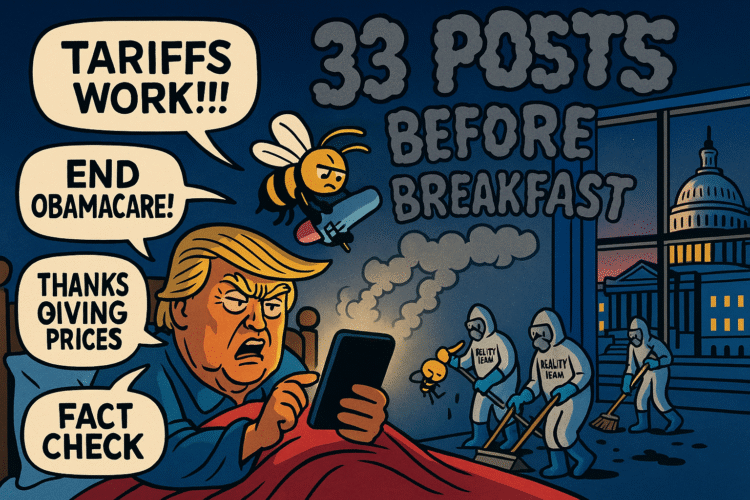
There is a sound that follows defeat, and it is not silence. It is the clattering of a smartphone in the small hours, the electronic cough of a man refreshing his own reflection. The morning after Democrats’ big wins, while New York was still sweeping up confetti and poll workers were still drinking reheated coffee, Donald Trump unleashed what might be the most unhinged burst of digital performance art in American political history: thirty-three posts in just over two hours, an emotional speedrun through tariffs, theology, and self-congratulation.
By the end of it, Truth Social looked less like a presidential feed and more like a manic group chat no one dared leave.
Act I: 7:03 a.m. — The All-Caps Alarm Clock
Verified coverage puts the first post at 7:03 a.m., timestamped in the Florida humidity. “AMERICA IS WINNING AGAIN!!!” he wrote, without specifying how, given that Democrats had just picked up more than a dozen legislative seats and locked in mayoral control from New York to Phoenix. The second post arrived one minute later: “TARIFFS WORK!!! ALMOST 50%!”—a claim that economists immediately flagged as nonsense, unless the new metric for victory is making imported coffee more expensive.
From there, the feed exploded into a threadbare carnival. Within fifteen minutes, Trump had declared himself the “Father of the Tariff,” denounced Obamacare as “unfixable and corrupt,” and demanded that Republicans “NUKE THE FILIBUSTER NOW!” as if the Senate were a Call of Duty map.
Somewhere between threatening to end Nigerian foreign aid over alleged Christian persecution and boasting that Thanksgiving prices were “lower than Obama’s disaster years,” the posts began to loop back on themselves. By 8:00 a.m., he was congratulating himself on “FOUR GREAT YEARS,” accompanied by a glossy graphic of his 2020 campaign logo under the caption “Reelected President.” The internet confirmed the image was AI-generated, a collage of digital delusion featuring Trump shaking hands with himself.
Act II: The Algorithm as Therapist
By breakfast, reporters had stopped counting. The official tally hovered around three dozen posts, though several were reposts of fringe blogs praising his tariff doctrine, a few “retruths” of conservative book plugs, and one birthday-style message commemorating his “great return to leadership,” which technically hasn’t happened.
Each topic received about the same intellectual weight. Health care? One line. Inflation? Two lines, mostly adjectives. Nigeria? Three lines and a stock photo of a church. The longest post, clocking in at 247 words, was a diatribe blaming “shutdown optics” for Republican losses: “We LOST because I wasn’t on the ballot!!! Everyone knows it!!!”
It was part grievance, part campaign pitch, part cry for help. It was also, according to White House reporters, a preview of what governance would look like if social media addiction could declare war.
The civic implications are not abstract. His posts naming foreign countries—even when unserious—trigger review processes under the International Religious Freedom Act, which designates “countries of particular concern.” Nigeria, which has appeared on and off that list for years, now finds itself once again the subject of a Trumpian threat, this time delivered through an app with less reach than a mid-tier podcast. The State Department will have to issue clarifications that policy is not made by meme.
Act III: Data vs. Drama
Tariffs, too, got their moment in the feed’s sunburned spotlight. Trump repeated his claim that “average tariffs are now almost 50%—the highest in world history,” a figure that economists immediately dissected. The actual weighted average under his own trade policies hovered closer to 18%. But accuracy is a currency he’s never traded in.
Fact-checkers had a busy morning:
- Tariff Impact: False. Most of the increases hit imported goods whose costs were later offset by domestic inflation.
- Thanksgiving Prices: Misleading. Food costs are up roughly 25% since 2019, though wholesale turkey prices did dip this fall.
- Obamacare Collapse: Fabricated. Enrollment under the Affordable Care Act reached record highs this year.
- “Winning”: Philosophical. Unverifiable under current scientific standards.
By the time analysts finished parsing his arithmetic, Trump had moved on to what he called “The Great Shutdown Betrayal,” a tirade about Congress and the optics of federal workers being paid “to do nothing while Republicans get blamed.” It was an ironic line from a man whose main occupation is posting about his grievances from a golf resort.
Act IV: The Reaction Economy
Reactions came in predictable flavors. CNN used the word “spree.” NBC went with “rant.” The Wall Street Journal called it “a rapid-fire sequence of grievances.” The Associated Press described it more diplomatically: “An unusual burst of social media activity.” Translation: everyone knows he’s spiraling, but no one wants to say “unfit” in print.
Cable panels spent the day toggling between footage of Zohran Mamdani’s historic New York mayoral win and screenshots of Trump’s posts, creating an unintentional split-screen of the past and future of American politics. On one side, grassroots organizing and progressive energy; on the other, a man rage-posting about turkey prices.
Inside Trump’s orbit, aides tried to rebrand the meltdown as “assertive messaging.” One advisor told Politico that “the President’s posts reflect his energy and engagement.” Another said it was “an intentional show of stamina.” Somewhere in that spin room, a staffer probably drafted a talking point that “33 posts before breakfast” is what leadership looks like in the digital age.
Act V: The Laws of Online Gravity
This is where civics collides with spectacle. A former president’s statements—no matter the platform—still carry legal and procedural weight. When he threatens to cut foreign aid, agencies must note it. When he claims to be “ordering” new tariffs, the Office of the U.S. Trade Representative must issue clarifications. When he implies that Obamacare is collapsing, healthcare markets react.
It’s governance-by-gripe, but the bureaucracy still has to follow the crumbs.
Lawyers at watchdog groups are already flagging his Nigeria comments under the Spending Clause and the Foreign Assistance Act, which forbid the executive branch from withholding funds without congressional authorization. The International Religious Freedom Act, which Trump invoked by name but clearly hasn’t read, requires a formal finding by the State Department—not a social media tantrum—to classify a country as hostile to religious liberty.
In other words, the levers of government are being tugged by a man pounding his phone like a malfunctioning slot machine.
Act VI: Mental Fitness, by the Numbers
Doctors are too professional to diagnose from a feed, but psychologists across cable news have stopped pretending. “Grandiosity, persecution, disinhibition, impulsivity,” said one mental health expert, “the digital fingerprints of instability are all there.”
Others pointed out the pattern: the post-election barrage always follows loss. In 2020, it was “Stop the Steal.” In 2022, “Fraud Everywhere.” Now it’s “Everyone But Me Is to Blame.” Each time, the volume increases.
By noon, the phrase “mental fitness” was trending on social media, followed by “keyboard presidency.” The question wasn’t whether Trump still commands influence, but whether his mind can distinguish between posting and governing.
One former official described the scene vividly: “You can tell when he’s alone. The posts get weirder. The punctuation starts to sweat.”
Act VII: The Subtext of Losing
Beneath the chaos, there’s a simple truth: he’s furious about the blue wave. Zohran Mamdani’s mayoral victory in New York, the Democratic sweep in statehouses, the rebuke of MAGA-aligned candidates—these were not just losses, they were existential slaps.
Trump’s feed may look like spontaneous combustion, but it’s the digital mirror of power slipping away. Each post is a substitute for relevance, each insult a coping mechanism.
That’s why his posts swing wildly from nostalgia to aggression. One moment he’s invoking his “great economic miracle.” The next, he’s attacking grocery prices as if inflation were a liberal conspiracy. The man who once claimed to have rebuilt the American economy now blames its state on people shopping for cranberries.
It’s projection as policy.
Act VIII: The Consequences of Noise
The next few days will determine whether the spree remains a tantrum or morphs into policy.
Checkpoint One: Official Letters. Will his staff issue any formal communications backing up the threats made in those posts? If a memo leaves Mar-a-Lago with the words “aid suspension” or “tariff directive,” the legal machinery grinds into motion.
Checkpoint Two: Court Citations. His social media posts have been cited in litigation before, including in free speech and incitement cases. Attorneys representing plaintiffs against his administration still quote his past tweets as evidence of intent. If a judge deems his Truth Social posts to have similar weight, they could become evidence in ongoing suits over election interference and international conduct.
Checkpoint Three: Bureaucratic Whiplash. Federal agencies may spend the week drafting clarifications to reassure foreign governments and domestic markets that Truth Social is not, in fact, the Federal Register.
Checkpoint Four: The Press Test. Will journalists call it what it is—a meltdown—or will they translate the posts into policy-sounding soundbites? Too often, media reports take his venting and add verbs it never earned: “Trump signals,” “Trump indicates,” “Trump pivots.” He didn’t pivot. He pouted.
Act IX: The Cult of Noise
Trump’s defenders insist this is strategy, not instability. “He’s controlling the conversation,” one pundit said. Maybe—but if your conversation is about whether your posts are real or AI-generated, control is not the word.
Even his allies admit the feed feels like a fever dream. “It’s hard to tell what’s real anymore,” one aide confessed anonymously. “Sometimes he’ll post a picture that doesn’t exist. We don’t know if it’s AI or if he’s commissioning art of himself.”
Some clips shared on his account—showing him “signing new trade deals” and “addressing cheering crowds”—appear to be digitally fabricated composites. One video analyst said, “You can see the pixels blink.” That detail somehow feels poetic. Reality blinks around him, and he doesn’t notice.
Act X: The Civics of Delusion
In a functioning republic, there’s a line between rhetoric and rulemaking. Trump continues to blur it. His followers treat every post as gospel; bureaucrats treat every post as paperwork. The result is a government that runs on emotional maintenance.
The civics lesson is grim but essential: free speech becomes dangerous when it impersonates authority. Every time Trump posts, the nation’s lawyers must decide whether to interpret or ignore him. That’s not politics—it’s triage.
Meanwhile, the economy keeps moving on data, not declarations. Tariffs remain capped by statute. Inflation is measured by the Bureau of Labor Statistics, not by mood. And Thanksgiving prices depend more on bird flu and fuel costs than on all-caps posts about socialism. But in Trump’s America, emotional resonance outweighs empirical truth.
Act XI: The Journalistic Dilemma
Reporters are trapped in the loop. They know the posts are performative, but they can’t look away. Every headline that begins “Trump Says” gives him oxygen. Every panel that dissects “what he meant” confuses gibberish for strategy.
The press still hasn’t learned the language of authoritarian absurdity. When a man issues thirty-three posts in two hours, you don’t analyze the grammar—you report the condition. Yet legacy outlets still cling to their ritual: translate chaos into governance. “Trump proposes,” “Trump signals,” “Trump weighs.”
No. Trump vents. Trump rages. Trump spirals.
To write otherwise is to launder dysfunction into diplomacy.
Act XII: The Country That Keeps Watching
What happens next is both predictable and alarming. His posts will fade by tomorrow’s news cycle, replaced by the next crisis. Staff will clean up the mess. Economists will issue rebuttals. Diplomats will assure allies the United States still operates under laws written by humans.
But the pattern will remain. Whenever Trump feels irrelevant, he will return to his comfort zone: chaos as proof of life. The feed is his oxygen. The audience, his medication.
He does not want power to govern; he wants it to post without consequence.
The nation that once measured leadership by policy now measures it by engagement metrics. And while the rest of us scroll through the wreckage, democracy keeps refreshing itself, praying for a day when sanity gets more likes.
Coda for a Country on Notification Overload
Donald Trump’s 33-post morning wasn’t communication—it was confession. It told us everything about his worldview: that power is projection, law is leverage, and reality is whatever the feed says it is.
But the feed is not the government. The tantrum is not the policy. The post is not the act.
Unless, of course, we let it be.
The task ahead is simple and exhausting: call the meltdown what it is, check the data he distorts, enforce the laws he threatens, and remember that governance-by-gripe only works if we pretend it’s governance at all.
Because the minute the country starts treating a rant like a roadmap, the republic becomes an app with no logout button.