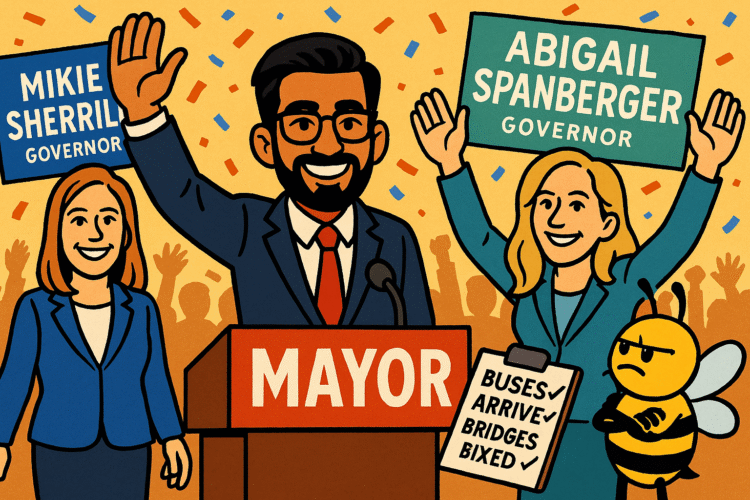
For once, America looked up from its collective doom scroll and saw something profoundly un-American by recent standards: functioning democracy. No coups, no indictments, no men in designer flak jackets shouting about tyranny from podcast studios. Just elections that ran, counted, and ended with results that made sense. Zohran Mamdani became New York City’s first Muslim mayor. Mikie Sherrill flipped New Jersey’s governorship. Abigail Spanberger took Virginia and, in doing so, broke the oldest glass ceiling south of the Mason-Dixon. It was, for lack of a better term, a normal week—and somehow that felt revolutionary.
1. The Civics Test Nobody Studied For
Let’s rewind to the eve of the election, when President Trump took to his natural habitat—rage broadcasting—to warn that if Mamdani won, the city would “lose federal funding.” It was the kind of legally incoherent threat that used to tank approval ratings but now serves as campaign oxygen. He labeled Mamdani a “Communist,” then pivoted to endorsing Andrew Cuomo over his own party’s candidate, Curtis Sliwa. It was political theater with all the depth of a TikTok filter and half the lighting budget.
But while Trump wagged his finger at bridges he didn’t build, voters in New York, New Jersey, and Virginia were quietly preparing for a referendum on something rarer than ideology: competence. The headlines wrote themselves before the polls closed—normalcy makes a comeback.
2. The Receipts: How the Timeline Turned
Monday night: Trump’s Truth Social feed goes full prophecy mode—“Federal money gone if Zohran wins,” he warns, as if the Spending Clause were an Amazon Prime subscription he could cancel.
Tuesday morning: New Yorkers flood the subways, not to flee, but to vote. Turnout breaks modern records. Polling stations in Queens and Brooklyn report surges of first-time voters, many citing “tired of the noise” as motivation.
Tuesday evening: Exit polls show Mamdani carrying youth voters by 42 points and winning outer borough working-class precincts that Democrats abandoned years ago.
Wednesday 12:03 a.m.: CNN calls it—Mamdani, the city’s first Muslim mayor.
By dawn, Virginia follows suit. Spanberger, a former CIA officer with the temperament of someone who actually reads legislation, defeats her far-right opponent by a healthy margin, flipping suburban counties that once treated Democrats like rare birds.
An hour later, New Jersey confirms what campaign reporters had suspected all week: Mikie Sherrill, the pragmatic Navy veteran, takes the governor’s mansion by refusing to cosplay populism. Three elections, three stories, one headline: receipts beat rants.
3. The Math of Normalcy
The numbers matter here because they reveal a quiet realignment beneath the noise. Youth turnout in New York hit a 25-year high. In Virginia, women over fifty swung nine points toward Spanberger. In New Jersey, small donors outspent major PACs two-to-one. Suburban precincts that once split evenly broke decisively blue, while rural counties trimmed their red margins enough to change the statewide calculus.
And yet, the most striking figure is symbolic: three victories, each in a place written off as hostile or ungovernable, powered by the unsexy promise of things working. The message was simple and devastating—voters do not actually hate government; they just hate government that acts like a reality show.
4. The Sound of Panic in the Distance
Within hours of the results, conservative media entered what can only be described as post-defeat improv. “Voter fraud,” they tried. “Illegal turnout operations.” “Deep state election machines.” But even the algorithms seemed bored. The new storyline emerging from the right was one of existential crisis. If competence could win again, what happens to the outrage economy?
On Capitol Hill, the mood shifted from bluster to bureaucratic panic. Committee aides whispered about “testing OMB apportionments,” Beltway code for “can we punish blue states quietly?” The White House floated trial balloons about freezing infrastructure grants and letters of credit. Legal scholars countered that the Spending Clause forbids conditioning federal funds on political obedience. The courts, predictably, prepared for another round of litigation that will end in judicial eye-rolling.
5. The Democrats’ Accidental Masterclass
The wild part is that Democrats didn’t so much reinvent politics as they remembered how to do it. Kitchen-table economics met rule-of-law framing, and suddenly the party rediscovered how to sound like grown-ups.
Mamdani talked transit, housing, and policing reform without treating compassion as a crime. His campaign was a mosaic of working-class stories, immigrants, and disillusioned moderates who wanted someone to fix the buses, not perform grievance kabuki on Fox News.
Sherrill campaigned on affordability—property taxes, childcare, infrastructure—wrapped in the moral clarity of post-Trump fatigue. She promised to make New Jersey boring again, and voters swooned.
Spanberger turned Virginia’s election into a referendum on ethics and institutions. Her slogan could have been, “Maybe let’s not set everything on fire this time.” It worked. She became the first woman governor of a state once allergic to women in power, and she did it without theatrics—just plans, receipts, and stamina.
6. The Subtext: The End of Intimidation Politics
What ties these races together isn’t ideology but the collapse of fear as a political tool. Trump’s threats to defund blue cities fell flat because voters finally understood the fine print: presidents don’t control the purse, Congress does. The law’s separation of powers isn’t sexy, but it’s sturdy. Past attempts to weaponize funding—counterterror grants, disaster aid, pandemic relief—were all slapped down by courts.
By election week, even moderate Republicans privately admitted the “funding freeze” line was more tantrum than tactic. Still, the bluff mattered, because it exposed how small the strongman act looks next to functioning local government. You can’t frighten voters who’ve stopped believing you can deliver anything.
7. The Stakes Ahead
The post-election horizon now splits into two tests.
First: will the White House attempt to re-litigate its humiliation through the machinery of budgeting—apportionments, letters of credit, slow-walking federal grants? Or will it recognize that punishing cities for voting the wrong way looks less like strength and more like an admission of impotence?
Second: can the new governors and mayor translate competence into results fast enough to make normalcy feel like progress? Mamdani inherits a city strained by housing and transit costs. Sherrill must make affordability reforms in a state allergic to them. Spanberger faces the bureaucratic labyrinth of Virginia’s infrastructure backlog. If they succeed, they’ll redefine Democratic governance from mood board to deliverable.
Because the test of competence isn’t aesthetic—it’s whether bridges get repaired, buses run, and bills shrink.
8. The Voter Mood: Exhaustion as Motivation
Reporters at polling sites heard the same refrain in every zip code: “I just want things to work again.” After a decade of chaos, that line reads like a manifesto. Voters are not ideological purists; they are practical existentialists. They’ve seen what spectacle costs, and they want a refund.
Young voters who once flirted with nihilism returned to the polls because rent and climate now feel non-negotiable. Older suburbanites who bought into the Trump experiment are discovering that grievance doesn’t fix potholes. The coalition that emerged isn’t loud, but it’s real: people trading performative politics for transactional competence.
9. The Media’s Reluctant Epiphany
Mainstream coverage, ever allergic to simplicity, tried to brand the sweep as “Democrats’ lucky night.” But luck implies chaos, and chaos was the other party’s brand. What happened was structural. The press, conditioned to treat every election as an existential cliffhanger, struggled to frame competence as newsworthy.
On social media, users mocked the coverage: “Breaking: Democracy works, pundits baffled.” Yet behind the sarcasm sits relief. For the first time in years, the story wasn’t about who shouted loudest but who built something tangible.
10. The Legal Machinery Wakes Up
Lawyers now brace for skirmishes that sound like homework but matter profoundly. Can the administration delay disbursements through OMB apportionment tweaks? Can agency letters of credit be reprogrammed without Congress? The short answer is no, not legally. But legality has never been the point; intimidation is.
Already, constitutional scholars cite South Dakota v. Dole—the case that limits federal coercion through conditional funding—as the wall against political blackmail. Expect lawsuits within weeks if the administration so much as flirts with fiscal punishment. The irony is that every attempt to weaponize funding will just remind voters why they chose competence in the first place.
11. The Cultural Shockwave
If the MAGA era was defined by adrenaline, the Mamdani-Spanberger-Sherrill trifecta feels like political melatonin. The crowd shots tell the story: diverse, tired, relieved. Campaign headquarters looked less like victory parties and more like exorcisms. The confetti fell softly because nobody wanted to jinx it.
The cultural pivot is palpable. For years, politics rewarded outrage entrepreneurs—those who could monetize chaos. Now, voters are tipping the balance toward people who can do math. The influencer-politician hybrid may still dominate screens, but governing requires spreadsheets, not livestreams.
12. The GOP’s Identity Crisis
Somewhere between Mar-a-Lago and Heritage’s conference rooms, the right’s strategists are drawing emergency Venn diagrams. The problem isn’t messaging—it’s math. When turnout spikes in cities, suburbs, and campuses simultaneously, fear no longer suppresses participation; it fuels it. Trump’s attempt to turn the federal purse into a club backfired spectacularly. Instead of obedience, he got record engagement.
Even within conservative circles, whispers of “post-Trump planning” have grown louder. Donors who once funded chaos now eye stability, if only for return on investment. The next Republican to seek national office will face a riddle: how do you run against competence without looking ridiculous?
13. The Democrats’ Real Challenge
Winning is easy when your opponent threatens to starve your city. Governing is harder. Mamdani, Sherrill, and Spanberger now inherit the same paradox that has haunted Democrats for decades: voters reward competence but rarely find it exciting. To keep this coalition, they’ll need to make the mundane feel revolutionary.
That means procurement reform that actually delivers bridges faster. Transit budgets that translate into trains that show up. Affordable housing projects that materialize before the next election cycle. The boring stuff is the ballast. Lose it, and the next wave of spectacle will come roaring back.
14. The Near-Term Checkpoints
Here’s what to watch in the weeks ahead:
- Heritage vs. Reality: whether think tanks pressure the White House to escalate funding threats or quietly advise retreat.
- Congressional posture: whether moderates codify protections against executive fiscal coercion.
- Governors’ rollout: whether Sherrill and Spanberger turn campaign blueprints into legislative wins by spring.
- Media framing: whether major outlets can say plainly that normal governance is not “luck,” it’s policy.
If those checkpoints land, this three-state sweep will mark more than Democratic momentum—it will signal the end of intimidation politics as a viable business model.
Section Title: The Boring Revolution
Democracy’s rescue, it turns out, doesn’t look like a movie. It looks like spreadsheets balancing, bridges reopening, and bus lines running on time. It looks like politicians who talk about cost of living instead of conspiracies. It looks, above all, like voters rediscovering that the smallest acts of normalcy—casting a ballot, reading the fine print, ignoring the chaos—can amount to a quiet insurgency.
When history writes this chapter, the headline won’t be about ideology or identity. It will read like an inside joke shared by 160 million tired citizens: Turns out, boring works.