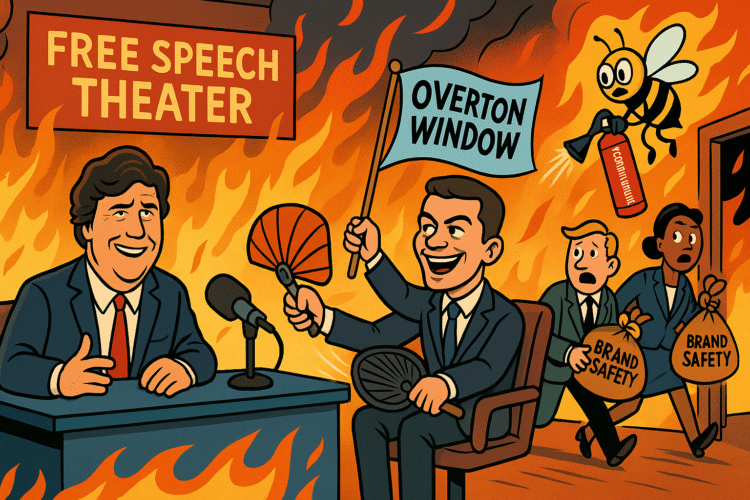
If there were ever a competition for “most predictable outrage cycle in American politics,” Tucker Carlson would have the trophy, the lifetime supply of microphones, and a commemorative mug reading I Platformed a Fascist and All I Got Was This Engagement Spike.
Because this week, Carlson gave airtime to Nick Fuentes, a man whose résumé reads like a Southern Poverty Law Center case study, and somehow the question wasn’t “Why?” but “What took him so long?”
The Setup: Carlson’s Algorithm of Outrage
Carlson teased the interview like a blockbuster. Days before release, his team dropped cryptic posts about “a conversation the media doesn’t want you to hear.” Translation: I am about to set myself on fire for clicks.
Then came the sit-down itself, a meandering therapy session in which Carlson played the role of faux-skeptical dad listening to his son explain why the Third Reich “wasn’t that bad if you think about GDP.” Fuentes, grinning with the smirk of someone who’s Googled “how to look moderate,” used the airtime to launder extremism through the soft filter of “free speech.”
And the internet, ever eager to oblige, made sure every word reached millions.
Within hours, clips flooded X, Rumble, Telegram, and every platform that pretends moderation is censorship. MAGA influencers called it “bravery.” Conservatives with careers to protect called it “idiocy.” Donors called their lawyers.
It wasn’t an interview. It was a stress test: how far can the movement stretch the moral floor before it cracks?
Who is Nick Fuentes, and Why Are We Pretending Not to Know?
For anyone who’s blissfully unaware, Nick Fuentes is not a “provocateur” or “controversial commentator.” He is a white nationalist whose “Groyper” movement was literally named after a meme of a smug frog too lazy for open fascism but too online to stop talking about “replacement theory.”
He attended the “Unite the Right” rally. He denied the Holocaust. He called for a “Catholic Taliban.” He was banned from multiple platforms for incitement. And yet, somehow, he keeps finding microphones eager to help him “reframe the narrative.”
Carlson, of course, knew all of this. You don’t stumble onto Fuentes like a lost hiker discovering quicksand. You invite him because you want to see who else is willing to drown.
The Fallout: Free Speech or Reputational Arson?
Within hours of the episode dropping, conservative outlets went into cardiac crisis mode.
The Washington Examiner ran a headline that read, “Carlson’s Fuentes Interview: Free Speech or Fatal Error?” The National Review called it “a new low in judgment.” Even a few Fox News alumni, now safely detached from Rupert Murdoch’s paychecks, used words like “disgusting” and “irresponsible.”
Republican strategists privately called it “reputational arson.” Donors called it “off-brand fascism.” Conference organizers called it “a scheduling conflict.”
And advertisers—those delicate moral barometers of the free market—began quietly withdrawing their buys. The phrase “brand safety” trended in corporate Slack channels faster than you could say “programmatic meltdown.”
It turns out that corporations will tolerate nearly anything except the phrase “race realism” uttered by a guest who once tried to get on the no-fly list for fun.
Timeline: From Teaser to Fallout in Record Time
Day 1: Carlson teases a “conversation you can’t find anywhere else,” proving once again that “nowhere else” usually means “for good reason.”
Day 2: The full interview drops. Fuentes spends ninety minutes laundering ideology while Carlson nods like he’s decoding the secrets of the universe.
Hour 3: Twitter melts. Rumble’s servers buckle under the weight of engagement farming. Conservative influencers tweet “bravery!” like they’re auditioning for a dystopian reality show called Cancel Me Harder.
Hour 6: GOP officials issue cautious statements about “rejecting hate” while avoiding Fuentes’ name like it’s Voldemort with a Wi-Fi password.
Day 3: Advertisers begin “reviewing commitments.” Translation: We’re leaving, but we’ll wait until Friday to avoid headlines.
Day 4: Civil rights groups issue statements cataloging Fuentes’ record. Jewish organizations remind the public that “mainstreaming hate” is not an abstract problem—it’s a policy incubator.
Day 5: Carlson claims victory. “If they’re mad, I must be doing something right,” he declares, mistaking outrage for relevance once again.
The Legal and Political Posture: Free Speech Theater
Every time Carlson gets called out, he retreats into the same rhetorical bunker: “It’s free speech.”
But here’s the problem. The First Amendment protects you from government censorship, not from advertisers, event organizers, or political consequences. Tucker isn’t Rosa Parks; he’s a private citizen on a private platform complaining that the mall won’t let him hold a fascism parade in the food court.
Platforms have rules. Party committees have standards. Donors have spreadsheets. And suburban swing voters—the people who decide elections—have Google.
The GOP knows this. That’s why campaign strategists panicked. The last thing a vulnerable House candidate in Michigan needs is an opponent’s ad quoting their favorite pundit flirting with Holocaust denial.
As one strategist told Politico, “Every time he opens his mouth, we lose a county.”
But that’s the paradox of modern conservatism: the louder the base cheers, the smaller the tent gets.
The MAGA Reaction: “Overton Window Shift” as Lifestyle
Meanwhile, Carlson’s loyal fan base declared victory.
Pro-Trump media personalities praised the interview as a “red pill moment.” They called Fuentes “young,” “brave,” and “unfiltered.” One podcast host said, “He’s just saying what everyone thinks.” Everyone, in this case, being a very specific subset of Telegram chat moderators.
The Overton window, they claim, is shifting. In reality, it’s just cracking under the weight of its own delusion.
Because here’s the thing: there is no strategic genius in amplifying hate. There’s only entropy. The right’s media ecosystem has become an attention black hole—where extremism isn’t the edge, it’s the currency.
Carlson doesn’t need to persuade anyone anymore. He just needs to outrage them enough to subscribe.
The GOP’s Split Personality Disorder
On one side: Carlson, Fuentes, and the culture war crowd, obsessed with “owning the libs” even if it means torching their own coalition.
On the other: the institutional GOP, still pretending it’s a party of ideas rather than a crisis communications firm for chaos.
The donors, consultants, and Hill operatives are trapped in what one aide called “the Tucker Triangle”—too afraid to denounce, too cynical to endorse, and too exhausted to explain why this keeps happening.
House and Senate campaign committees are quietly drafting memos warning candidates not to share or quote the interview. Party lawyers are reviewing the “coordination” implications if any campaign account retweets it.
And yet, the fear persists: say nothing, and you look complicit. Say something, and the base calls you a traitor.
It’s not a big tent. It’s a hostage situation.
Civil Rights Groups: Receipts, Not Reactions
The watchdogs wasted no time. The Anti-Defamation League, the Southern Poverty Law Center, and Jewish organizations immediately issued detailed reminders of Fuentes’ record.
They didn’t editorialize. They just listed quotes, dates, and events.
It’s remarkable how short the debate becomes when you show receipts.
Fuentes called for a “white America.” He mocked interracial marriage. He blamed Jews for the Holocaust and women for feminism. He was denied entry to multiple countries for incitement.
That’s not “controversial.” That’s documented extremism.
The ADL’s statement was pointed: “When influential voices normalize hate, violence follows. This isn’t about free speech; it’s about civic decay.”
But their words barely made cable coverage. After all, hate sells more ads than nuance.
The Donor Class: Silent but Calculating
Behind the scenes, the Republican donor network began to panic.
Super PACs that had bankrolled conservative media ventures suddenly found themselves fielding calls from corporate boards. “What’s your stance on Fuentes?” became the question of the week.
Conference organizers rescinded invitations. Ad networks paused inventory. Even crypto sponsors—those human avatars of volatility—decided this was a bridge too far.
By the end of the week, Carlson’s team was downplaying the backlash as “predictable noise.” But the money was already moving. In politics, outrage drives small donors; stability keeps the big ones. Tucker just picked the wrong fuel.
Platform Moderation: The Dance of Denial
Meanwhile, social media companies did their usual tango.
X (formerly Twitter) flagged clips for “context.” YouTube demonetized reaction videos but left reposts intact “for newsworthiness.” Rumble’s moderation team issued a statement promising to “balance expression with safety,” which is corporate code for “we like the clicks too much to stop.”
The platforms know Carlson is a ratings machine. They also know hosting extremists invites regulatory scrutiny. So they do what they always do: pretend neutrality while selling ads between atrocities.
The irony, of course, is that free speech absolutists like Carlson depend entirely on private companies choosing to host them. The moment they’re deplatformed, they cry tyranny, not irony.
The Cultural Cost: When the Window Becomes the Wall
Every cycle of outrage leaves the public a little more numb. What once disqualified candidates now barely dents their poll numbers. What once got pundits fired now gets them podcast deals.
Carlson’s interview wasn’t just a scandal. It was a normalization ritual. It tested how much hate could be repackaged as discourse before anyone flinched.
And the result was grim: fewer flinches, more shrugs.
The Overton window isn’t expanding; it’s dissolving. The wall between mainstream and fringe has been replaced by an algorithmic recommendation feed. The line between journalist and propagandist is now an engagement metric.
It’s not that we’ve stopped recognizing extremism. It’s that outrage fatigue has made it background noise.
The Accountability Vacuum
The question now is whether anyone with power will do more than tweet disapproval.
Republican leadership could issue formal guidance barring campaigns from associating with Fuentes or his affiliates. Donors could codify “no buy” clauses for outlets that normalize hate. Platforms could enforce their own policies instead of writing white papers about them.
But will they? History suggests otherwise.
The GOP spent years flirting with extremism because it paid. Every “own the libs” soundbite bought another quarter’s fundraising bump. Every fringe voice invited in the name of “diversity of thought” became a future liability.
Now, the bill is due, and Tucker Carlson is holding the receipt in one hand and a flamethrower in the other.
What Comes Next
In the coming weeks, the story will splinter into smaller headlines: advertiser withdrawals, canceled appearances, legal filings, more “debate” panels about free speech. Each will treat the symptom while ignoring the disease.
But the real stakes are simpler.
If Carlson can platform an avowed white nationalist and still be called a “serious journalist,” then the bar for what qualifies as extremism has collapsed. The right’s media ecosystem is no longer debating ideas; it’s testing the market price of moral corrosion.
And the rest of the country, weary and half-scrolled through, may not notice until the damage calcifies into normalcy.
Closing Section: The Ratings of Wrath
Tucker Carlson once told an audience that journalism is about “telling the truth no one else will.” It sounded noble until you realized the “truth” in question was a conspiracy buffet garnished with white nationalism.
Free speech isn’t supposed to be a fire sale for decency. It’s a principle rooted in civic responsibility, not nihilism. But Carlson has built a career mistaking provocation for courage.
Fuentes didn’t need mainstream validation; he needed distribution. Carlson handed it to him on a silver platter and called it bravery.
The interview wasn’t journalism—it was a confession. It revealed a movement so addicted to outrage that it can no longer tell the difference between dissent and decay.
And when future historians trace how the American right normalized the unthinkable, they’ll find this moment preserved like amber: Tucker Carlson, leaning forward into the mic, nodding sagely at a white nationalist, pretending it was a conversation about freedom.
Meanwhile, the rest of us are left with the real question—how many times do we have to watch this cycle before we admit the outrage is the business model, and the business is good?