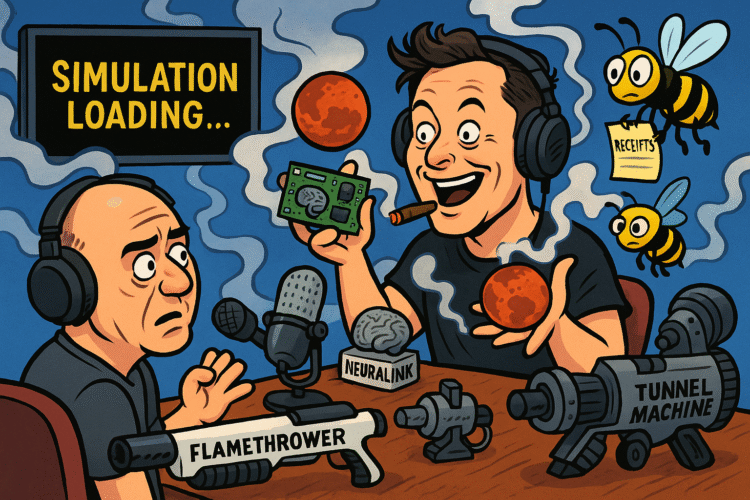
There are two kinds of people in this world: those who think Elon Musk is the next Da Vinci, and those who think he’s the world’s most expensive Reddit thread. After three hours on The Joe Rogan Experience, you can be forgiven for believing he’s both.
Because when Musk starts talking, time stops being linear. He begins with a story about selling 20,000 flamethrowers as a joke fundraiser, veers into colonizing Mars to “back up civilization,” warns that AI is “the demon you don’t want to summon,” and somehow lands on Neuralink drilling holes in skulls because, in his words, “we’re already cyborgs.” It’s like watching a TED Talk get drunk and forget its slide order.
The latest Rogan appearance reminded everyone of one essential truth: Musk doesn’t do interviews. He does three-hour improv sessions where the punchlines are venture capital valuations.
The Gospel According to Elon
Let’s start with the flamethrower.
In 2018, Musk announced a product called “Not a Flamethrower.” The Boring Company, his tunneling startup, sold 20,000 units at $500 each, raising $10 million for what was ostensibly an infrastructure project but looked more like a postmodern art prank. He said it was a fundraiser “to help end traffic by going 3D underground.”
That’s right: the man who wants to colonize Mars began his public works empire by arming tech bros with weapons that could toast a marshmallow at six feet.
On Rogan’s show, Musk reminisced about it fondly. “We sold them all in four days,” he said, with the same tone your uncle uses to brag about buying Bitcoin in 2011. He framed it as proof that the public loves fun engineering. But it also hinted at something deeper—his knack for turning irony into revenue. It wasn’t a flamethrower, it was performance capitalism.
The Boring Company’s grand plan, meanwhile, was to revolutionize urban transport by going underground. Musk promised to “end traffic forever” through a network of tunnels small enough for Teslas and big enough for fantasy. The first prototype, the 1.14-mile Hawthorne tunnel, had a 12-foot diameter, cost roughly $10 million, and ran beneath the SpaceX parking lot. It was less “transportation revolution” and more “underground Tesla joyride.”
Critics noted that bus rapid transit could move more people for less money. Musk shrugged. “Buses suck.”
And that’s the charm, or the danger, depending on your taste for hubris. Musk talks like a man allergic to limits. He doesn’t want to improve public systems; he wants to replace them with smaller, sexier versions he can own.
The Demon in the Machine
Then came the AI sermon.
“I tried to warn them,” Musk told Rogan, eyes wide, voice dipping into apocalypse mode. “Artificial intelligence is like summoning the demon.”
This from a man who simultaneously founded OpenAI (before quitting and declaring it dangerous), co-founded Neuralink, and routinely sells the future as a half-exorcism, half-Ponzi scheme.
Neuralink, his brain-computer interface company, is supposed to protect us from AI by merging us with it. “If you can’t beat the machines,” Musk said, “join them.”
At one point, he described the Neuralink implant as “a neural lace that allows direct brain-to-computer communication,” boasting of thousands of microthreads thinner than a human hair. Early animal trials involved macaques playing Pong with their minds—a feat impressive enough to awe engineers and unsettle ethicists.
The company now touts its first human trial, authorized under strict FDA investigational device rules, though details remain vague. On paper, it’s about curing paralysis. In Musk’s mouth, it becomes a prophecy. “Eventually,” he said, “you could replay memories.”
If that sentence doesn’t make your spine twitch, congratulations—you’re ready for the dystopian future.
Critics call it techno-spiritualism, the faith that coding can redeem the soul. But Musk sells it as salvation through firmware. The irony is that his supposed fear of AI has created the most literal pathway to artificial consciousness humanity has ever attempted. It’s a horror story disguised as a startup pitch.
The Reality Simulation and the Martian Backup
Halfway through the interview, Musk pivoted to metaphysics. “We’re probably living in a simulation,” he said, taking a slow drag from the joint Rogan handed him. “If civilization keeps improving, there’s likely to be many simulations, so the odds we’re base reality are low.”
Rogan blinked. Twitter imploded. NASA sighed.
Moments later, Musk added that it was humanity’s moral duty to colonize Mars. “Civilizations need off-site backups,” he said. “If something happens on Earth, we need a second seed of consciousness.”
Imagine explaining to your landlord that you can’t pay rent because your consciousness is currently being uploaded to Mars.
The Mars pitch has always been Musk’s personal religion. He paints the planet as a redemptive Ark—an escape hatch for human error. But it’s telling that his plan for saving civilization starts by leaving it. For all the talk of innovation, his instinct is always to build exits, not repairs.
And yet, fans call him a visionary. They quote him the way ancient Romans quoted their emperors: with equal parts awe and fear.
The Machine That Builds the Machine
Of course, none of this would matter if Musk’s terrestrial projects ran as smoothly as his cosmic fantasies. But the receipts tell another story.
When Tesla was scaling up the Model 3, Musk promised an automated factory so advanced he called it “the machine that builds the machine.” What emerged was a chaotic hybrid of robots and exhausted humans working 12-hour shifts under fluorescent light.
He slept on the factory floor, called it “sacrifice,” and told investors it proved his commitment. Workers called it unsafe. Reports described bottlenecks, injuries, and missed production targets. But the narrative never changed—Musk was building the future, one recall at a time.
By 2023, Tesla’s recall count surpassed 2 million vehicles, mostly for software fixes that arrived via Wi-Fi. He framed that as progress too. “Other automakers can’t fix cars over the air,” he said.
Translation: our defects are futuristic.
And yet, despite the chaos, Tesla remains the world’s most valuable automaker. Investors worship volatility as vision. They see each meltdown as a feature, not a bug. Musk doesn’t defy gravity; he monetizes it.
The Pot Puff Heard Around the Market
No Musk retrospective would be complete without the joint.
During that first Rogan episode, in 2018, Musk took a puff of marijuana on camera. The next day, Tesla stock dropped nine percent, the Air Force reviewed his SpaceX security clearance, and the SEC sighed so loudly you could hear it from orbit.
It wasn’t about the weed—it was about optics. The richest man in tech had turned the world’s most watched podcast into a performance art piece about corporate anxiety.
The SEC’s lawyers likely spent that night drafting memos titled “Jesus Christ, Not Again.”
But the stunt also crystallized Musk’s appeal: a billionaire who looks like he’s daring regulators to stop him. He brands impulsiveness as authenticity, chaos as courage. He is, in a sense, the world’s first influencer-CEO. Every tweet, every puff, every impulsive promise is both market signal and confession.
Supersonic Daydreams
Somewhere between neural lace and Mars colonies, Musk pitched Rogan another idea: supersonic electric vertical takeoff and landing jets.
“They’d be quiet, fast, zero emissions,” he said, sketching invisible wings in the air. “Kind of like if Top Gun met sustainable aviation.”
The problem, of course, is physics. Batteries still lack the energy density to sustain such flight, not to mention the cost, noise, and airspace issues. It’s not a plan—it’s an aesthetic.
Musk doesn’t brainstorm; he mythologizes. Each idea sounds like a hallucination funded by venture debt. He’s not designing systems—he’s producing memes that happen to involve infrastructure.
It’s why his fans believe he can do anything, and his critics wonder if he ever finishes anything.
From Hype to Regulation
The chaos that follows him isn’t random; it’s structural.
The SEC scrutinizes his tweets because each one can move markets. In 2018, his “funding secured” post about taking Tesla private triggered a $40 million settlement and years of oversight.
The FDA and USDA oversee Neuralink, which has already faced internal whistleblowers over animal welfare violations during primate tests.
The NHTSA continues investigating Tesla’s Autopilot crashes, with fatalities linked to system misuse and overpromising.
The FAA still has to certify SpaceX’s Starship launches after repeated explosions and debris fields that have local residents posting videos titled “Rain of Fire Over Boca Chica.”
Even the Boring Company faces municipal battles over permits, noise, and procurement transparency. One Vegas project was supposed to carry thousands of passengers per hour. It currently moves hundreds, and mostly tourists.
In every arena, the pattern is the same: overpromise, underregulate, deflect.
The Cult of the Billion-Dollar Mouth
To Musk’s defenders, all this chaos is proof of genius. “He’s a doer,” they say. “He moves fast.”
But moving fast isn’t the same as moving forward. It’s more like spinning a roulette wheel of technology until the odds hit PR jackpot.
What makes Musk unique isn’t that he’s wrong—it’s that he’s rewarded for it. When he misses deadlines, stock prices rise. When he alienates regulators, investors double down. When he tweets at midnight about Dogecoin, the internet treats it like scripture.
He’s turned uncertainty into currency.
That’s why the Rogan interview mattered less for what he said than for what it symbolized: the total merger of personality and platform. When Musk speaks, markets move. The man has become an asset class.
And like any asset, he’s volatile by design.
The Vibe Industrial Complex
Part of the problem is media complicity. Every outlet covers Musk like a weather event: unstoppable, fascinating, occasionally catastrophic. His words are treated as forecasts, not symptoms.
“Visionary CEO Predicts Future of Humanity” reads better than “Guy Who Overworked Factory Now Thinks Reality Is a Simulation.”
But the vibe is the story. The spectacle replaces scrutiny. If Musk says Neuralink will cure paralysis, headlines echo it. When it doesn’t, silence.
The Boring Company’s Vegas tunnel? Still a glorified car loop. Neuralink’s “telepathic typing”? Still lab-bound. Tesla’s “Full Self-Driving”? Still not full or self-driving.
Yet Musk’s myth persists because failure never lands on him—it disperses through the ecosystem. Engineers take the blame, workers absorb the stress, and investors reframe disappointment as iteration.
The result is a culture where accountability is optional if your promises are loud enough.
Fans, Critics, and the Billionaire Messiah Problem
To his fans, Musk represents liberation from bureaucracy. To his critics, he embodies its replacement: private absolutism.
He sells rebellion as a subscription service. He tells working people that government sucks, then privatizes the services government was meant to provide. Electric cars instead of transit, tunnels instead of trains, space tourism instead of climate policy.
It’s a politics disguised as progress, one where regulation is the villain and innovation is always the excuse.
But the punchline is crueler: every Musk company depends on government contracts, tax credits, and subsidies. He rails against the state even as it bankrolls him. He’s not dismantling the system. He’s feeding on it.
And yet, his supporters see him as a self-made pioneer. They quote his aphorisms about risk and failure, ignoring that his safety net is woven from public money and stock options.
That’s the genius of Muskism—it’s capitalism pretending to be revolution.
What Happens Next
The next year will test whether Musk’s hype finally meets gravity.
Neuralink’s first human trial will reveal whether the implant works beyond YouTube demos. Regulators are watching for brain injuries, data integrity issues, and post-operative complications. The stakes are existential—for both patients and investors.
The Boring Company must prove it can move more people per hour than a Vegas shuttle bus. Its proposed Austin and San Antonio corridors face environmental review and cost blowouts.
Tesla’s global factories are scaling output while recalls and NHTSA investigations pile up. “Quality is improving,” Musk insists, but numbers tell another story: nearly 3,000 complaints filed in 2024 about braking and steering anomalies.
And through it all, Musk keeps tweeting, now through X, his rebranded vanity project masquerading as free speech utopia.
Every post remains a market event. Every contradiction becomes content.
He is both the richest man alive and the most expensive algorithm in human history.
Closing Section: Between Myth and Machine
In the end, the Rogan episode was never really about innovation. It was about performance—the constant, looping monologue of a man who can’t stop narrating his own legend.
He wants to save humanity but can’t manage a factory shift. He warns about AI while building it. He preaches transparency while suing regulators. He sells flamethrowers to fund tunnels no one needs, implants to fight machines he created, rockets to escape the planet he’s actively making worse.
It’s not futurism. It’s ego with a business plan.
If the UK can strip a prince of his title, maybe America should consider revoking billionaire sainthood. Musk isn’t a villain or a hero. He’s an economy built on vibes, where sincerity is optional and spectacle is policy.
The true innovation isn’t in rockets or robots—it’s in convincing millions that ambition excuses everything.
When historians look back, they won’t ask whether Neuralink changed the brain or Tesla changed the grid. They’ll ask how one man convinced the world that chaos was genius, that volatility was vision, that every contradiction was proof of depth.
And maybe, buried in a Mars archive centuries from now, an old Neuralink prototype will whisper the answer into the void:
He didn’t build the future. He built a simulation of one.