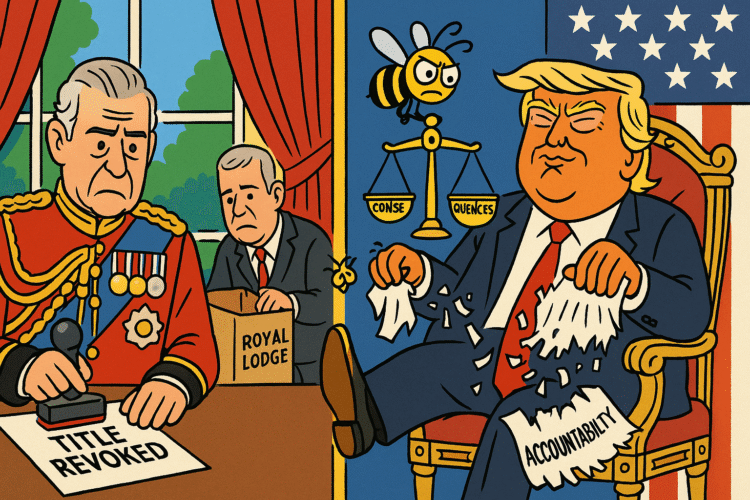
Somewhere in the foggy precincts of Britain’s class system, King Charles III just did something extraordinary: he looked his brother in the face, stared into the abyss of Jeffrey Epstein’s fallout, and said, “Not in my house.”
And then, with the unhurried precision of a man pruning a diseased branch, he cut.
Prince Andrew, Duke of York, Knight of the Garter, Royal Navy veteran, and the human embodiment of “bad optics,” is no longer a prince. As of this week, he’s just Andrew Mountbatten-Windsor, soon to be the world’s most awkward tenant relocation case.
The royal family, that ancient institution built on denial, pomp, and the national pastime of pretending it’s fine, finally found the one line it couldn’t spin.
And honestly, America should be taking notes.
The Royal Guillotine
Let’s be clear: Charles didn’t need a parliamentary act, a committee report, or a 67-page ethics finding. He didn’t even need to send a sternly worded letter to a Select Committee. He used what the British call “royal prerogative,” which sounds fancy but mostly translates to “Dad says no.”
Buckingham Palace invoked it this week in a rare, unvarnished statement confirming Andrew’s complete removal from the institution: titles stripped, honours revoked, lease notice served on Royal Lodge, and a rebrand that turns “His Royal Highness” into “That Guy from the Epstein Documentary.”
It’s the kind of swift, surgical accountability you only get in systems where the crown doesn’t need to count votes before cleaning its own house.
And while the UK’s tabloid establishment gasps into its Earl Grey, one question echoes across the Atlantic:
If the British monarchy can strip a literal prince of his title for cozying up to Epstein, why is America still bowing to a man who called Epstein a “terrific guy” and built a political movement on vibes and vengeance?
The Timeline of a Fall
The palace didn’t stumble into this. It was a carefully orchestrated public exorcism.
It began on October 17, when Andrew agreed to “cease the use” of his peerages and knighthoods. A polite way of saying, “You’re out, but we’ll let you keep the stationery for now.”
By October 30, the gloves came off. Buckingham Palace briefed trusted outlets that the King had approved a full revocation process. The statement confirmed three things:
- Andrew will no longer hold or use the title “Prince.”
- His remaining honours and styles will be rescinded.
- The lease on his royal residence, Royal Lodge, will be surrendered.
Translation: you don’t get to keep the castle if you’re the scandal.
By November, logistical teams are already scheduling his move, reissuing armorial bearings, and stripping royal insignia from uniforms and ceremonial materials. The College of Arms, which handles coats of arms and heraldic design, has reportedly been consulted to reclassify his personal crest under private citizenship.
That’s how you know it’s over. When even the embroidered monogram on your bathrobe gets canceled.
The Legal and Ceremonial Machinery of Shame
Britain loves its rituals, even in disgrace. Every aspect of Andrew’s un-princing has been handled through centuries-old ceremonial channels:
- Royal Prerogative: The monarch’s constitutional right to grant or revoke titles, exercised without ministerial interference. The same mechanism that can declare war can also declare, “You don’t get to be a prince anymore.”
- College of Arms: The heraldic body now tasked with erasing his HRH insignia from official registers, reassigning him as a private citizen.
- Orders and Chapters: Knighthoods, decorations, and medals go next. Every order of chivalry from the Garter to the Thistle operates under the monarch’s discretion. Andrew’s will quietly disappear from the rolls like a deleted LinkedIn endorsement.
- Military Precedence: Already suspended since 2022, but now formalized. No more honorary admiralships or fancy uniforms. Just a suit and the uncomfortable weight of civilian life.
It’s a constitutional exorcism by paperwork, an ancient bureaucracy reclaiming its dignity one embossed seal at a time.
And somehow, it’s still more moral clarity than the United States Congress has managed after eight years of Trump.
Meanwhile, in America: The Art of Getting Away With It
Across the pond, the man who palled around with Epstein, held fundraisers at Mar-a-Lago, and flirted with the idea of pardoning his co-conspirators is gearing up for another run at the presidency.
Donald Trump’s social media posts read like a fever dream written by a gold-plated fax machine. He’s calling for political purges, promising to weaponize the Department of Justice against comedians, and bragging about “terminating Democrat programs” during a shutdown that he engineered for sport.
And the reaction from America’s institutions? A shrug.
The same country that will investigate a minor cabinet official for misusing a government printer won’t muster the courage to bar a man who incited an insurrection from running again.
The British monarchy just performed a moral housecleaning with better optics and more spine than the American republic supposedly built on accountability.
Let that sink in.
The Epstein Thread That Never Snaps
This isn’t just about Andrew’s royal downfall. It’s about the connective tissue between power, privilege, and immunity.
The Epstein scandal didn’t just expose a predator’s network. It revealed how elite institutions respond when their own are implicated. They stall, deny, and negotiate the damage down to something manageable.
Except now, at least in the UK, someone finally decided the “manage” part wasn’t enough.
King Charles didn’t wait for a Netflix docuseries to trend. He acted to protect the institution. Not out of altruism, but survival instinct. The monarchy’s credibility depends on pretending that its shame is surgical, not systemic.
In America, that instinct doesn’t exist.
Our powerful men survive scandal by tweeting through it. They fundraise off indictments, claim martyrdom on cable news, and hold rallies where their base cheers not for innocence, but for audacity.
Trump doesn’t need to be cleared. He just needs to be louder.
Prince Andrew got stripped of his title. Trump gets a speaking slot at CPAC.
The Optics of Consequence
Let’s talk about optics, because politics is nothing but theater now.
In Britain, Buckingham Palace released its October statement with the restraint of a scalpel. No adjectives. No spin. Just facts and finality. The institution moved on.
In America, every Trump scandal arrives with a Netflix docuseries trailer, a merch drop, and a three-day cable debate about whether consequences are divisive.
The U.S. doesn’t lack the tools to hold him accountable. It lacks the will to use them.
Section 3 of the 14th Amendment literally bars insurrectionists from office. Emoluments clauses exist for a reason. Campaign finance laws, tax fraud statutes, obstruction charges—they’re not decorative.
But America has a unique affliction: an allergic reaction to enforcement when power wears a red tie and a golf handicap.
The British monarchy said, “We cannot have this man representing us.”
The U.S. political class says, “We can’t alienate his voters.”
Victims, Advocates, and the Price of Silence
Back in the UK, survivors’ advocates have called Andrew’s demotion “a long overdue step toward institutional honesty.” Royal biographers describe it as “the only path left.” And the press—normally a pit of deferential euphemisms—finally dropped the velvet gloves.
Andrew’s camp, predictably, insists that his 2022 settlement with Virginia Giuffre was “not an admission.” Yet he’s losing not just titles, but allies. His remaining defenders are dwindling faster than his leases.
Meanwhile, the American right still defends Trump as a victim of persecution. The MAGA movement’s relationship with scandal isn’t damage control. It’s content. Every felony becomes a bumper sticker. Every court date becomes a campaign event.
And in the process, America has normalized what the rest of the world still calls corruption.
A Tale of Two Institutions
Here’s the contrast in one sentence:
The monarchy just stripped a prince to save its legitimacy. The American republic is letting a felon run to test its fragility.
King Charles did what American institutions refuse to do: enforce consequences at the top. Not because it’s easy, but because legitimacy is finite.
If a king can protect an unelected monarchy by purging its rot, why can’t a democracy protect itself from its own?
The Irony of Republican Royalists
The irony, of course, is that many of Trump’s loudest defenders are self-styled anti-monarchists. They love to sneer about the “British nanny state.” Yet they worship a man who lives like a gilded despot, punishes dissent, and demands loyalty oaths like a Game of Thrones side character.
Trump isn’t an outsider. He’s the loud American cousin of every privileged aristocrat who ever assumed the rules didn’t apply to him.
King Charles may be a monarch, but at least he remembered that power comes with upkeep.
Trump, meanwhile, treats accountability like an optional subscription service he forgot to pay for.
The Near-Term Checkpoints
The palace still has paperwork to file. Armorial revisions will be published in the next round of the London Gazette. The College of Arms will formalize Andrew’s new styling as a private citizen. Lease deadlines at Royal Lodge are set for review next quarter. And biographers are already sharpening their quills for a new chapter titled Exile in Windsor.
In America, the near-term checkpoints are depressingly predictable: a rally, a subpoena, another Truth Social rant about “witch hunts.” The machinery of consequence turns slowly when it turns at all.
But history is watching both systems closely. Britain is proving that even the oldest institutions can evolve when pressed. America, meanwhile, risks proving that its Constitution is more decorative than functional.
Closing Section: “The Prince and the Pretender”
In the end, Andrew’s fall is not a royal scandal. It’s a cultural mirror. It shows what accountability looks like when the institution itself decides it has limits.
Charles wasn’t being brave. He was being pragmatic. But in the world of power, pragmatism is the rarest virtue left.
America doesn’t need a king. It needs a spine.
If a hereditary monarchy can expel a brother to protect its legitimacy, surely a self-proclaimed democracy can hold a former president accountable for crimes against the state.
Otherwise, the difference between the two nations isn’t history. It’s honesty.
At least in Britain, when someone falls from grace, they lose the castle too.
Here, they just build another golf course.