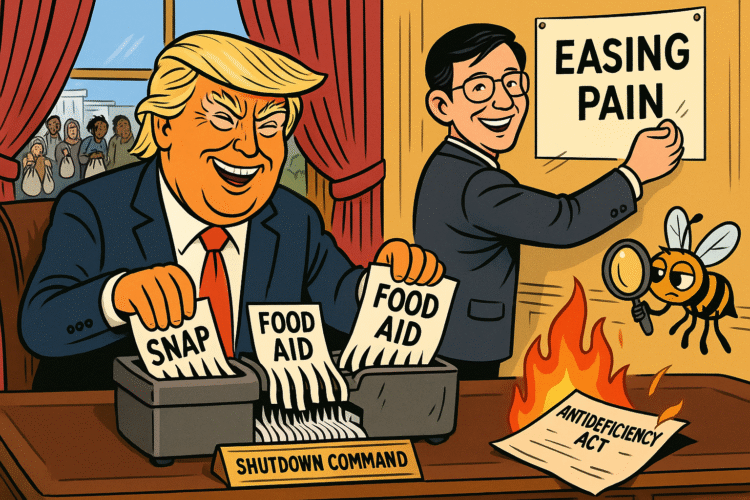
By now, Americans should know better than to mistake cruelty for incompetence. But here we are again, watching a government shutdown framed as bureaucratic “discipline” when it’s really just budgetary arson disguised as fiscal virtue.
The Bulwark’s analysis this week pulled the curtain all the way back. Speaker Mike Johnson, playing the human air freshener to Trump’s decay, insists that the administration is “easing shutdown pain.” He says this while Donald Trump gleefully posts on Truth Social about “cutting Democrat programs” and “terminating” the Gateway Tunnel project connecting New York and New Jersey—an infrastructure plan that has been years in the making, employing thousands. In Trump’s America, pain isn’t collateral. It’s the point.
And if you listen closely, you can hear the applause. Not from the working class, not from the military families or SNAP recipients or civil servants now raiding their savings—but from the donor suites that see human suffering as a market correction.
The Weaponization of a Shutdown
Historically, government shutdowns were political standoffs—painful but unplanned, consequences of brinkmanship rather than deliberate cruelty. This one is different. This one has been built like a policy instrument.
From day one, the messaging was clear. Trump and Speaker Johnson framed the shutdown not as a crisis, but as a “realignment.” Johnson took the microphone at his first Hill briefing and said, “The president is managing this responsibly, ensuring minimal pain.” Within hours, Trump contradicted him on Truth Social:
“We’re finally CUTTING the Democrat handouts. No more blue state tunnels. No more food welfare for the lazy. This is real leadership!”
It’s almost artful—the contradiction is the plan. Johnson plays the choirboy while Trump smashes the organ and calls it music.
The Blueprint for Harm
The Bulwark’s investigation outlined how the White House crafted a shutdown strategy that would inflict maximum political discomfort on blue-state populations while sparing red constituencies. It’s a governance model that treats federal spending as partisan therapy: reward your friends, starve your enemies, call it patriotism.
Let’s review the timeline.
Day One: The Office of Management and Budget distributed talking points to agencies urging them to “prioritize national security and essential operations.” Translation: pay the military, freeze the poor.
Day Three: USDA suspended new SNAP allotments but refused to tap the contingency reserves—billions Congress had explicitly authorized for precisely this situation. The justification? “Administrative prudence.” The subtext? Hunger as leverage.
Day Seven: The Department of Transportation froze funding for all “non-critical” infrastructure projects. Within hours, Trump bragged at a rally in Florida that the “Gateway boondoggle” was dead. “Why should hardworking Americans in Texas and Florida pay for some New York subway for Democrats?” he shouted to roaring applause. The crowd cheered their own alienation.
Day Fifteen: Facing backlash over troops going unpaid, the White House ordered the Pentagon to “find the money.” Officials did so by raiding unrelated accounts, diverting maintenance and procurement funds. That move—legally dubious under the Antideficiency Act—ensured soldiers got their checks while the rest of the country got a civics lesson in selective compassion.
Day Twenty: Twenty-five Democratic-led states and the District of Columbia sued USDA Secretary Brooke Rollins, arguing the refusal to release contingency funds violated the Food and Nutrition Act and the Administrative Procedure Act. The case landed in Boston federal court before Judge Indira Talwani, the same jurist overseeing other shutdown fallout cases. The plaintiffs seek a temporary restraining order to force USDA to disburse the funds.
By then, more than 40 million Americans faced disruptions in food benefits. Grocery stores began reporting SNAP transaction errors. Governors sounded alarms over stalled infrastructure and looming layoffs. Meanwhile, Speaker Johnson stood in front of cameras repeating, “The president is easing shutdown pain.”
The Law: A Primer in Selective Legality
The administration’s approach tests every seam in constitutional and administrative law.
Under the Antideficiency Act, federal agencies cannot spend money not appropriated by Congress. But the same law allows contingency funding for critical programs like SNAP when appropriations lapse. USDA’s refusal to use those reserves isn’t fiscal discipline—it’s an intentional policy choice designed to create pressure.
The lawsuit from the 25 states hinges on two statutes:
- The Food and Nutrition Act of 2008, which mandates that eligible households receive benefits “without interruption.”
- The Administrative Procedure Act (APA), which prohibits arbitrary and capricious administrative actions.
Both statutes were designed to prevent exactly this kind of political hostage-taking. The plaintiffs argue that USDA’s inaction constitutes both an abuse of discretion and a violation of statutory duty.
Add to that the separation of powers implications: Congress holds the purse, not the White House. By selectively redirecting military funds while withholding aid, Trump’s administration is effectively rewriting appropriations law by whim—an executive overreach masquerading as efficiency.
And let’s not forget the procurement and grant conditions that legally tether infrastructure funding to performance metrics and public benefit. Trump’s claim of “zero zoning conditions” on the canceled Gateway project wasn’t bravado—it was confession.
The Gospel of Pain
Trump’s language around the shutdown borders on theological. “You have to feel the pain to fix the country,” he told Fox Business. It’s the prosperity gospel’s evil twin: salvation through suffering, with the suffering outsourced to someone else.
In this worldview, the poor are props, the hungry are data points, and the military are stage extras in a patriotic pageant. Fiscal cruelty becomes moral purity.
Russ Vought, Trump’s former budget director and now architect of the shutdown playbook, called it “a once-in-a-generation opportunity to reshape the federal landscape.” Translation: dismantle the social safety net and blame Congress for the holes.
It’s no wonder Wall Street loves it. Markets surged on reports of “executive discipline.” Investors translated “mass layoffs and frozen aid” into “reduced government spending.” The Dow climbed 400 points on the day the SNAP lawsuit was filed.
The cruelty isn’t collateral—it’s bullish.
The Echo Chamber of Euphemism
The press, meanwhile, is doing what it does best: laundering intent through euphemism. Headlines speak of “shutdown strain” and “partisan impasse,” as though the pain were accidental. It’s not. It’s designed, targeted, and celebrated.
NBC’s chyron calls it “Budget Realignment Efforts.” The New York Times refers to “disruptions disproportionately affecting blue states.” CNN politely notes “administration reluctance to utilize contingency funds.”
No one wants to say it plainly: this is retribution by spreadsheet.
When a president weaponizes governance against his political enemies, that’s not policy—it’s persecution. When he brags about it on national television, it’s not strategy—it’s confession.
The Human Fallout
While the talking heads debate abstractions, the consequences are tangible.
In Massachusetts, food pantries report double the usual traffic. In Pennsylvania, child care centers funded through federal grants are shuttering. In California, road crews on federally supported infrastructure projects have been sent home.
Military families got their paychecks only after a Pentagon shell game. Meanwhile, civilians working at the same bases went unpaid.
In New York and New Jersey, the Gateway Tunnel—the project Trump calls “the Democrat subway”—faces a freeze that could cost thousands of construction jobs and billions in lost contracts. Local officials warn that terminating the project midstream could expose the federal government to massive breach-of-contract claims.
Yet Trump keeps boasting that he’s saving taxpayers money. By “money,” he means “campaign points.”
The Lawsuit: Boston Becomes the Frontline
The lawsuit filed by 25 states and D.C. in Boston federal court represents more than a budgetary fight—it’s a test of whether a president can intentionally magnify suffering for political gain.
Judge Indira Talwani, who has heard her share of high-profile cases, now faces a decision that could define executive limits. The plaintiffs argue that USDA’s refusal to deploy contingency funds is not just unlawful but inhumane. The government’s defense? “We’re exercising fiscal restraint.”
You could call it Orwellian if Orwell hadn’t already rolled over so many times in his grave that he’s now a renewable energy source.
If Talwani grants the temporary restraining order, USDA will be compelled to release billions in reserves, restoring food benefits to more than forty million Americans. If she denies it, those same Americans become pawns in a political chess game where starvation is a tactic.
The Cheerleaders of Collapse
Speaker Johnson continues to perform his part, repeating “easing pain” like a mantra while quietly applauding the strategy’s “efficiency.” He speaks about “discipline” as though withholding food from children were a spiritual exercise.
Trump, meanwhile, praises budget hawks like Russ Vought for using the “opportunity” to erase blue-state priorities. He posts images of himself smiling at Mar-a-Lago with captions like, “Winning the Shutdown!”
It’s the moral equivalent of an arsonist livestreaming a house fire while claiming he’s conducting a stress test.
The Markets Clap, the Country Coughs
Investors call it “streamlining.” Economists call it “austerity.” Historians will call it what it is: cruelty in a tailored suit.
The markets, predictably, rallied. “Investors like predictability,” CNBC reported, apparently forgetting that “predictable suffering” still counts as suffering. Hedge fund managers see opportunity where others see hunger.
Wall Street loves Trump’s shutdown for the same reason it loves deregulation and tax cuts: fewer rules, fewer responsibilities, fewer lines on the corporate expense sheet labeled “human cost.”
The Moral Vacuum at the Center of Power
Every administration reveals its soul by what it protects in crisis. This one protects defense contractors and donors. It starves the poor, halts construction, and calls it sovereignty.
The Antideficiency Act was meant to prevent executive overreach. Now it’s being used as a cudgel to punish opponents. Separation of powers wasn’t supposed to mean separation from humanity.
But that’s where we are—governed by men who see the state not as a public trust but as a personal grudge ledger.
The Spin Cycle of Suffering
By month’s end, we’ll see whether Judge Talwani issues an injunction. We’ll see whether the Government Accountability Office reviews the Pentagon’s reprogramming. We’ll see if Congress can muster the backbone to challenge the selective cruelty masquerading as “reform.”
But even if the courts intervene, the damage is done. The administration has set a precedent: that human misery can be rebranded as fiscal prudence, that compassion can be optional, and that cruelty, properly packaged, polls well.
This isn’t governance—it’s vandalism with PowerPoint slides.
Closing Section: The Gospel of Intent
Every empire has its tell. Rome had bread and circuses. America has Truth Social posts about cutting food stamps.
The cruelty is no longer hidden behind bureaucratic jargon—it’s live-streamed and hashtagged. It’s cheered on cable news and monetized in campaign emails. The message is simple: pain is patriotic, empathy is weakness, and suffering is just another data point in the march toward “efficiency.”
Speaker Johnson can keep insisting that the president is “easing shutdown pain.” Trump can keep boasting that he’s “terminating” tunnels and starving programs that feed the poor. But the rest of us know what’s happening.
This isn’t the easing of pain. It’s the engineering of it.
And until someone in power has the courage to say that out loud—to call the suffering not accidental but intentional—America will remain what it is right now: a country where hunger is a political choice and cruelty is a governing philosophy.