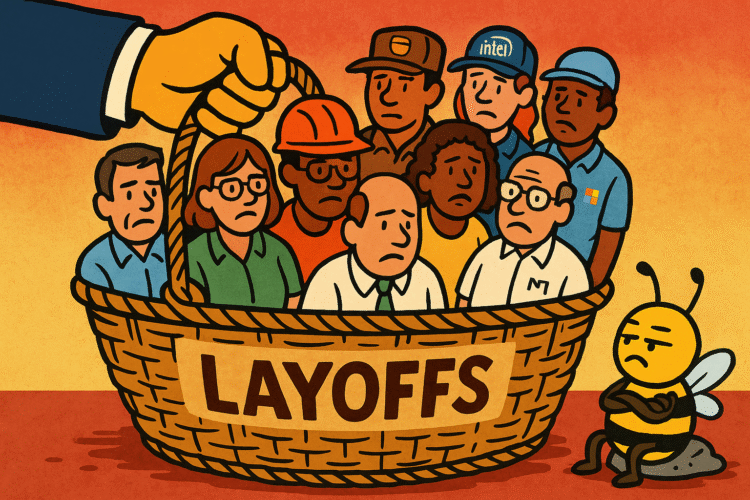
There’s an old rule in politics: if you can’t fix the problem, fire the statistician. And sure enough, President Trump has done exactly that, sacking the head of the Bureau of Labor Statistics for the crime of arithmetic. Because in this second-term economy, math itself has become subversive.
Without the Bureau’s honest numbers, the government can now say anything it wants about jobs. It can declare record employment while pink slips rain like confetti. It can tout “growth” while the middle class burns. It can claim “resilience” while American workers are quietly erased from the spreadsheets. The numbers aren’t down, you see, they’re just gone.
But the real economy is still visible to anyone with eyes. We have entered what historians may someday call The Golden Age of Layoffs: a radiant era where entire industries are pruned like bonsai trees, payrolls are turned into dividends, and the unemployment rate is buried with the evidence.
Trump, of course, calls it “efficiency.” Wall Street calls it “discipline.” Economists call it “market correction.” Everyone else just calls it what it is: being fired in the most profitable way possible.
The Numbers Don’t Lie (But They Might Be Fired for It)
Let’s build the ledger.
UPS has axed roughly 48,000 workers, citing “logistical realignment” and “strategic optimization,” which are corporate euphemisms for “we found cheaper humans somewhere else.” Amazon followed with 30,000 cuts, blaming “automation synergies” while installing more warehouse robots that don’t unionize, need bathroom breaks, or vote. Intel shed 24,000, calling it “streamlining for innovation.” Translation: fewer engineers, more consultants.
Nestlé downsized 16,000, which is rich for a company whose business model is literally feeding people. Accenture and Ford clocked in at 11,000 apiece, the former blaming “AI transformation” and the latter blaming “electric vehicle headwinds,” which sounds less like a reason and more like a curse. Novo Nordisk, now worth more than Denmark, cut 9,000 anyway, because apparently even miracle drugs can’t fund middle management.
Microsoft let go of 7,000 as part of its “AI-driven future,” PwC cut 5,600, Salesforce another 4,000, Paramount 2,000, Target 1,800, Kroger 1,000, Applied Materials 1,444, and Meta a modest 600, proving that even in Silicon Valley, layoffs can be boutique.
In total, 172,444 jobs have disappeared under what the White House calls a “strong market.” It’s an impressive number, if you ignore the lives behind it.
Every company delivered its bad news with the same pious tone: “This difficult decision will allow us to serve our customers and shareholders better.” Not workers, not families, not the people who built the company. Just shareholders.
The WARN Act and the Fine Print
Under the Worker Adjustment and Retraining Notification (WARN) Act, large employers are supposed to give 60 days’ notice before mass layoffs. In practice, that’s become a formality. Companies now send emails late on Fridays or deactivate badges by Monday morning. Some workers find out via chatbots. Others discover they’ve been “transitioned out” when their paychecks stop showing up.
A Ford engineer told a local reporter, “My job disappeared faster than the charger network.”
Unions have scrambled to keep up, but their resources are stretched thin. City councils are warning about tax-base collapses. State attorneys general are investigating whether layoffs have targeted older workers or those involved in union organizing. The NLRB is flooded with complaints about retaliation and coercion.
But the cruelty is administrative, not emotional. Every layoff is surrounded by nondisclosure agreements, severance conditions, and compliance choreography. You can sue, but only if you can afford it. You can talk, but only if you want to lose your benefits.
It’s the bureaucratic version of a mugging, complete with paperwork.
The Money Didn’t Disappear. It Migrated.
The pink slips are bad enough. What’s worse is where the money went.
UPS announced a five-billion-dollar stock buyback within weeks of its layoffs. Amazon’s board approved a ten-billion-dollar repurchase program while lobbying against warehouse safety regulations. Intel redirected billions in “restructuring savings” toward investor dividends. Ford’s CEO, meanwhile, got a 26 percent pay bump for “cost efficiency.”
At Microsoft, Satya Nadella reassured investors that “rightsizing our workforce allows us to pursue higher-margin opportunities.” Wall Street applauded. Salesforce handed fresh stock options to executives. Paramount issued a new dividend.
Every dollar saved on payroll has been converted into stock gains, bonuses, and dividends. The workers lose income, healthcare, and security, while shareholders gain equity. The ledger balances perfectly if you stop counting people.
The Legal Fiction of “Restructuring”
Every press release calls this a “restructuring.” It’s a word that has lost all meaning. Once upon a time, restructuring meant rescuing a company from collapse. Now it’s just an excuse to cut staff and boost EPS before the next quarterly earnings call.
Under Trump’s second term, corporate deregulation has turned layoffs into performance art. The administration’s new “Workforce Flexibility Initiative” quietly loosened reporting requirements under the WARN Act and removed enforcement teeth from several labor statutes. The Department of Labor now talks about “partnerships with industry leaders,” which is bureaucratic code for “you’re on your own.”
The result is a nation of at-will workers who can be dismissed with algorithmic precision and legally sanctioned silence. Severance packages come with non-disparagement clauses. Noncompetes remain enforceable in many states. And COBRA premiums can cost more than rent.
This isn’t incompetence. It’s design.
The Shutdown Economy
While millions are out of work, the federal government itself has been dark for weeks, trapped in a shutdown that feels more like a business model than an accident. Federal workers are furloughed. Contractors aren’t getting paid. Airports are understaffed. And the president, between campaign stops, is calling it proof of “lean government.”
Treasury officials are quietly rationing funds to avoid default. Food assistance programs are collapsing. Hospitals are bracing for gaps in federal reimbursements. But the Dow keeps rising, thanks to companies replacing salaries with share buybacks.
This is Trumponomics 2.0: shrink the public sector, privatize the pain, and call it patriotism.
The White House insists “the economy remains strong.” And maybe it is, if you define “economy” as “people who own stock.” For everyone else, it’s the Great Depression with better Wi-Fi.
Local Fallout
Los Angeles lost thousands of UPS and Amazon jobs, sending shockwaves through its logistics sector. In Phoenix, Intel’s downsizing gutted an entire service corridor. In El Paso, Denver, and Philadelphia, the ripple effects are visible in shuttered restaurants, empty storefronts, and desperate local governments.
City councils are scrambling to fill budget gaps. School districts are warning of lost funding. Food banks are reporting record lines. But on television, administration officials still point to “market confidence” and “strong fundamentals.”
They’ve mastered the art of describing disaster as data.
Wall Street Applauds
For Wall Street, this is the best of times. Every “headcount reduction” is greeted as a sign of fiscal maturity. Analysts call it “margin expansion.” CEOs are praised for “discipline.” Stocks jump five percent overnight.
The market doesn’t see people. It sees ratios. The fewer workers, the more efficient the machine. The more suffering, the stronger the signal.
When asked about the human cost, one analyst on Bloomberg shrugged. “You can’t fight gravity,” he said. As if gravity, not greed, were the culprit.
It’s not physics. It’s policy.
Political Theater, Economic Reality
In Trump’s Washington, the spectacle always comes first. He’s turned the economy into a reality show where every crisis is just another episode. “The layoffs are proof of strength,” he tells reporters. “We’re trimming the fat.”
What he’s really trimming is the evidence. By firing the Bureau of Labor Statistics chief, Trump has made sure the official jobless numbers never catch up to the reality on the ground. No independent verification, no accountability. The BLS used to be the scoreboard. Now the scoreboard’s been unplugged.
The president tweets that “job creation is booming,” while companies are busy deleting jobs like browser history. And since the press corps is too busy covering his insults to notice his policies, the lie stands unchallenged.
It’s the perfect scam: hide the numbers, declare victory, and call the critics “fake news.”
WARN Filings and Paper Trails
The truth still leaks through the cracks. WARN filings across states tell the real story. Thousands of layoffs logged week by week, each conveniently timed around quarterly reports.
Week 1: announce “restructuring.”
Week 2: file WARN notices.
Week 3: report “strong results despite headwinds.”
Week 4: announce buybacks.
Week 5: executives cash out.
By week 6, the headlines have moved on, and the workers have moved out.
Workers’ Rights, Shrinking Every Quarter
Unions are filing record numbers of unfair labor practice charges. State labor boards are backlogged. But the system was designed to exhaust, not protect. Employers know the rules, and they know how long enforcement takes.
Workers are told to “be patient” while their lives fall apart. Legal protections exist in theory, but in practice they’re ornamental. The Department of Labor is a shell, the NLRB is underfunded, and the courts are stocked with corporate sympathizers.
The playing field isn’t uneven. It’s vertical.
The Redistribution Nobody Mentions
The layoffs are just the visible symptom. The deeper sickness is the transfer of wealth they conceal. Every dollar “saved” on labor becomes a dollar redistributed upward.
Payroll shrinks, profit margins expand, and Wall Street cheers. It’s a seamless system of extraction: from workers to shareholders, from towns to tax havens, from the public to the private. And all of it is justified in the name of “efficiency.”
Executives frame it as “adapting to AI,” as if technology is forcing their hand. But the truth is simpler. Automation doesn’t eliminate work; it eliminates wages.
And the administration is happy to help.
The Coming Reckoning
A handful of state attorneys general are probing discriminatory layoffs. The NLRB is investigating union retaliation. A few lawsuits have been filed over WARN violations and severance abuses. But accountability moves slowly. The stock market moves fast.
There are more mergers on the horizon, more “synergy-driven” consolidations, more cost-cutting ahead of earnings season. And because the Bureau of Labor Statistics has been gutted, the real numbers will stay buried until after the damage is done.
The White House will call it success. Wall Street will call it discipline. The unemployed will call it Tuesday.
The Efficiency Gospel
Here’s the moral math of Trump’s second term. When 172,000 people lose their jobs, markets rise. When a president fires the statisticians, the unemployment rate magically improves. When a company “rightsizes,” executives triple their bonuses. It’s the theology of cruelty dressed up as competence.
This isn’t a free market. It’s a free-for-all. An economy where people are inefficiencies, laws are optional, and the truth itself is pink-slipped.
So yes, welcome to Trump’s Golden Age of Layoffs, where the only transparency left is in WARN filings, the only accountability left is silence, and the only jobs growing are the ones writing the press releases.
The Republic isn’t collapsing. It’s being “restructured for growth.” And if you listen closely, you can almost hear the new national anthem:
“Thank you for your service. Your position has been eliminated.”