Most voters back abortion rights, gun safety, paid leave, cheaper insulin, the Child Tax Credit, DACA, clean energy, and voting rights, yet a right-wing media machine keeps drowning them out on purpose.
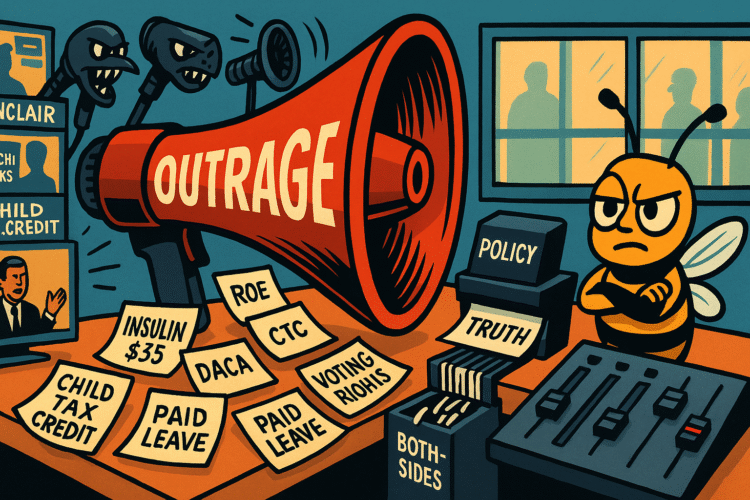
The Party With the Policies, the Party Without the Mic
I keep a small superstition on my desk, a notebook where I write the things we all agree on in poll after poll so I can remind myself I am not hallucinating. In it you’ll find everyday American preferences, not avant-garde manifestos: keep abortion legal with reasonable limits, protect contraception and IVF, make it harder for people who should not have a gun to get one, raise the federal minimum wage above a number that cannot buy breakfast, guarantee paid family leave like we live on the same planet as every peer economy, cover preexisting conditions without a scavenger hunt, let Medicare negotiate drug prices and cap insulin at something a human can pay, expand the Child Tax Credit that briefly sliced child poverty nearly in half, build clean energy here with the jobs attached, protect Dreamers and sketch a humane path to citizenship, and stop closing polling places like a hobby. The paradox is not hidden. The party that consistently backs these majority planks keeps getting out-narrated by a minority message machine that never stops talking.
Here is the most perverse part. You can read a good chunk of these planks straight out of the legal code or the last budget that passed. The National Instant Criminal Background Check System exists and could be enforced with the spine it deserves, alongside red-flag laws that let families and police intervene before a headline. The Affordable Care Act already outlaws preexisting condition denials, while recent reforms pushed Medicare to negotiate drug prices and set a thirty-five dollar insulin cap for seniors. The Inflation Reduction Act did not just say “climate,” it stapled tax credits to American manufacturing and told the market to build. The expanded Child Tax Credit was not a theory, it was a deposit, and for one bright season it lowered the temperature in millions of kitchens. On the voting front, the John R. Lewis Voting Rights Advancement Act stands ready to restore teeth to enforcement. And yet we are still trapped inside an attention economy where a policy that works is less marketable than a feud that trends.
If you want to understand why, you have to watch how narrative gets laundered. Start with the media architecture that calls itself neutral while behaving like a dam that only opens to one side. Cable primacy still belongs to networks that package outrage as programming strategy, and local television has been consolidated to the point where scripted segments can ride the 6 p.m. slot in dozens of markets at a time. Talk radio syndication fills the highways with a single note symphony. Platform algorithms do what they are engineered to do, reward friction, punish context, and dock points for nuance. Private equity bought local newsrooms because the numbers worked on a spreadsheet, then hollowed them until the only thing left was a logo and a skeleton crew. What used to be the Fourth Estate now often reads like a horse-race program describing policy as vibes and governance as optics, a glamorous way to avoid the work of telling people who benefits and who pays.
Into that ecosystem walks a Republican communications apparatus that has spent decades mastering repetition. Minority positions become majoritarian myths not because they are persuasive but because they are omnipresent. Court-shopping and gerrymanders translate into asymmetric power that tells a very tidy story: if you hold the mic, the minority feels like the center and the center starts to doubt itself. Dark-money networks pay for the stagecraft, selective leaks keep the oxygen on the right fires, and litigation moves the battlefield from public hearings to judge’s chambers where discovery never embarrasses anyone on television. Meanwhile, Democrats counter with a press release explaining an acronym, a coalition tweet about “stakeholders,” and the painful belief that a fact sheet is a narrative.
Let’s walk through the planks that ordinary people already favor, because the details matter and the pattern is the point. On reproductive freedom, majorities support the Roe framework and want contraception and IVF protected. That is not a coastal thing; it is a country thing, where people who do not want politicians in their bedrooms also do not want politicians in their ultrasounds. On gun policy, majorities back universal background checks, support closing loopholes that function like invitations, and accept red-flag provisions that temporarily remove firearms from those who are demonstrably dangerous. On wages and time, raising the federal minimum to something that can buy actual life has polled well for years, and paid family leave is as basic as gravity everywhere except inside certain committee rooms. On health, nobody wants to take an underwriting quiz after a diagnosis, and nobody wants to pay a thousand dollars for a medication that costs pennies to manufacture. The drug negotiation milestone and the insulin cap for seniors are not theoretical wins. They are receipts that clarify how pricing works when the government remembers who it serves.
Then there is the Child Tax Credit that flicked the lights on in so many households. A bump in the bank account is the opposite of a vibe; it is groceries, rent, gas to get to work, a co-pay that does not metastasize into debt. When that expansion expired, child poverty rose again because the math did what the math always does in a country that treats a tax credit as a moral hazard instead of a policy lever. Climate and jobs belong on the same line because that is how the law wrote them, clean-energy credits yoked to domestic production, a manufacturing revival in the only language capital hears, which is returns. DACA stability for people who have lived more American years than some senators have been in office is not controversial anywhere except in feeds calibrated to be. A humane path to citizenship has always polled better than the rhetoric suggests because voters understand what a neighbor is when they see one. And voting rights enforcement is not a fever dream. It is a repair of a system that we know how to operate but have chosen to neglect.
Now look at those planks through the red-letter lens so many “family values” candidates love to quote until it touches their donors. Matthew 25 is either a job description or a wall decoration. “I was hungry and you gave me food, I was sick and you took care of me, I was a stranger and you welcomed me.” That yardstick collapses three culture wars into one arithmetic problem: if your platform makes it easier to welcome migrants, feed children, and heal people without a wallet check, you pass. If it does not, you fail in the very words rural billboards pretend to defend. Luke’s Good Samaritan is either a bedtime story or a travel advisory for policy. A foreigner crosses the border of disgust and pays the bill for a stranger’s recovery, then gets the only command many churches will not say into a microphone: go and do likewise. Wealth, in the same canon, is not a virtue. Excess is a liability. Hoarding corrodes, and gatekeeping mercy so you can tithe mint and dill while neglecting justice is the sort of hypocrisy that earns a table-flipping. Arrange those passages next to the majority planks above and the picture is almost impolite in its clarity. The neighbor-first ethic reads like a liberal platform because neighbor first is what liberal has always meant at street level.
If the moral math is that clean, why are we living in the opposite story. Part of it is staffing. Newsrooms have shed bodies like autumn trees shed leaves, and beats that require fluency get merged into general assignment under a deadline timer. It is safer to point a camera at a riot of talking heads than to explain the statutory mechanics of gun checks or the dollar flows that make insulin so expensive in the first place. Another part is incentives. Outrage buys more clicks than a primer on how the Child Tax Credit worked, so the primer loses the time slot, and the public learns the score of the horse race but not the rules of the game. The final part is discipline. Republican communications have a cathedral quality: the sermon is the same in cable, radio, email, and pulpits, and it is repeated until it feels like gravity. Democratic messaging has a potluck quality: everyone brings a dish, the table looks generous, and nobody can remember what the main course was supposed to be. The result is voters who want the policy and vote the brand that tells the better story about their resentments.
Follow the money and you get even less romance. Ad spend chases outrage clusters because the ROI spreadsheet says so. Donor networks that would rather not see a higher corporate tax rate also would rather sponsor narratives that teach you to blame immigrants for the cost of eggs. Private equity prefers “discipline,” which is a euphemism for headcount reductions and a newsroom that does not have time to watchdog the zoning board that approves a donor’s tower. When consolidation narrows ownership, fewer gatekeepers make more choices, and the safest choice in a fractious country is often soft focus. Call it tone, not truth, and watch the hard edges of power slide out of frame.
The legal posture under all of this is designed to be boring, which is how it gets ignored. The First Amendment protects the press; it does not require the press to be interesting or brave. Campaign-finance law leaves disclosure gaps that make the funding of astroturf organizations feel organic until you pull a paper trail that nobody has time to pull. Antitrust oversight has lagged vertical media integration to the point where a single corporate family can own the sport you watch, the movie you stream, and the news voice that tells you whether a particular tax credit is a giveaway or a strategy. Add it up and you have an environment where the road of least resistance goes in one direction, toward coherent outrage and away from coherent policy.
What does this cost and who is paying. Women pay first, in travel miles and court dates and the quiet calculus of a pregnancy that becomes a paperwork fight. Minorities pay in ritualized suspicion and statehouse experiments that define belonging by zip code and surname. The working class pays in wages that lag productivity by a generation and in school meals turned into bargaining chips on the House floor. Pastors and public health advocates can stand at the same microphone and say love your neighbor all they want; if the narrative engine is set to invert reality, the law will turn their sermons into counterprogramming. Investors and executives praise discipline as if the moral weight of public goods belongs on the expense line. What works is labeled radical, what fails is called normal, and the majority looks at the minority’s microphone and thinks, maybe we are the outliers after all.
If you need a single narrative example, look at the Child Tax Credit. It reduced child poverty quickly, cheaply, and without the humiliations that keep so many people away from help. It sunsetted not because it failed, but because it succeeded in the wrong direction for the wrong people. The headline narrative reverted to the same myth that always sells: dependency is contagious, thrift is moral, and the poor must be taught the lessons the rich learned from luck. Imagine the same narrative engine trained on gun policy. The public supports background checks. The minority microphone calls it tyranny. Guess which word buys more airtime.
Democrats are not helpless victims in this. They contribute to the paradox with a maddening habit of explaining instead of declaring. That instinct is noble in a classroom and fatal in a chyron. “We expanded the ACA’s advance premium tax credits through the ARP and IRA” is a correct sentence that dies on contact with a living room. “We made your plan cheaper and stopped insurers from using your cancer against you” is a correct sentence that might survive. This is not about dumbing down. It is about remembering that language is the only tool voters hear at volume. Clarity is not abandonment of detail. It is a choice to put the subject, verb, and beneficiary in the same breath.
A remedy exists and it is not pretty. It requires Democrats to speak like they believe their own polls. It requires newsrooms to stop describing minority rule as a scheduling note and start naming it as a governance strategy. It requires unions to insist that beats survive reorgs and that editors outlaw the passive voice that turns power into weather. It requires regulators to treat consolidation in news and platform markets as a democracy risk, not just a consumer price question. It requires pastors who quote Matthew 25 to say migrant out loud and to treat budgets as moral documents instead of donor diplomacy. It requires public health to stop letting its name be used as a punchline and to recruit storytellers as aggressively as it recruits statisticians. Above all, it requires a decision to tell the truth without apologizing for its politics.
Near-term checkpoints are not theoretical. Congress can restore the expanded Child Tax Credit and watch poverty fall again, or it can audition new euphemisms for why children do not deserve breakfast. Congress can pass a voting rights fix that returns preclearance and penalties to the toolbox, or it can keep pretending that litigating elections precinct by precinct is a plan. The FCC and FTC can treat media and platform consolidation like a power-concentration problem with political costs, or they can count ad markets and call it a day. Newsroom unions can force contract language that protects investigative capacity and public editors can revive the unfashionable craft of saying who pays and who profits in plain language. And somewhere inside a major outlet, a decision can be made to stop laundering minority preferences through the passive voice and to say the thing: the party proposing policies that align with Matthew 25 and with the country’s stated preferences is losing the microphone to a machine that does not care what the country wants.
I am not naïve. The right-leaning media superstructure did not spring up by accident. It was built, financed, and disciplined over decades, and its stewards do not take holidays. They know that if you repeat a story long enough and everywhere at once, people will begin to measure their neighbors against it. They also know that shaming works, which is why so much energy goes into labeling majority positions as deviance. The antidote is not a mirror image built on the other side. It is a decision to attach story to structure, to take the policies people already want and wrap them in the kind of language that honors their intelligence and their attention spans. Tell them what changes next month, not what might change in committee. Put names on the benefits and faces on the costs. If it helps, quote the book on all those yard signs and let the red letters do the talking.
Because under all the strategy and the metadata, the paradox is almost tender in its simplicity. Americans, across lines the algorithms insist we cannot cross, keep saying the same things. Let women and families decide pregnancies with their doctors, not with a legislature that would not last five minutes in a delivery room. Make it harder for dangerous people to get guns and easier for parents to get baby formula. Pay people more than lip service. Give families time to heal and grieve without losing a paycheck. Stop pretending sickness is a moral failure. Keep the Child Tax Credit because a child with dinner is not a partisan statement. Build the clean-energy economy here and hire our neighbors to do it. Let Dreamers exhale and give the next generation a line to stand in that leads to a ceremony, not a deportation bus. Protect the vote because it is the only nonviolent way we correct our mistakes.
All of that lives in statutes we can name, budgets we can pass, and sermons we can stop sanitizing. None of it requires permission from the outrage economy. It requires a coalition willing to speak like a majority and to behave like one, to abandon the reflex that says winning the argument in a thread is the same as winning the story that decides who shows up. The right wing’s message machine will not go silent. It will keep calling the neighbor a stranger, the stranger a threat, and the threat a budget line. The task is not to out-shout it with adjectives. The task is to out-clarify it with verbs.
So here is my small superstition, written this time not in my notebook but on the page where you can see it. The paradox breaks the minute we stop treating policy as a secret handshake and start treating it as the beginning of a sentence that ends at a kitchen table. The minute we stop apologizing for aligning with both Matthew 25 and mainstream preference. The minute newsrooms stop calling minority rule a mood and start calling it a method. The minute Democrats remember that the public wants what they are offering and decide to sell it like they mean it.
Feed the hungry, heal the sick, welcome the stranger, protect the vote, lift from the bottom, and say so. If that sounds like scripture, that is because it is. If it sounds like common sense, that is because it is. And if it sounds like a message, good. It is one, and it belongs to a majority that deserves to hear itself over the din.