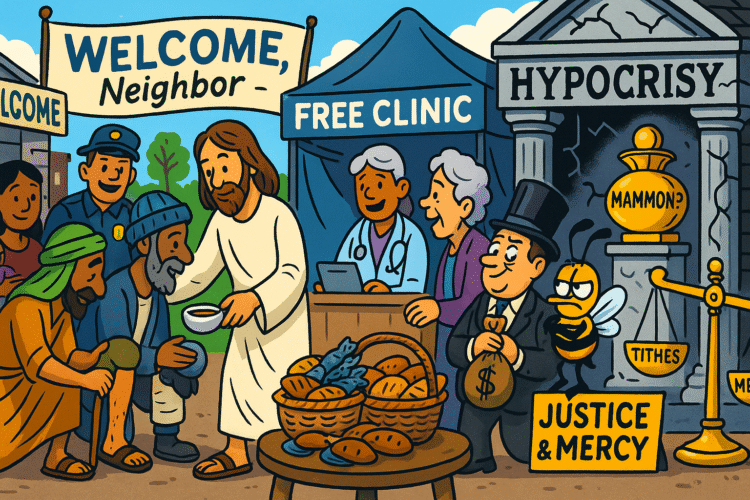
He said welcome the stranger, heal the sick, and give to the poor, which sounds a lot like policy priorities and not a Sunday slogan.
I did not grow up with a theology degree. I grew up with casseroles at funerals, a choir that sang off key with conviction, and a rotating cast of adults who weaponized scripture like it was a yardstick. If you asked me then what Jesus wanted, I would have said behave and donate. I would have been wrong. Years later, after enough bruises from life and several long nights with a Bible I no longer believed in but refused to misquote, I realized the red letters are less a set of manners and more a political platform that terrifies anyone who treats money like a sacrament. You can hear it straight from him. Welcome the stranger. Feed the hungry. Heal the sick. Give away the riches that keep you safe while your neighbor sleeps outside. Mock the hypocrites who polish religion to hide that they will not lift a finger for someone else’s child. None of this is subtle. It only becomes complicated when wealth and power start editing.
If you want the map, Matthew 25 gives it in plain speech. “I was a stranger and you welcomed me, I was hungry and you gave me food, I was sick and you took care of me, I was in prison and you visited me.” He then delivers the punchline that should ring like a fire alarm in every policy shop: whatever you did for the least of these, you did for me. Not said for me, not prayed about for me, not fundraised in my name. Did. That is a verb, not a vibe. You can tattoo a fish on your truck and still fail that test.
Before anyone sighs and says but that is charity, not politics, let us try honesty. Charity is personal mercy inside a system designed to produce need. Politics is the system. If Matthew 25 is the platform, then the planks look like this. Immigration policy that treats asylum seekers as neighbors, not confetti for fear rallies. Food security that is boring, automatic, and universal, where children eat school breakfast and lunch without a cashier inspecting their parents’ pay stubs. Healthcare that begins with the sick and poor and works outward, not a maze where coverage is a prize you win for staying healthy. Tax rules that stop rewarding hoarding, because money piled high enough hides a lot of sins and purchases a lot of exemptions. None of that requires a miracle. It requires the kind of courage that does not trend.
The story most people know is the feeding of five thousand. Matthew 14 records it like a logistical master class. A crowd shows up in the thousands, five thousand men plus women and children, the text insists on the plus because the head counters of history have always forgotten everyone who is not a man. The disciples understand scarcity math immediately. Send them home. We do not have enough. Jesus says the sentence that ought to live above every budget hearing. You give them something to eat. The inventory is a handful of loaves and fish, exactly the kind of cupboard a poor family knows too well. He blesses, breaks, distributes, and at the end of the day the leftovers require twelve baskets. In Matthew 15, a similar scene yields seven baskets after feeding four thousand. The numbers are not the point, although the numbers help. This is abundance as policy, not as accident. The lesson is embarrassingly clear. If leadership commits to feeding people first, the math obeys.
Move two chapters earlier to Matthew 8 and 9 and you get triage in real time. A leper, a fevered woman, a paralyzed man, a hemorrhaging woman, two blind men, a mute man, and a little girl pronounced dead. It reads like the intake board at a county ER where the administrator is whispering about budgets while the nurses sprint. Jesus does not gatekeep the door. He does not ask about preexisting conditions, nor does he quiz anyone on personal responsibility or deductible status. He heals, often with the instruction to speak softly about it, because he seems more concerned with the work than the applause. If that is not a social ethic for healthcare access, I do not know what is. I can already hear the objections. That is spiritual healing. Save it. The bodies in those stories are not metaphors. Neither are the ones we keep triaging today because we designed a system where paperwork outpaces pulse.
Cross the border to Luke 10 and you meet the Samaritan, the foreigner who shows up as the moral center of a story told to an expert in religious law. A traveler is beaten, robbed, and left in a ditch. A priest passes. A Levite passes. Both know the rules, and both choose ritual purity over a bleeding body. The Samaritan, despised for his identity, crosses the road, bandages wounds, pays for lodging, and leaves a blank check with the innkeeper. Then comes the command that gets deflected by a thousand sermons about personal niceness. Go and do likewise. Not go and feel likewise. Not go and draft a resolution about how compassion matters. The foreigner models cross border mercy and Jesus tells the room of respectable men to copy it. That is an immigration sermon if you are brave enough to say migrant out loud from a pulpit.
Let us talk about money, since Jesus did with a bluntness that could make a stewardship committee faint. “You cannot serve God and Mammon,” he says in Matthew 6, and later in Matthew 19 to a rich young man he says, sell your possessions and give to the poor, then come follow me. When the man walks away sad, Jesus turns to the room and drops the line that should come printed on donor envelopes. It is easier for a camel to go through the eye of a needle than for a rich person to enter the kingdom. This is not a koan. It is a warning. If you build your life to hoard, you also build it to justify why other people deserve less. That logic eats empathy for breakfast and calls it discipline.
Now we arrive at the part that polite religion likes to skip. Jesus does not whisper about hypocrisy. He names it and reads a list of counts. Matthew 23 is a roast without a punchline. He calls the religious leadership blind guides, whitewashed tombs, lovers of titles, people who tithe mint and dill and cumin while neglecting justice and mercy and faith. He says they lay heavy burdens on others and will not lift a finger to move them. Then, for anyone still pretending that his anger is purely spiritual, he walks into the temple in Mark 11 and overturns tables. He quotes scripture to say the place should be a house of prayer for all nations, not a market run for profit. Imagine telling him today that tax exemptions belong to ministries that build private jets and lobby to criminalize their neighbor’s existence. Imagine telling him that book bans save children while school lunch audits do not matter. Imagine telling him that the poor are poor because they failed to hustle. There is a reason the elites bristled then and bristle now. He threatens the social math that keeps them comfortable.
Set the scenes in a rough timeline and the pattern sharpens. Early on, he heals and feeds with little commentary. As the crowds grow, he teaches in parables that protect the vulnerable and confuse the smug. He keeps inviting insiders to become neighbors and inviting outsiders to the head table. The backlash rises with every act of abundance, because abundance exposes profiteering. By the time he cleanses the temple, the coalition against him has already formed. Power hates a mirror that tells the truth.
So what does any of this have to do with policy in a country where church and state are separate by design? Everything and also the one thing that matters. If you carry Jesus into the public square, carry his program, not his logo. Humane immigration is not a culture war. It is a Matthew 25 mandate placed in the mouth of the person you claim to follow. Food security is not a partisan hobby. Jesus fed two massive crowds and then collected leftovers as if to embarrass every politician who says feeding children produces dependency. Community health is not charity in a Christian nation fantasy. It is the daily practice of Matthew 8 and 9, where the waiting room is full and the instruction is direct. Heal. As for wealth, if you announce yourself as Christian while writing tax policy, admit that the founder of your brand said the quiet part loudly. Wealth hoarded corrodes the soul and the neighborhood. Create a system that taxes excess on purpose, that funds the least first, that lifts from the bottom and stops pretending the top will not survive a smaller yacht.
Quantify the scenes, since data heals arguments that refuse to hear poetry. Two feedings, nine thousand men, women and children uncounted, twelve baskets after the first, seven after the second. Serial healings across two chapters, at least ten in the span of a few pages if you stack them. Named offices rebuked in Matthew 23, scribes and Pharisees, the keepers of doctrine and the administrators of purity. The crowds react with astonishment and relief, because good news for the poor is not a standard press release. The elites react with suspicion, then anger, then strategy. None of this is mysterious. Some people lose status when the hungry eat.
Now for the modern translation that offends everyone who prefers their faith as a scented candle. Humane immigration policy starts with the sentence in Matthew 25 and the command in Luke 10. Welcome the stranger and go and do likewise. That means asylum processing that is staffed and humane, legal pathways that do not require military-grade luck, city and state partnerships that refuse to treat human beings like shipments, and a national vocabulary that uses neighbor where television has trained you to say invasion. It also means acknowledging that borders exist and laws matter, then drafting those laws with the same energy used to draft tax cuts. Mercy is not mush. Mercy has logistics.
Food security should be boring. Universal school meals, EBT that functions instead of humiliates, senior nutrition programs funded at levels that match our speeches about honoring elders, and a farm bill that remembers eaters are the end user, not hedge funds. If Jesus can feed thousands in a field with no warming trays and still find twelve baskets of leftovers, you can pass a budget where children do not owe debt to a cafeteria. Anything else is performance art.
Healthcare is where our hypocrisy shows up in high definition. The Jesus of the Gospels healed freely and often, then told his followers to go and do likewise. We built a system that interrogates the sick and then sends them a bill large enough to set their future on fire. Choose an ethic. If the ethic is Gospel, then fund community health centers, forgive medical debt as if Jubilee were not just a Bible word, create pathways where rural hospitals do not die and urban clinics do not drown, and tie executive bonus structures to measurable outcomes for the poorest patients. There is a reason the earliest Christians became known for tending the plague-stricken. They saw Matthew 25 as a job description, not a parable for embroidery.
Tax policy is the sacred cow that always moos about innovation. Fine. Innovate your way into generosity. Construct brackets that stop pretending stock buybacks are medicine. Close the sanctuaries where money disappears while schools hold bake sales. Reward companies that raise wages at the bottom rather than the top. And if the verse about camels and needles makes you itchy, admit that itch is your conscience. You can keep your faith private if you like, but if you make it public, make it honest. Jesus did not say, blessed are the donors who name the fellowship hall after themselves. He said, give, and do not let your left hand know what your right hand is doing.
Let us also look the hypocrisy in the eye and give it its proper name. The fake holy leadership of Matthew 23 is alive and loud. Performative piety loves the podium, loves the title, loves the ability to decide whose family counts as a family. It tithes mint and dill and cumin. It fights in school board meetings about sex education and bans books about brown kids who make it to the other side of a fence. It does not show up for the night the city council votes to cut the bus route that delivers workers to the late shift. It will write op-eds about crime while ignoring wage theft, the largest theft in America that never trends. It calls migrants invaders while hiring them for the jobs that sabotage your back. It raises money to fight drag queens, then returns to the donors’ lounge to sip a drink poured by a bartender who cannot afford the cover charge. Matthew 23 called it two thousand years ago. It is still a whitewashed tomb with a gold plaque.
There is a role for the Fourth Estate in all of this, and it starts with a very basic editorial decision. Will sermons about Matthew 25 be allowed to say migrant out loud without being scolded for politics, or will they be patted on the head and told to focus on soup drives while lawmakers weaponize scarcity for sport. Will budgets align with Matthew 5:42, give to the one who asks, or will budgets continue to align with donors who ask for a wing named after their dog. Will churches and politicians who brandish faith pass the fruit test of Matthew 7:16 through 20, by their fruits you will know them, or will we keep grading on a curve that only applies to power. If the loudest Christian voices cannot say, plainly, that the platform described by Jesus is liberal because it is radically neighbor first, then at least admit you have built a religion that prefers gatekeeping to grace.
Since we are being honest, I will tell you my stake. I am an atheist who spent enough years inside the machinery to know how much pain we justify with ritual. I do not believe in miracles. I believe in budgets, policies, and the quiet miracle of a hot lunch that arrives without a cashier’s sigh. If Jesus is going to be invoked in our public life, then the invocation should be constrained by his own words. Welcome the stranger. Feed the crowd. Heal the sick. Challenge the rich. Rebuke the fake holy. That is not a culture war. That is a to do list.
I can already hear the rebuttals. But borders. But fraud. But dependency. But personal responsibility. Fine. Put them on the table and answer them without slurs. Build an asylum process with staffing and shelters and community sponsors. Modernize the immigration courts instead of starving them and then using the backlog as proof of failure. Design public benefits that are universal where possible so stigma goes quiet and fraud becomes a footnote. Give families enough to breathe so that dignity can compete with despair. Pair generosity with labor policy that punishes wage theft, strengthens unions, and refuses to let billionaires turn neighbors into enemies so nobody looks up at the penthouse. Responsibility is not a cudgel when the deck is stacked.
If you want quantities, I will give you a few more because policy makers love a spreadsheet. Imagine a city where every elementary school serves breakfast and lunch without means testing. Attendance rises, discipline problems fall, nurse visits for headaches drop. Imagine a county hospital funded to hire primary care doctors for every zip code under the poverty line, with mobile clinics in the neighborhoods where illness is a commute away. Emergency room visits fall. Hospitalizations for uncontrolled diabetes fall. Imagine a regional asylum network that pairs new arrivals with sponsors, language learning, and employment pipelines that match the jobs we pretend American labor shortages cannot fill. Tax receipts rise. Employment rises. Neighborhood businesses revive. We do not need parables for this. We have data. We also have a choice to keep ignoring it because someone on television can make fear sound patriotic.
There is a simpler way to close. I picture that hillside where the five thousand ate. The disciples are already exhausted. The crowd is unsettled and hopeful. Jesus says feed them. He does not say conduct an audit, split families by legal status, demand proof of worthiness, or ask the women and children to wait at the back while the men go first. He says feed them, then gathers leftovers, then does it again in the next chapter because one miracle did not fix the human appetite. It is the most realistic portrait of care I know. People need what they need today and again tomorrow. Systems should reflect that.
The politics of Jesus are not coy. Welcome the stranger, feed the hungry, heal the sick, confront the rich, and expose the hypocrites who use religion as a velvet rope. Every time a leader tells you this is naïve, ask them why it threatens them. Every time a church tells you this is too political, ask them why their faith fits so neatly into donor strategy. Every time a pundit tells you this is socialism, ask them why Matthew 25 reads like a budget bill written by someone who has seen a kitchen table. We can keep performing reverence while designing scarcity. Or we can do the work the red letters require.
The crowds then heard good news. The elites then plotted. The crowds now still hear the same good news when policy stops pretending that suffering is a sign of moral failure. The elites now react the same way because status has muscle memory. The questions for our moment are embarrassingly direct. Will sermons about Matthew 25 say migrant without flinching. Will a budget ever reflect Matthew 5:42 more than a donor’s mood board. Will the fruit test of Matthew 7 be applied to the loudest Christian voices with the same vigor they apply to everyone else. And will anyone in a suit admit the obvious. The platform described by Jesus is liberal precisely because it is neighbor first.
If you insist on bringing Jesus into American politics, do him the favor of accuracy. He did not say build a wall. He said who is your neighbor, then gave the starring role to a foreigner. He did not say starve children to teach their parents a lesson. He made a picnic out of scarcity and sent everyone home with leftovers. He did not say go fund me. He said go and do likewise. The rest is commentary, and we have already lost too many years to footnotes that never fed anyone.