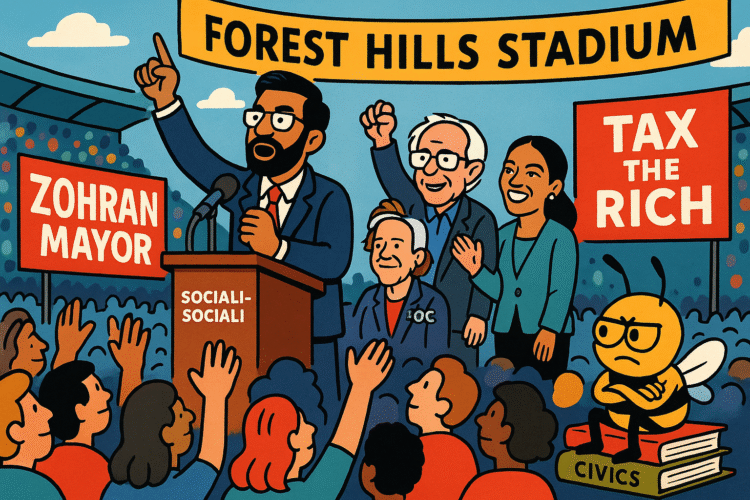
It takes a certain kind of political gravity to fill Forest Hills Stadium with hope. Not the campaign-slogan kind, but the kind that hums under the skin, the kind that makes people believe power might still be something they can touch. On a humid New York afternoon, tens of thousands showed up for Zohran Mamdani’s mayoral rally, a spectacle equal parts movement, music, and municipal manifesto. Bernie Sanders was there, looking like a man who’d been waiting fifty years to see this kind of crowd again. Alexandria Ocasio-Cortez was radiant and sharp, the same blend of idealism and fury that first cracked open the city’s political ceiling. Governor Kathy Hochul appeared, too—less radiant, more strategic—flanked by a Democratic leadership suddenly remembering what enthusiasm looks like.
The Politico write-ups called it a “unity event.” They missed the tone. This wasn’t unity; it was vindication. For years, the progressive wing of the Democratic Party has been told to temper its expectations, to wait its turn, to accept that morality is “unrealistic” if it costs money. Forest Hills was the turn finally arriving. Sanders and AOC didn’t endorse Mamdani because he’s perfect; they endorsed him because he’s the first one in a long time who’s talking about power as something other than inevitability.
The Sound of a New Majority
You could hear it before you saw it: the steady drumline of chanting tenants, union nurses, delivery drivers, childcare workers—the people usually too busy keeping the city upright to attend a weekday rally. When Mamdani took the stage, he didn’t perform a revolution; he explained a plan. Rent freezes, universal childcare, ambitious housing targets funded by top-bracket tax hikes. No buzzwords, no jargon, no PowerPoint. Just an argument that life in New York doesn’t have to feel like a survival sport.
Bernie nodded through it all, that familiar Vermont stoicism softening into something close to pride. AOC leaned forward, mouthing lines she’s been carrying since 2018: dignity, fairness, climate, care. The moment felt less like a passing of the torch than the creation of a circuit—old movement energy completing a loop with its future. The pundits will call it left-wing populism. Those who were there will call it reality finally catching up with conscience.
The Agenda as Moral Geometry
Mamdani’s platform is simple because it’s radical in the literal sense—rooted. Freeze rents so the working class can breathe. Fund childcare so parents can participate in the economy instead of apologizing for it. Build housing like it’s infrastructure, not a side hustle for developers. Pay for it by asking those who profited from decades of upward redistribution to give a little back. It’s not utopian; it’s arithmetic with a conscience.
The critics, of course, are having palpitations. Cuomo, now running as an independent and speaking entirely in warnings, calls Mamdani “too far left,” as though empathy were a fire hazard. Business groups whisper about capital flight, the way they always do when fairness threatens to get a vote. The Republican nominee repeats the phrase “public safety” like a nervous tic, hoping it still works as a talisman against change.
But the polls tell a different story: New Yorkers are tired of being told what’s impossible. They’re watching the rent checks grow and the subway crumble and asking, what exactly are we preserving?
The Mechanics of a Movement
Behind the stagecraft is a campaign running like a disciplined orchestra. Ranked-choice residue from the last cycle left the progressives with data gold mines—maps of which neighborhoods still believe in government as a public service instead of a landlord. Mamdani’s team mined that data, then did something rare: they knocked on doors that don’t usually open. Queens and the Bronx have become canvassing capitals, and turnout operations there now rival the Midtown donor circuit in political gravity.
Unions are aligning like planets. Teachers and nurses are all in. Transit workers are close behind. The trades are cautious but listening. Even some of the service unions, once welded to centrist pragmatism, are drifting toward a movement that actually shows up at picket lines instead of tweeting about them. Outside money floods in from both directions—dark cash trying to smother the glow, small donations stoking it brighter. The math so far favors the glow.
The Gospel According to Sanders and AOC
For years, Bernie Sanders has been treated as the conscience of the party—the one you invite to remind everyone what decency used to sound like, before returning to business as usual. At Forest Hills, he wasn’t the conscience; he was the chorus. His presence wasn’t symbolic; it was catalytic. His voice, still gravel and fire, lent institutional memory to a movement that’s too young to remember the smell of tear gas from earlier fights for the same ideas.
And AOC—well, she’s no longer the insurgent. She’s the bridge. Her speech cut through the cynicism with surgical clarity: “When they say we can’t afford justice, what they mean is they don’t want to share.” It’s the line that crystallized the rally, the thesis statement of a generation raised on debt, precarity, and the knowledge that moderation is just inertia in better shoes. Watching her speak beside Sanders and Mamdani felt like watching lineage form in real time—a multigenerational coalition fluent in both policy and poetry.
The Establishment’s Careful Applause
Governor Hochul’s handshake with Mamdani was the night’s most photographed moment. She smiled like someone who’d just signed a ceasefire with weather itself. The subtext was survival: the left is ascendant, and the path to power now runs through it. Her appearance signaled what the consultants call “message alignment” and what the rest of us call “finally reading the room.” Hakeem Jeffries’ endorsement added weight. Together they created a tableau of party consolidation that, for once, didn’t feel like an arranged marriage.
Still, no one should mistake this truce for peace. The real test will come when governing replaces celebration. Tax policy, policing, labor contracts—each is a live wire waiting to expose who means what they say. But for now, the sight of Sanders, AOC, Hochul, and Jeffries on the same stage was enough to make even the jaded believe that coexistence might be possible.
The Fear Economy Reacts
Wall Street did what Wall Street always does when progressives gather—checked their pulse and their portfolios. Financial media ran stories predicting “fiscal strain” and “market uncertainty,” as if decency were a new form of inflation. Yet beneath the panic, there’s a quiet acknowledgement: New York is still New York. Capital will complain, then adapt, because there’s no substitute for the city’s gravity.
The more interesting reaction came from ordinary voters who’ve spent a decade being told that “progressive” means naïve. They saw a platform that treats their lives as worth planning around. They saw Bernie’s plainspoken righteousness, AOC’s ferocious eloquence, and Mamdani’s calm, deliberate competence—and realized that idealism isn’t immaturity, it’s maintenance. Someone has to keep the idea of fairness alive long enough for the budget analysts to catch up.
The Political Physics of Hope
Momentum, like gravity, obeys certain laws. Once enough bodies move in the same direction, the center of mass shifts whether the pundits like it or not. Forest Hills marked that moment for the Democratic Party. The crowd wasn’t chanting abstract slogans; they were chanting line items. Rent freezes. Childcare. Housing. The language of policy has become the language of belonging. And that’s terrifying for those who built careers on the idea that inspiration and implementation are opposites.
Sanders looked content to pass the torch not to a single heir but to a movement that no longer needs permission to exist. AOC looked like someone who’s learned that charisma is a tool, not a destination. And Mamdani looked like what every city eventually produces when inequality stretches too far—a candidate who refuses to apologize for moral math.
The Upcoming Trials
The next checkpoints are procedural but symbolic: debates, outside-spending disclosures, potential ballot challenges from Cuomo’s camp, maybe a late-cycle ethics complaint filed by a donor with more lawyers than friends. Each will be framed as crisis. Each will instead be a stress test for a movement that has finally outgrown its fragility.
The polls will narrow, the money will harden, and the headlines will oscillate between “progressive surge” and “socialist overreach.” None of it will matter if the campaign keeps doing the quiet work—registering voters, protecting ballots, showing up where cameras aren’t. The lesson of Forest Hills isn’t that the left has won; it’s that it has learned how to endure.
The City as Test Case
If Mamdani wins, New York becomes the proof of concept for a kind of governance the consultants say can’t exist—empathetic yet rigorous, redistributive yet solvent. The stakes are enormous: the world’s financial capital run by someone who still takes the subway. If he loses, the rally will still stand as the night the Overton window finally shattered, the point when policy imagination stopped needing an apology.
For AOC and Sanders, it’s legacy made visible: a generation they inspired standing on its own. For Hochul and Jeffries, it’s the realization that you can’t out-poll a movement; you can only join it or get replaced by it. For Cuomo, it’s an empty podium and an audience that has moved on.
The Joke That No Longer Lands
Once upon a time, the establishment mocked rallies like this—called them drum circles with better signage. But the joke doesn’t land anymore. The crowd at Forest Hills looked like New York itself, multilingual and multigenerational, carrying both student-debt scars and retirement anxiety. They weren’t chasing purity; they were demanding competence that cares.
The critics will keep calling Mamdani’s agenda “unrealistic.” But the rent is what’s unrealistic. The childcare waitlists are unrealistic. The idea that billionaires can buy naming rights to buildings while the city’s teachers buy their own supplies—that’s the fantasy. What Mamdani, AOC, and Sanders offered instead was reality with empathy baked in. Turns out, that’s what fills stadiums.
SECTION TITLE: The Republic of Belief
When the lights dimmed and the chants softened into the city’s usual hum, something rare lingered. Not triumph, not naïveté—continuity. The sense that politics could be cumulative rather than cyclical. That Sanders’ marches, AOC’s insurgency, and Mamdani’s mayoral run are chapters in the same stubborn book about decency refusing extinction.
The next months will test that faith, as they always do. Budgets will tighten, headlines will sneer, and some of the new allies will forget why they showed up. But the record will remain: a socialist filled Forest Hills, and the crowd didn’t flinch. They clapped for the math of fairness, for the possibility that adulthood in politics might mean compassion with competence.
New York has seen plenty of messiahs and mayors, but rarely one who makes the old revolutionaries smile like proud grandparents. The city might still break your heart, but for the first time in years, it’s breaking in the shape of progress.