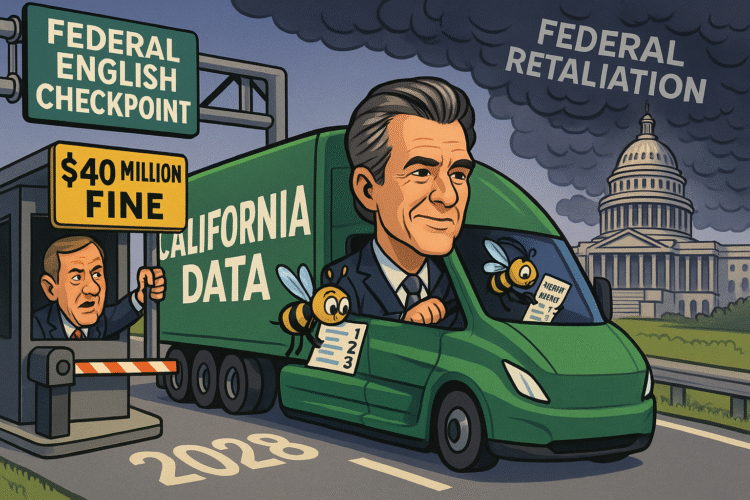
Some politicians run for president. Others just wait until the universe hands them a feud that doubles as an audition. Gavin Newsom appears to have found his in a televised spat about truck drivers, English proficiency, and the statistical miracle of California’s 40% lower fatal crash rate.
During his CBS News Sunday Morning interview, Newsom did that elegant California thing where he admits nothing but implies destiny. “I’ll seriously consider a 2028 run after the 2026 midterms,” he said, which in political dialect means, I’m already measuring the Oval curtains, but we’ll keep calling them drapes until the pollsters are ready. His term-limited governorship ends in early 2027, and the gods of optics could not have scripted better timing: the end of a term, the start of a grudge, and a Republican administration handing him a $40 million soapbox.
The $40 Million Language Lesson
Enter Transportation Secretary Sean Duffy, the Trump appointee who apparently woke up one morning and decided California wasn’t enforcing “federal English proficiency rules for commercial drivers.” Duffy’s Department of Transportation threatened to withhold $40 million in highway funds—a modest ransom by federal standards, but an irresistible headline. The subtext was clear: Speak English or lose your infrastructure allowance.
California fired back with data and disdain. The governor’s office pointed to its Commercial Driver License (CDL) safety record, showing that California truckers have a fatal crash rate about 40% lower than the national average, while Texas—the administration’s moral compass du jour—runs nearly 50% higher.
Translation: our truckers might speak multiple languages, but they’re killing fewer people, so maybe focus on results instead of accents.
This was not just a rebuttal—it was a thesis statement for the next Democratic era: competence as rebellion, evidence as resistance, and governance as trolling by spreadsheet.
The Timeline of a Perfect Political Collision
The timeline writes itself.
- Sunday Morning, CBS: Newsom hints at a 2028 run, camera-ready and under perfect studio lighting.
- Monday Afternoon: DOT fires off its funding threat over “English proficiency.”
- Tuesday: California releases its crash-rate comparison, turning data into drag.
- Wednesday: Republicans call it “discipline.” Democrats call it “retaliation.” Journalists call it “a developing story,” which is newsroom code for “we’ve got B-roll of trucks.”
- Thursday: Pollsters detect a modest bounce for Newsom among Democrats and a corresponding dip in GOP approval of gravity.
By Friday, the clash had evolved from a budget dispute to a federalism morality play, with Newsom starring as the stylish governor standing athwart Washington yelling, “Not in my freeway median.”
Polling: A Nation Shrugs, Democrats Swoon
Early polling snapshots show Democratic enthusiasm for a Newsom run topping 60%, while the general electorate remains ambivalent—roughly split between “he seems competent” and “he seems like he moisturizes too much to lead.” Among independents, his name recognition is climbing faster than his approval. That’s usually how national candidacies start: people learn who you are because you’re fighting someone they already dislike.
Meanwhile, my personal ballot remains on hold for Kamala Harris and Pete Buttigieg—the unofficial duo of competence and caution. Still, even from that perch, Newsom now stands as an undeniable top-three contender: a governor with a tan, a statistical shield, and a well-timed villain.
Federalism, Now With Retaliation Sauce
What makes this skirmish more than a headline is how it exposes the fault lines between federal leverage and state defiance.
Duffy’s funding threat isn’t just fiscal—it’s constitutional theater. The First Amendment lurks in the background because the administration is punishing speech about speech. Newsom’s office didn’t issue new policy; it issued a press release questioning federal competence. In response, the feds threatened cash. That’s retaliation, not regulation, and it sits uncomfortably close to the constitutional nerve labeled “prior restraint by another name.”
Then there’s the Administrative Procedure Act, the unsexy backbone of American governance. Any change to grant conditions—especially one tied to cultural or linguistic standards—requires rulemaking, notice, comment, and a paper trail thicker than a truck stop diner menu. But Duffy’s announcement skipped that and went straight to public decree. Lawyers call that arbitrary. Californians call it Tuesday.
Add the separation of powers wrinkle: Congress controls the purse, yet the administration now wields DOT grants like campaign yard signs. The president’s allies call it “discipline.” Constitutional scholars call it “executive overreach with a side of pettiness.”
Safety Data as Scripture
Newsom’s best defense isn’t ideological—it’s empirical. The 40% figure has already achieved meme status, appearing on placards, podcasts, and late-night monologues. It’s become a shorthand for California’s liberal paradox: a state mocked for regulation that somehow outperforms the deregulated.
Transportation analysts corroborated the numbers using Federal Motor Carrier Safety Administration data, confirming that California CDL holders are significantly less likely to be involved in fatal crashes. Meanwhile, Texas, which prides itself on rugged individualism and high-speed everything, scored nearly 50% above the national average.
The punchline writes itself: one state prioritizes English; the other prioritizes not dying.
Even highway-safety advocates, usually allergic to politics, weighed in. “If California’s data is accurate,” one said diplomatically, “perhaps we should focus on outcomes, not language tests.” Translation: this is stupid.
The Press as Playground
By midweek, cable news had fully discovered the feud. MSNBC called it “a test of federal authority.” Fox News called it “Newsom’s woke trucker agenda.” CNN called it “breaking news,” again, and cut to a split screen of semi-trucks and a sunset over Sacramento.
Conservative pundits praised the administration’s “discipline.” Liberal commentators labeled it “retaliation in bureaucratic form.” The Associated Press went with “California, federal officials spar over driver rules,” which is why satire remains a necessary public service.
Within California, the story was pure oxygen. Local radio ran round-the-clock segments featuring bewildered truckers: “I just drive,” said one, “I didn’t know my grammar could cost $40 million.”
Democrats See a Blueprint
Inside Democratic strategy circles, the fight was seen less as policy and more as rehearsal. The governor’s team has been quietly aligning his 2026 midterm messaging with a national recovery strategy—ballot measures, redistricting, and a moral narrative about competence under siege.
Newsom’s communications advisors, who have never met a camera they didn’t like, framed the DOT threat as “proof that Republican governance requires federal blackmail.” Party operatives privately rejoiced: no opposition researcher could have scripted better contrast.
The calculus is simple: a sitting president weaponizes funding; a blue-state governor stands up for data, democracy, and diversity; Democratic voters get a preview of 2028 leadership that doesn’t sweat under klieg lights.
Republicans Cheer, But Quietly
Republicans, for their part, couldn’t resist. “This is about accountability,” said a Texas congressman who once co-sponsored a bill to let states opt out of federal traffic laws entirely. “If California can’t enforce English standards, maybe they shouldn’t get taxpayer money.”
When reminded that California contributes more in federal taxes than it receives, he adjusted the mic and muttered something about fairness.
Still, even GOP strategists admit privately that Duffy’s move might backfire. It reinforces the Democratic narrative of government as political weaponry—the very “deep state” dynamic conservatives once pretended to hate. But as long as it annoys California, they’re fine with it.
The Legal and Political Chessboard
In practical terms, the next steps unfold along familiar paths:
- Formal DOT Notice: Expect a letter of intent to withhold funds, likely citing “compliance deficiencies.” California will respond with a 200-page rebuttal printed on recycled indignation.
- Litigation: If the funding is actually withheld, California sues under the APA, alleging retaliation and arbitrary enforcement. The Ninth Circuit sharpens its pencils.
- Consent Decree or Quiet Backdown: Most of these fights end in bureaucratic truce. Federal lawyers discover a new “interpretive flexibility,” everyone saves face, and the money moves anyway.
- Polling Wave: Each confrontation feeds new national polling. Expect fresh surveys before summer recess testing “Newsom vs. Trump,” “Newsom vs. Harris,” and “Newsom vs. the concept of term limits.”
- 2026 Midterms: Newsom campaigns for Democratic House candidates under the banner “Competence Is Not a Crime.” Republicans counter with “English or Bust.” Both sides claim victory.
The Constitutional Vaudeville of Retaliation
The deeper issue is how normalized this federal-state combat has become. We’ve reached a point where policy differences are adjudicated through grant threats and executive orders, not negotiation. The Founders warned about factionalism, but they didn’t foresee a Department of Transportation acting as moral hall monitor.
Newsom’s potential lawsuit will likely cite South Dakota v. Dole (1987), the case that allowed the feds to tie highway funding to the drinking age—but only if the conditions were unambiguous and related to the program’s purpose. English proficiency doesn’t qualify unless California’s highways start conducting grammar tests at weigh stations.
In short, it’s constitutionally thin, politically thick, and perfect for prime-time news.
Data vs. Discipline
At the heart of it lies a moral choice masquerading as bureaucracy: whether policy should reward data or obedience.
Duffy says discipline; Newsom says outcomes. Duffy wants compliance; Newsom wants correlation. One side cites the supremacy clause; the other cites fatality rates. The irony, of course, is that both men claim the mantle of “safety.”
But safety, in this case, is code for power—the ability to define what counts as responsible governance. California’s argument is essentially, we work, leave us alone. Washington’s is, obedience first, metrics later.
And somewhere between the interstate guardrails, the Constitution’s commerce clause sighs in exhaustion.
The 2028 Chessboard
So, is this the moment Gavin Newsom becomes the Democratic front-runner for 2028? Not yet, but it’s the moment he becomes impossible to ignore.
His feud with the Trump administration gives him national airtime without the stench of opportunism. He’s fighting on home turf, armed with data, and cast as the foil to federal overreach. That’s a campaign commercial disguised as governance.
Still, vulnerabilities lurk. The same charisma that delights donors sometimes reads as arrogance to voters outside the Pacific time zone. The same glossy competence that reassures liberals fuels Fox News monologues about “Hollywood socialism.”
But in a field likely to feature Harris, Buttigieg, and perhaps a surprise from the Midwestern bench, Newsom now holds the inside lane.
And while I’m still holding out for Harris and Buttigieg—the duo that blends experience with technocratic calm—there’s no denying that Newsom has joined the top three. He’s the Democrat most likely to turn a bureaucratic slap fight into a campaign launch, complete with spreadsheets and lighting cues.
Epilogue: The Highway to 2028
The coming months will reveal whether this was just another red-blue skirmish or the prelude to a generational contest. Watch for three signals:
- A formal DOT notice converting bluster into policy.
- A lawsuit turning policy into precedent.
- And a polling surge turning precedent into inevitability.
If those align, Gavin Newsom’s road to the presidency will start not on a convention stage but on a highway ledger, paved with 40% fewer fatal crashes and 100% more symbolism.
Until then, California keeps driving, Washington keeps threatening, and the rest of us keep wondering whether the republic runs better on competence, compliance, or pure caffeine.
Either way, buckle up. The next presidential race just merged onto the freeway.