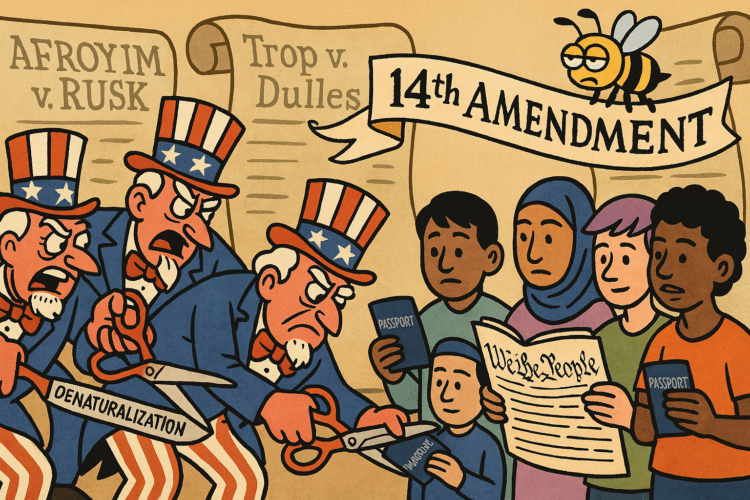
It’s happening again. The right has discovered a thrilling new hobby: pretending the Fourteenth Amendment is optional. Apparently, “We the People” now comes with a disclaimer—“unless you’re Muslim, queer, left of Ronald Reagan, or pronounce your name with too many vowels.” Across talk radio, committee hearings, and influencer podcasts with the production value of a basement hostage video, a familiar chant hums beneath the noise: You’re not a real American.
This isn’t just the garden-variety xenophobia that pairs well with Facebook comment sections. No, this is a full-blown “denaturalization” cosplay, where pundits dress up as constitutional scholars and play-act revoking citizenship from their ideological enemies. They invoke “loyalty,” “tradition,” and “border integrity” while somehow forgetting the border between reality and fantasy. And like every great American reboot, this one insists it’s new while stealing every plot point from its racist prequels.
The Constitutional Wet Blanket
Here’s the problem with the “Go back where you came from” brigade: they keep bumping into the Constitution like it’s an inconvenient piece of furniture in their ideological man cave. The Fourteenth Amendment’s Citizenship Clause—drafted after a literal civil war—says anyone born or naturalized here is a citizen. Not provisionally. Not until Tucker Carlson gets nervous. Just citizen.
Then came the supporting case law, the boring, lawyerly kind of magic that makes democracy more than a vibe. Afroyim v. Rusk (1967) confirmed you can’t lose citizenship just because you offended the State Department’s feelings. Trop v. Dulles (1958) ruled that denationalization as punishment is “a form of punishment more primitive than torture.” Schneider v. Rusk (1964) banned treating naturalized Americans as second-class. And 8 U.S.C. §1451—the denaturalization statute—only applies if you lied in your application. Fraud, not heresy.
Translation: there’s no “bad vibes” exception. Criticize a president, burn a flag, marry the wrong gender—your citizenship doesn’t expire like a gym membership. Yet somehow, this civics homework keeps getting erased by the same crowd who think “constitutional originalism” means rewriting the syllabus with white-out.
The New Faces of an Old Fear
The targets are depressingly predictable. Congresswoman Ilhan Omar, whose family fled war, is accused of “hating America” for voting her conscience. New York Assemblyman Zohran Mamdani, a son of Ugandan immigrants, gets labeled a “foreign agent” for caring about housing policy. Journalist Mehdi Hasan is accused of dual loyalty for doing what journalists do—asking questions.
These aren’t fringe accusations anymore. They’re soundbites recycled through congressional microphones, influencer livestreams, and cable panels featuring men whose only known credential is “used to guest host for Bill O’Reilly.” Each segment ends the same way: with the moral panic of a country that still can’t tell the difference between critique and treason.
It’s always the same formula. Smear Muslims as infiltrators. Treat dissent like espionage. Wave “border security” around like it’s a constitutional Swiss Army knife. Then, for flair, cut to B-roll footage of sirens and hijabs. Because nothing says “fair journalism” like editing worship footage to a horror soundtrack.
A Brief History of Paranoia
If this feels familiar, that’s because America runs on fear with the reliability of a diesel engine. The Chinese Exclusion Act of 1882. The Palmer Raids of 1919. McCarthy’s blacklist in the 1950s. The post-9/11 surveillance state that mapped mosques like Pokémon gyms. Every era has its scapegoat, its loyalty oath, its constitutional blind spot dressed up as national security.
The modern twist is aesthetic. Instead of trench coats and typewriters, we have podcasts and hashtags. Instead of HUAC hearings, we have viral clips of congressional staffers “owning” witnesses in five-second bursts for likes. Instead of the FBI tailing activists, we have algorithms amplifying “who really belongs here” montages.
But the choreography hasn’t changed. Step one: pick a minority. Step two: question their allegiance. Step three: pass laws or resolutions that make them prove their love for a country that keeps trying to uninvite them.
The Bureaucracy of Bigotry
Even the administrative ghosts have come out to play. Conservatives fondly reference programs like NSEERS, the Bush-era Muslim registration system that achieved nothing except wasting taxpayer money and terrorizing families. It was officially dismantled in 2011, but it lives rent-free in the GOP subconscious. They talk about reviving it the way old men talk about Woodstock.
They love bureaucratic nostalgia—because bureaucracy gives cruelty a clipboard. It turns prejudice into paperwork, and paperwork feels patriotic. Why say “I hate Muslims” when you can say “We’re simply updating our national security database”?
Meanwhile, the First and Fourteenth Amendments sit in the corner, sighing like tired teachers grading essays titled Why Freedom of Speech Shouldn’t Apply to People I Disagree With.
The Real Cost of Pretend Patriotism
There’s a human cost to this performance art. It shows up as vandalized mosques, schoolyard taunts, and job offers that vanish after someone Googles your name. It’s the aunt terrified to travel because she wears a hijab. The journalist who gets daily death threats for writing about policy instead of propaganda. The kid who hears “go back” before learning long division.
Then there’s the policy cost—the laws written to solve imaginary problems. School boards passing “American values” pledges that sound suspiciously like purity oaths. Statehouses introducing bills about “foreign influence” that treat brown skin as probable cause. Congress holding hearings about “anti-American sentiment” as if criticism of power were not the point of citizenship.
All this moral theater costs money, attention, and something less quantifiable but more dangerous: public courage. It teaches bystanders that silence is safer, that defending your Muslim neighbor might get your own Americanness questioned.
The Algorithm of Fear
On social media, fear now comes pre-packaged with ambient music and stock footage. Influencers splice together clips of protests, prayer calls, and politicians like Omar, set to the kind of ominous score usually reserved for alien invasions. The captions ask leading questions: Who are these people? Why don’t they love our flag?
The answer, of course, is that they do—just not in the way that fits the merchandising. Loving your country doesn’t mean performing adoration for the camera; it means caring enough to demand it live up to its promises. But nuance doesn’t trend. Rage does. And rage has better SEO.
The Law Still Wins—For Now
Here’s the stubborn, boring truth that ruins every culture-war fantasy: the Constitution doesn’t care about your panic. The courts have made it clear that citizenship is not conditional on behavior, belief, or belonging to the dominant religion. You can’t deport someone for tweeting about Gaza or writing an op-ed that hurts your feelings.
Every time a demagogue suggests otherwise, they crash against the same wall of case law. Afroyim. Trop. Schneider. These rulings are not optional footnotes. They’re the legal spine of belonging. And that’s what makes the current cosplay so pathetic—it’s rebellion without consequence, authoritarianism without homework.
Still, the fantasy persists because it’s emotionally satisfying. It lets the insecure imagine themselves as gatekeepers of something sacred. “Real American” becomes a brand, a badge, a club with a strict dress code: white, straight, Christian, deferential. But citizenship was never meant to be couture; it’s meant to be universal.
The Counterculture of Belonging
Thankfully, the resistance is real, and it’s doing the unglamorous work of fixing what demagogues break. Pluralist coalitions across cities are passing anti-hate ordinances. Lawyers are staffing hotlines for people targeted by immigration stunts. Schools are teaching civic literacy that goes beyond reciting the Pledge.
In Queens, organizers from multiple faiths show up for each other’s vigils. In Minneapolis, queer Muslim collectives are reclaiming joy as political defiance. These acts aren’t glamorous. They don’t trend. But they’re the quiet infrastructure of democracy—the scaffolding that holds up a house even when the loudest tenants keep trying to burn it down.
Because the truth is simple: Americanness isn’t inherited; it’s enacted. It’s not a purity test; it’s a promise. And every time someone like Mamdani or Omar or Hasan refuses to play the villain in someone else’s morality play, they remind us that the Constitution isn’t a relic—it’s a receipt.
The Inflation of Treason
So why the obsession with denaturalization rhetoric now? Because calling opponents “traitors” is cheaper than governing. When your policy ideas fit on a bumper sticker and your empathy fits in a tweet, branding dissenters as foreign fills the vacuum. It turns democracy into a zero-sum game where patriotism is currency and outrage is inflation.
It’s also lucrative. Fear sells. Each viral clip of an angry “foreign-sounding” name earns ad revenue, donations, and social capital. It’s performance populism—a nationalism so commercialized it might as well come with a merch table.
But the Constitution doesn’t run on merch. It runs on consent. And consent requires something the outrage economy can’t provide: good faith.
The Real American Test
So let’s propose a new test of Americanness: can you name more Supreme Court cases than conspiracy theories? Do you know your neighbor’s name, or just their demographic? Can you read the Citizenship Clause without inserting “except”?
Because here’s the thing the purity crowd can’t stand—the Constitution already decided who counts. There’s no asterisk beside “All persons born or naturalized.” It doesn’t say “unless they criticize the president” or “unless they pray differently.” If you want to rewrite that clause, you don’t love America; you love your reflection in its flag.
And yet, amid all this noise, something hopeful hums underneath. The louder the gatekeepers shout, the more people realize the gate never belonged to them.
The Quiet Clause of Hope
Maybe that’s the final irony: for all their posturing, the self-appointed arbiters of Americanness keep losing to the very people they try to erase. Pluralism is messy, but it’s stubborn. It keeps voting, organizing, suing, teaching, and laughing in the face of intimidation.
And if Zohran Mamdani really does succeed in chasing out “twenty-eight percent of the racists,” maybe New York rent will finally dip below “kidney donation required.” But the deeper win is quieter: communities building new definitions of belonging that don’t require permission slips.
So, here’s your homework, patriot. Learn the case law. Learn your neighbors’ names. The next time someone says “real Americans,” ask them which amendment defines that. And if they can’t answer, remind them that the only loyalty oath worth taking is to the Constitution—the one written in ink, not fear.
Because citizenship isn’t a costume. It’s a covenant. And the people trying hardest to revoke it are the ones who understand it least.