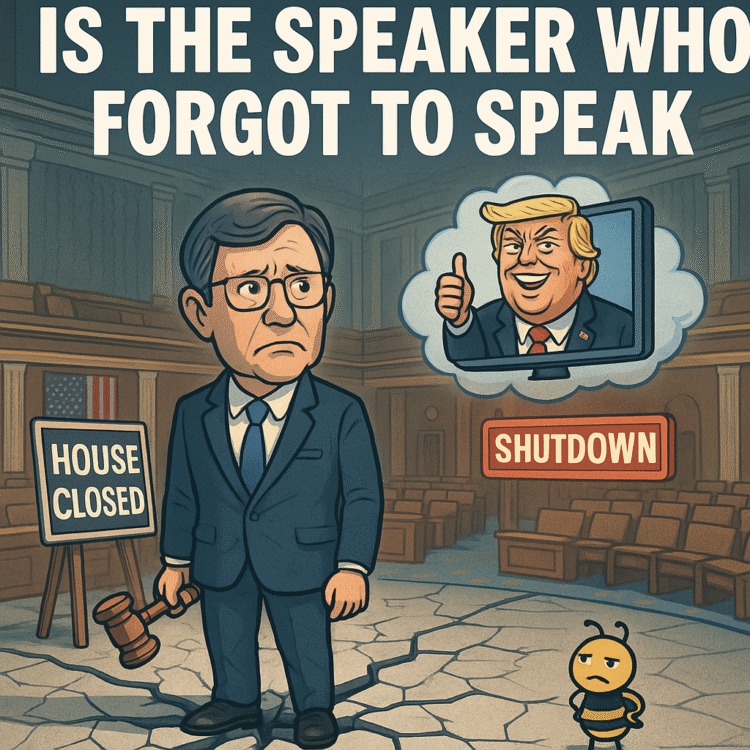
Somewhere between the Capitol dome and Mar-a-Lago, the People’s House misplaced its voice. The New York Times tried to call it “a portrait,” but it read more like an autopsy. Speaker Mike Johnson, the man theoretically third in line to the presidency, has kept the House out of session for most of the shutdown, spending his time proving that silence really can be a governing philosophy. The country is closed for business, and so is Congress.
But not to worry: the Speaker’s got district work weeks to declare, prayer breakfasts to attend, and the occasional sermon to post. The governing part? That’s on pause until the former president gives his next cue. Because, as Donald Trump privately brags, “I’m the speaker and the president.”
The Times calls Johnson “subservient.” Trump calls him “loyal.” Everyone else calls him “missing.”
The Church of Congressional Inactivity
The shutdown is now a museum exhibit about irony: airports are jammed, SNAP benefits are frozen, and Smithsonian lights are off while the man constitutionally charged with keeping government open has decided that the best way to lead is by doing nothing at all.
Johnson’s strategy, if it can be called that, is a kind of legislative monasticism. Close the doors, silence the chamber, and wait for divine (or Mar-a-Lago) intervention. He’s the first Speaker to confuse “recess” with “rapture.”
The House floor sits empty, save for echoes and the occasional mouse seeking committee assignment. Staffers wander the halls like characters in a gothic novel, haunted by memories of appropriations.
To the outside world, this looks like dysfunction. Inside Johnson’s theology of governance, it’s faith-based outsourcing. Why legislate when you can wait for Trump to text you what God’s will happens to be that week?
The Rise of the Executive Ventriloquist
When history writes about this period, the footnote will sting: Congress didn’t fall to a coup, it fell to codependence.
Trump says “jump,” and Johnson doesn’t even ask how high—he just quietly commissions a nonbinding resolution declaring that gravity is fake. The Speaker has turned the legislative branch into a stagehand crew for executive theater.
Republicans once warned that Obama’s pen and phone were signs of tyranny. Today, they stand in line for Trump’s Sharpie like it’s a communion cup. The man who promised to “drain the swamp” now directs it by remote control, and Mike Johnson is happy to play the world’s meekest amphibian.
When aides whisper that Trump privately gloats, “I’m the speaker and the president,” it’s not bluster. It’s an org chart update.
The Ghost of Regular Order
Remember “regular order”? That quaint ritual where Congress debates bills, votes on amendments, and passes budgets before the fiscal year ends?
Johnson doesn’t.
Under his watch, the House has achieved a level of stillness rivaled only by deep space. There have been no votes since mid-September. No committee markups. No visible pulse.
He has effectively replaced legislative deliberation with a concept called “district work weeks,” which sounds productive but actually means “everyone go home until the headlines look better.”
The lower chamber is now more like an Airbnb for ambition: rented out every few weeks for partisan photo ops, then shuttered for maintenance.
Meanwhile, Democrats, who once rescued Johnson from a motion to vacate in the name of stability, are now realizing they saved a man who governs like a screensaver.
The Quiet Coup of Coequality
The Constitution imagines three coequal branches of government, but Johnson’s House has demoted itself to audience participation.
While the Senate huddles to patch holes and governors improvise disaster aid, the Speaker insists that holding out during a shutdown builds leverage. The problem is, leverage only works when you have an endgame. Johnson’s endgame is whatever Trump tweets next.
It’s a delicate symbiosis: Trump gets to cosplay as a strongman without having to read briefing books, and Johnson gets to pretend that submission is strategy.
This is not checks and balances. It’s checks and blind allegiance.
Performance Politics and the Art of Not Governing
The most damning thing about Johnson’s tenure is not that he’s obstructing—it’s that he’s abstaining.
He doesn’t rail. He doesn’t threaten. He doesn’t even grandstand particularly well. Instead, he performs a kind of minimalist politics, where inaction masquerades as moral conviction.
Reporters describe him as “polite,” “soft-spoken,” “prayerful.” They mean “absent.”
You could replace him with a cardboard cutout and no one would notice, except that the cutout might vote faster.
The modern GOP has traded governance for grievance, but Johnson has gone one step further. He’s turned grievance into ghosting. The Speaker of the House is now a man who simply refuses to show up.
Separation of Powers, Separation of Responsibility
The Founders designed the legislative branch to be loud, messy, argumentative. That was the point: disagreement as democracy.
Johnson’s House, by contrast, feels like a megachurch after hours. The pews are empty, the microphone still smells like hair spray, and the sermon’s been replaced by a press release.
When the Speaker calls for “prayerful reflection” instead of a vote on SNAP benefits, it’s not just bad optics. It’s a constitutional joke.
Every day the House stays closed, it drifts closer to being an accessory, not an institution. We no longer have coequal government. We have co-dependent government.
The Abdication Economy
The irony is that Democrats, in an attempt to preserve governance, enabled this vacuum. When Marjorie Taylor Greene tried to oust Johnson in the spring, Democrats saved him. They told themselves it was a defense of normalcy, a bulwark against chaos.
But Johnson’s normalcy turned out to be chaos in slow motion.
He doesn’t light fires; he just lets them burn. The shutdown could stretch into record territory, not because of strategy, but because of inertia. It’s less a standoff than a sleepwalk.
When airports snarl, when grocery benefits lapse, when federal workers paw through savings, Johnson’s response is to schedule a “district work period,” as though constituent barbecues can substitute for governance.
The Speaker has become a metaphor for the shutdown itself: still, stubborn, self-justifying, and quietly falling apart.
The Theater of Subservience
It would be funny if it weren’t functioning as policy.
In practice, Johnson’s deference means that the legislative agenda now lives and dies on Trump’s mood. When the former president wants to look decisive, the House gets a memo about “restoring order.” When he wants to play victim, Johnson holds a press conference about “weaponized governance.”
The result is a government running on vibes and vintage talking points. Oversight hearings have stalled. Committees are dormant. Major bills only pass when Democrats provide the votes.
The People’s House has become the president’s green room, its members checking their phones for direction before daring to speak.
It’s not separation of powers anymore. It’s separation of responsibilities.
The Cowardice of Convening
Johnson’s defenders call his approach “deliberative.” That’s like calling a coma restful.
He warns that reconvening too soon would “reward dysfunction,” as though inactivity were a moral stand. But what he’s really rewarding is obedience.
He’s found a way to please both the far-right ideologues who despise compromise and the Trump orbit that thrives on paralysis. His secret formula: do nothing and call it discipline.
Meanwhile, ordinary Americans are discovering that “smaller government” was never a philosophy. It was a threat.
Trump’s Invisible Hand, Holding the Gavel
The relationship between Trump and Johnson is no mystery. It’s theater.
Trump calls. Johnson listens. Trump dictates. Johnson echoes. Trump contradicts himself. Johnson calls it strategy.
The Speaker’s power is purely derivative. Every public statement feels like a secondhand sermon, every delay a quiet prayer for permission.
Even his allies are getting restless. Behind closed doors, Republican members grumble that the House has been “marginalized.” They’re not wrong. Congress now functions like a support group for elected officials coping with irrelevance.
But no one dares break ranks. Not because Johnson inspires loyalty, but because he has mastered the one survival skill that matters in the Trump era: staying invisible until needed.
The Shutdown of Governance, Not Just Government
At this point, calling it a “shutdown” is generous. Shutdowns imply tension, negotiation, stakes. This is just slow decay.
The House could reopen tomorrow. It could pass clean funding for troops, SNAP, and TSA paychecks in an afternoon. But that would require leadership, which Johnson interprets as disobedience.
Instead, he prays for patience while the country prays for paychecks. He tells reporters that endurance is virtue while endurance quietly becomes abdication.
This is what happens when government is treated as performance art. The applause lines replace the legislative ones, and every act of passivity is reframed as “standing firm.”
Johnson isn’t the first Speaker to cave to the executive branch. But he’s the first to do it proudly, as though muting the House were an act of patriotic humility.
The Constitutional Comedy
There’s something tragically funny about it all.
The Founders imagined Congress as a check on executive ambition. Johnson has turned it into a mirror. The president wants power? Here, take mine. The president wants credit? Here, take that too.
Trump doesn’t even have to fight for control anymore. He’s already won by default.
Every constitutional scholar in America could write essays about separation of powers, judicial review, and the dangers of executive creep, but all you really need to know is that the Speaker of the House has chosen to be a supporting character in someone else’s show.
When asked if the House would return to session before mid-November, Johnson smiled and said, “We’re evaluating our options.” That’s not leadership. That’s a voicemail greeting.
The Closing Act
Someday, there will be a civics textbook with a chapter titled “The Great Legislative Vanishing.” It will explain how a once-loud chamber became a whisper, how oversight turned into overthinking, and how the Speakership devolved into customer service for the executive branch.
And right next to a photo of an empty House floor, there will be a caption: “Speaker Mike Johnson: the man who mistook subservience for strategy.”
When historians look back, they won’t see ideology or even cowardice. They’ll see vacancy. They’ll see a Congress that mistook silence for strength, and a Speaker who mistook obedience for faith.
And in that silence, they’ll hear the faintest echo of democracy clearing its throat, wondering when it gets to speak again.