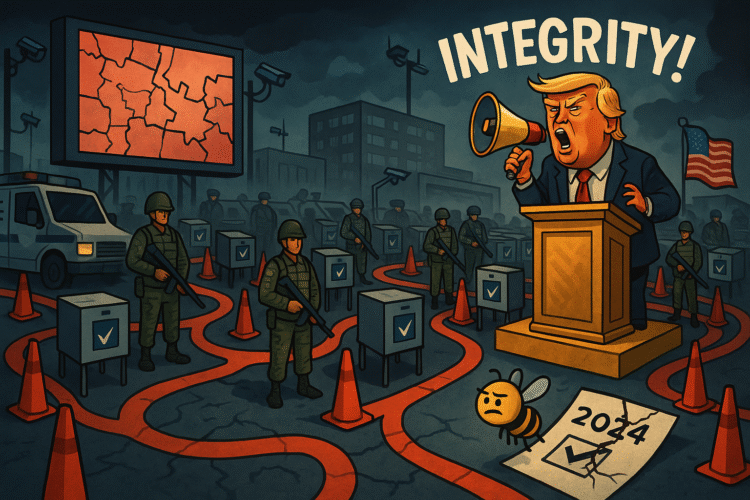
It’s 2025, which means we’re back in the part of the American cycle where politicians stop pretending to govern and start designing the next democracy-themed escape room. The new blueprint—marketed, ironically, as Never Again 2020—isn’t a conspiracy theory or a master plan. It’s a step-by-step guide written in bureaucratic beige and marketed as “election integrity.” And like any good confidence game, it works best when everyone insists it’s totally normal.
Welcome to your guided tour of how to rig an election without ever saying the quiet part out loud.
Step 1: Begin With a Map and a Straight Face
The first rule of modern election manipulation: start with geometry. Democracy dies not in darkness but in committee hearings about “compactness.” The Never Again 2020 team knows this. Their first stop is every red-state legislature they control—and a few they just think they might someday.
There, under the sacred invocation Rucho v. Common Cause (the Supreme Court decision that essentially told federal courts to sit this one out), they redraw districts like drunk cartographers who’ve just discovered a protractor app.
The trick is to make it sound noble. Words like “fair representation,” “community alignment,” and “population equalization” are chanted like Gregorian hymns while precinct lines slither through neighborhoods like oil spills.
When someone complains, they point to Rucho like it’s the Ten Commandments. “The Court said partisan gerrymanders are nonjusticiable,” they murmur, which translates roughly to: We’ve been deputized to color inside the lines however we want.
Step 2: Replace the Referees
A rigged system needs the right referees. And so the next phase of Never Again 2020 is the quietest purge this side of a mid-century coup.
Local election boards? Out. County clerks with actual experience counting votes? Early retirement. Replace them with “true believers”—people whose idea of “chain of custody” sounds more like a hipster café than a legal term.
Training is minimal. Loyalty tests are not. The new hires arrive with résumés built from election-denier podcasts and Facebook threads titled How to Spot a Dominion Server in the Wild.
They’re told to expect chaos, to trust their gut over their training, and to remember that “fraud” doesn’t need evidence—it just needs confidence.
The result? A bureaucracy primed for paranoia. A system where every routine process—from signature matching to ballot storage—becomes a moral crusade. And, crucially, where no one in charge remembers how it’s supposed to work when it doesn’t.
Step 3: Add a Dash of Security Theater
No good performance of authoritarianism is complete without uniforms.
That’s why Never Again 2020 includes a proposal for “poll security”—a term so broad it can mean anything from installing cameras to staging a full-blown military cosplay.
The pitch goes like this: We just want safe elections. Who could object to that? So they float the idea of “optional National Guard deployments” under state Title 32 authority. Maybe even a shaky Title 10 “federalization,” if the President feels frisky.
To the average voter, it looks like patriotism: soldiers in camo, standing near polling places, smiling for the cameras. To constitutional lawyers, it looks like a migraine: the Posse Comitatus Act prohibits using troops as domestic police, but what’s a century-old statute between friends?
Then come the “ICE vans,” coincidentally idling near majority-minority precincts “to ensure safety.” And DOJ “escorts” for ballot boxes “to protect the count.” It’s theater, not security—but the intimidation lands just the same.
Because nothing says “free and fair” like casting your ballot while a Humvee hums outside the gymnasium.
Step 4: Invoke Laws You Haven’t Read
For every illegal act, there’s a corresponding misquote.
The Never Again 2020 playbook treats Article I, Section 4—the Elections Clause—as a blank check. “Congress may at any time make or alter such regulations,” they say, pretending the phrase “times, places, and manner” means “rules, outcomes, and vibes.”
They conveniently forget the Voting Rights Act’s anti-intimidation sections (52 U.S.C. §10307(b) and §10101(b)), the Civil Rights Act’s equal-access guarantees, and the small mountain of criminal statutes (18 U.S.C. §§241, 242, 594, 595) that make it a felony to interfere with a citizen’s vote.
But those numbers are boring, and boring doesn’t trend.
So the talking heads roll out phrases like “election interference by the deep state” and “restoring confidence in federal property.” Then they propose things like moving ballot counting to “secure federal facilities”—which, in plain English, means: handing the keys of the election over to the DOJ.
A clever move, if not for that whole “ballot custody belongs to the states” thing. The minute federal agents touch a ballot box, a thousand lawyers materialize like locusts with injunctions in hand. The Purcell principle (which bars courts from changing election rules too close to an election) would melt under the weight of emergency filings.
But again—legality isn’t the point. The point is to exhaust the system until voters can’t tell the difference between a lawsuit and a press release.
Step 5: Legal Until It Isn’t
Voter suppression, in the modern age, is an art form that thrives on plausible deniability.
Start with the classics: aggressive voter-roll purges misusing the NVRA (National Voter Registration Act). Call it “cleaning the rolls.” Then tighten ID requirements just enough to disqualify the elderly, the poor, and the students.
Reduce early voting “for cost savings.” Close polling sites “for efficiency.” Introduce “exact match” registration rules that turn typos into disenfranchisement.
Then sit back and watch turnout dip just enough to flip a few seats.
If anyone complains, point to the law: “We’re following procedure.” Never mind that procedure was written in disappearing ink.
And when watchdogs sue, stall. By the time the case reaches a judge, the election’s over, the damage done, and the defense ready: We were just enforcing integrity.
It’s voter suppression that feels legal—until a court says it’s not. And even then, the only punishment is a shrug and a headline three news cycles too late.
Step 6: Normalize the Circus
Once the groundwork’s laid, it’s time to build the stage.
Cue the press conferences about “ballot chain of custody” and “ballot mules.” Cue the “patriotic” volunteers filming voters from across the parking lot. Cue the sheriff who shows up “to keep the peace” but somehow only patrols neighborhoods where English isn’t the first language.
Every spectacle doubles as propaganda. Every headline blurs trust just a little more.
And through it all, the architects of Never Again 2020 smile serenely into cameras. “We’re restoring faith in elections,” they say, as they dismantle the conditions for faith itself.
It’s the perfect grift: claim you’re saving democracy while you rebrand it as a franchise operation.
Step 7: Pretend It’s Patriotic
Authoritarianism in America never wears black boots—it wears flag pins.
So every step in this playbook comes draped in stars and stripes. Troops at the polls? “Honoring the military.” ICE near precincts? “Protecting lawful voters.” Redistricting? “Ensuring representation.” Ballot-count takeovers? “Safeguarding transparency.”
Each move is sold as a defense of the republic against invisible enemies—antifa hackers, ballot smugglers, rogue postal workers. The list changes daily, but the script stays the same.
By the time anyone notices the pattern, it’s too late. The spectacle has already hardened into ritual, and the ritual into norm.
Step 8: Study Abroad in Moscow
If this all sounds familiar, it should. It’s the Russian playbook with better branding.
Start with cartography cosplay—gerrymanders so egregious they deserve gallery space. Add a sprinkle of “election security” that looks a lot like law enforcement. Throw in some NGO intimidation, a captured media ecosystem, and a few show-trial arrests of “vote fraud rings” that don’t exist.
The end result isn’t dictatorship. It’s managed democracy—the art of letting people vote for the illusion of choice.
Russia perfected it. Hungary franchised it. America’s just now opening its first domestic pilot program.
Step 9: Pretend There’s No Precedent
The Never Again 2020 playbook didn’t appear out of thin air. It’s the sequel to Trump’s greatest hits reel—the same man who once mused about “fixing 2028,” who insisted he “won in 2020 by a lot,” and who openly called his supporters to “never let it happen again.”
Add to that his public flirtations with federalizing state Guards “to protect federal property,” deploying ICE “to preserve law and order,” and ordering DOJ “to secure and count the ballots.”
Each of those proposals runs headlong into stubborn, boring law.
Federal observers under the Voting Rights Act can’t just appear—they must be invited or court-ordered. Armed presence near polls is restricted by state statute. Ballot custody is a state matter, not a federal one. And any attempt to commandeer it would be nuked by injunctions before the ink dried.
But again—this isn’t about winning in court. It’s about creating chaos and claiming victimhood when courts intervene. “They’re afraid of oversight,” he’ll say. And a third of the country will nod.
Step 10: Spin the Chaos as Confidence
The genius of the Never Again 2020 model isn’t efficiency—it’s entropy.
By flooding the system with lawsuits, executive orders, National Guard “deployments,” and endless audits, they create confusion so deep that no one knows where the authority actually lies.
Every bureaucratic delay becomes a talking point. Every court injunction becomes proof of persecution.
And when Election Night finally arrives, the groundwork is set: a sea of untested rules, overworked administrators, and disoriented voters.
Whatever happens, the narrative writes itself. If they win, it’s proof the system worked. If they lose, it’s proof it was stolen.
Either way, faith in democracy erodes. And that’s the real victory.
Step 11: Deny, Distract, Repeat
When confronted with facts, the architects of this playbook will perform their favorite two-step: denial and distraction.
First, deny everything. “We’re following the law.” “We’re protecting the vote.” “We love democracy.”
Then, distract. Bring up Hunter Biden. Gas prices. Crime in cities you’ve never been to. Anything to keep attention off the machinery grinding in the background.
It’s the political version of a magician’s flourish: make the audience look at the shiny object while you pocket the card.
And by the time the public realizes the trick, the count’s certified, the laws are rewritten, and the next election is just another episode in the same franchise.
Step 12: Watch the Guardrails Groan
The Constitution is an extraordinary document, but it was not designed to withstand reality television.
The 14th and 15th Amendments say no race-based vote denial. The 24th bans poll taxes. The 26th guarantees 18-year-olds can vote. HAVA sets federal election standards. State constitutions explicitly outlaw partisan maps.
All of these are guardrails, not force fields.
Every time a bad actor bends them—by redistricting mid-decade, by closing polling sites in minority areas, by intimidating voters under the guise of “security”—the guardrails hold a little less.
And when the Supreme Court treats disenfranchisement as “political questions,” those guardrails become guard suggestions.
That’s how democracy dies in slow motion: one misapplied statute, one ignored precedent, one “temporary measure” that somehow never expires.
Step 13: Remember the Lawyers Are Coming
Here’s the good news: for every scheme, there’s a lawyer ready to sue it into oblivion.
Independent redistricting commissions still exist—and they’re winning in state courts with explicit anti-gerrymander clauses. Civil-rights lawyers are filing §11(b) suits to block uniformed presence at polls.
Consent decrees are being restored to protect minority voters in states that once gutted them. Federal monitors are standing by—legally, not militarily.
And grassroots organizations are running massive voter-education campaigns: deadlines, ID requirements, drop-box maps, and hotline numbers that outlast intimidation.
Democracy isn’t defenseless. It’s just under-caffeinated.
Step 14: The Civic Antidote
The antidote to authoritarianism has never been subtle. It’s paperwork, patience, and participation.
Show up. Law up. Vote early, vote legal, and watch the watchers.
The courts can’t fix what the ballot box won’t. The ballot box can’t work if people are too scared to use it.
That’s the paradox of democracy: it relies on faith, but faith alone won’t protect it. It needs lawyers, line-sitters, volunteers, poll workers, watchdogs, and the boring, everyday patriots who refuse to let “never again” become “maybe next time.”
Step 15: The Punchline
If voters treat a finger on the scale as normal, the show will go on: a pageant of uniforms, cones, and confiscated ballot boxes dressed up as patriotism.
There will be speeches about “order.” There will be applause for “strength.” There will be op-eds marveling at the “new normal.”
And then one morning, someone will look around and realize that democracy hasn’t been stolen—it’s just been rebranded.
The Never Again 2020 playbook isn’t an instruction manual for a coup. It’s a customer-service guide for authoritarianism: Please hold. Your republic will be restored shortly.
Unless, of course, the audience changes the ending.
Because a republic doesn’t survive by hoping 2020 “never happens again.” It survives by making sure 2026 and 2028 do—legally, loudly, and with every vote counted where it’s cast.
That’s the real secret they won’t say out loud: the only way to rig an election in America is to convince you it’s already over.