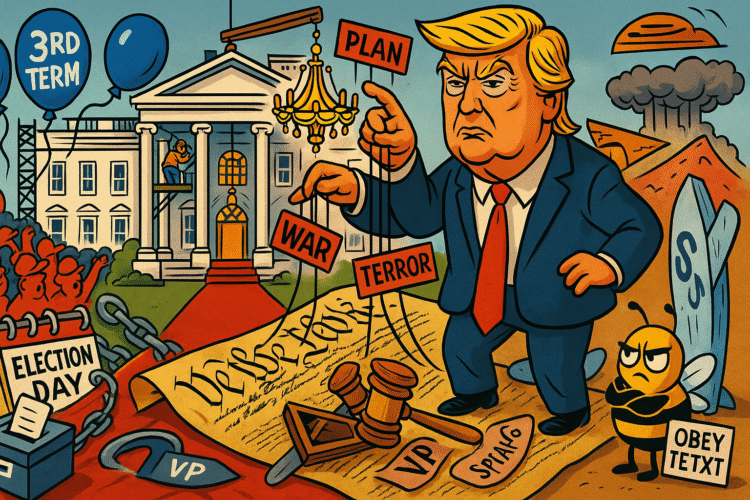
A twice-elected president doesn’t get a do-over—but anyone who watched the fake elector schemes, the pressure on state officials, and the January 6th gambit knows attempts can be real; the likeliest 2028 plays are pressure campaigns, calendar games, and emergency pretexts that slam into law, courts, and a public done being played—no matter how grand the ballroom.
There’s always a man at the end of the bar who orders three shots of inevitability and announces that the Constitution is a mood. Lately he has a microphone, a merchandise pipeline, and a habit of winking at forever. When Steve Bannon boasts there’s “a plan” for 2028, the point isn’t jurisprudence; it’s appetite. And when Trump riffs about “methods,” jokes-not-jokes about third terms, and toys with delay-the-election chatter, the point isn’t subtlety; it’s rehearsal. If you floated through the last decade thinking “he wouldn’t actually do that,” January 6th retired your optimism. He tried to muscle swing-state officials, elevate fake slates, strong-arm the Justice Department into saying “just say it was corrupt,” and summon a crowd to help the pressure campaign breathe. He tried. So the question for 2028 is not whether he’ll try something; it’s which something—and whether the guardrails hold again.
Let’s talk about the theater and the carpentry—because while the talkers talk, contractors work. You don’t rip out walls and re-dress the East Wing like a gilded event venue if you’re spiritually preparing for a graceful exit. You do that if you imagine hosting a long-running show and want a room that flatters permanence. Statecraft meets stagecraft; “no taxpayer dollars” becomes the lullaby; the message is architectural: I’m not staging a farewell—this is act two. You don’t pave a garden into a patio, blueprint a ballroom, and audition donors under new chandeliers if your self-image is a tenant who respects the lease. You do it if you think the lease answers to you. The optics aren’t evidence of law; they are evidence of intent.
Now, back to the law, because it’s the only grown-up in the room. The Twenty-Second Amendment is not coy: “No person shall be elected to the office of the President more than twice.” That is granite, not mood lighting. The only lawful way around it is a new constitutional amendment—two-thirds of Congress, thirty-eight states. Supermajorities are Everest in bowling shoes. Which is why the third-term chatter always drifts toward workarounds: vice-presidential trapdoors, Speaker-of-the-House surfboards, “methods” that never get explained because explaining them kills the mystique. Those fantasies crash into the Twelfth Amendment’s bar on a “constitutionally ineligible” person serving as VP (most scholars read a twice-elected president as ineligible), into the Presidential Succession Act’s anti-contrivance design, and into the most stubborn guardrail of all: legitimacy. A republic cannot run on cleverness that half the country—and the courts—won’t accept.
So if the straight-up third-term route is a legal dead end, what are the real-world plays to watch? Three families of mischief, all tested in 2020, all likely to reprise with louder sound.
1) Pressure Campaigns Wearing a Tie.
January 6th wasn’t a spontaneous tantrum; it was the tail of a months-long dog: pressure on state officials to “find votes,” pressure on legislatures to swap slates, pressure on DOJ to declare doubt so allies could do the rest, pressure on the Vice President to invent powers the Constitution denies him. Expect any future version to skip the learning curve: the phone calls will be harsher, the legal theories slicker, the coordination tighter, the crowd primed earlier. Fake-elector paperwork won’t print on Kinko’s stock; it’ll come pre-lacquered with footnotes. The target isn’t the law—it’s time. Create enough fog between November and the safe-harbor deadlines, and you don’t need to win; you just need to jam.
2) Calendar Games in an Emergency Costume.
We already watched the test balloon: “delay the election” because of mail ballots. The office doesn’t have that power; Congress fixes the date; the term ends at noon on January 20 whether you’ve found the shredder or not. But the appetite for elastic calendars didn’t die; it got bolder. Expect war talk framed as necessity—what if we’re at war, surely we can’t switch leaders now—and its domestic cousin: terrorism from within, as a pretext to “secure” voting infrastructure by restricting it. Translation: take the words that trigger deference (war, terror, emergency) and strap them to the clock. It won’t survive court scrutiny. But scrutiny takes days, and days are the only currency in a post-election knife fight. The play is delay. The payoff is chaos that can be bargained into concessions.
3) Institutional Intimidation and Noncompliance Theater.
If you can’t change the rules, change the behavior of the referees. Threaten secretaries of state with investigations; promise pardons to friendly saboteurs; signal to U.S. attorneys that the path to promotion runs through “election integrity” press conferences; dangle budgets over agencies that won’t invent fraud on cue. None of this wins in the long run; all of it buys noise in the short run. And noise is the oxygen of anti-majoritarian projects. If officials flinch, you don’t need a legal pathway; you need a few local yeses and a national headache.
Add the suspend-the-election fantasy, fueled by the confusion between emergency powers and absolute ones. Presidents have latitude in crises—military deployments under the Insurrection Act, targeted economic authorities under emergency statutes, even narrow communications controls under dusty laws. None of that creates a red button labeled Cancel Democracy. But it creates a story: enemy at the gate; traitors within; only decisive leadership can protect the ballot. The hope isn’t to actually stop the election; it’s to shrink it—narrow access, disqualify swaths of votes, or force improvised procedures that can be attacked later as illegitimate.
So yes: it is a real possibility he’ll try something. The better question is whether we’ve learned to meet attempts fast—with law, with staff who refuse to be stagehands, and with a public immune to the old tricks. Because here’s how this actually plays out if the schemes reprise.
- Eligibility fights start early. States can and will decline to list an ineligible VP on a ticket. Lawsuits file before the primer dries on the yard signs. Injunctions issue. Appellate courts move like fire alarms. The Supreme Court doesn’t have the luxury of slow-walking a constitutional meltdown; it moves because it must.
- Election date and term end are non-negotiable. Congress set the date; the Constitution ends the term. War and terror don’t stop clocks; they heighten turnout. We voted amid Civil War and world wars. “Suspend” is a slogan, not a power.
- Succession-by-stunt collapses on contact. A staged resignation to elevate a twice-elected VP or a contrived double vacancy to spring a Speaker into the chair would trigger a legitimacy crisis that eats its architects. The result isn’t rule-bending glory; it’s mass injunctions, noncompliance, and a market, military, and diplomatic panic that no responsible institutional actor will touch.
- Pressure campaigns meet receipts. We live in an age where every phone leans toward the record button. Threats to “find votes,” to “just say” it was corrupt, to “hold back the count”—all of that is discoverable in hours, not months. The speed of sunlight is part of the guardrail now.
Where does the remodeling fit in? Optics aren’t law, but they are motive. You don’t build a ballroom in a hurry if you imagine yourself a temporary custodian. You build a ballroom if you’re designing a court. You don’t tear out and “modernize” social space that symbolizes the people’s house unless you think the people will keep watching you from the cheap seats. It’s the aesthetic of permanence: patina that says we were always meant to be here. That’s not dispositive. It’s suggestive. It tells you the mind-set you’re up against.
This is the part where a cynical realist admits something unfashionable: the paper alone won’t save us. The Twenty-Second and Twelfth are steel, but steel needs drivers who respect lanes, cops who enforce limits, and a public that refuses to treat celebrity as a passport. The good news is we’ve already rehearsed the response. Secretaries of state discovered spines. Courts discovered calendars that sprint. Staff discovered “no” is a complete sentence. Voters discovered that the cure for magical thinking is turnout.
Also, because the theater won’t stop, we should expect the following choreographies and prepare to boo on cue:
- Friendly resolutions to tweak term limits that will never pass but will hog headlines.
- “Not joking” interviews about “methods” delivered with the charm of a cliffhanger.
- War-room rumor mills pumping scenarios where critical infrastructure or “terror within” justifies “temporary safeguards.”
- Legislative theater aimed at blessing alternative slates or criminalizing routine administration steps to create artificial jeopardy for honest officials.
None of this changes the granite. It changes the tempo. And tempo, in a contested season, is nine-tenths of mischief.
So here’s the battle-worn checklist that beats stunts:
- Name the rules out loud, often. Two terms means two terms. Eligibility for VP tracks eligibility for President. Election dates are statutory. Terms end on schedule.
- Pre-litigate the gimmicks. Don’t wait for November; test the vice-presidential and Speaker gambits in courts now, so the opinions exist before the panic does.
- Harden the bureaucracy. Train election officials, U.S. attorneys, and military lawyers on exactly what lawful orders look like—and what to do when orders aren’t.
- Immunize the public. Teach people that “suspend the election” is marketing copy, not a mechanism. Show the receipts from 1864 and 1944.
- Refuse the palace aesthetic. Treat the remodel as what it is: set dressing that hopes to hypnotize. The Constitution is not impressed by chandeliers.
To be clear, I’m not arguing he’ll succeed. I’m arguing he’ll try, because he already has, and because trying pays—money, loyalty, leverage—even when it fails. The point of the third-term talk, the emergency cosplay, the war-gaming, the donor-lit ballroom isn’t to pass a civics test; it’s to test us. Do we remember the words? Do we move fast enough? Do we still laugh, loudly, at the idea that a clause is a suggestion?
For the mock-serious benediction: I consulted the sacred urn of arithmetic, shuffled the bones of dull law, and returned with this prophecy. If a twice-elected president wants a third term, he must convince two-thirds of Congress and thirty-eight states to amend the Constitution; failing that, he will try to manufacture time, fog, and fear. Our answer is not mystical. It’s procedural—and immediate. We hold the election on time. We count the votes on time. We certify on time. We swear in on time. We admire the new ballroom if we must, and then we walk past it to do the paperwork that ends one term and begins another. The show can redecorate; the calendar cannot.