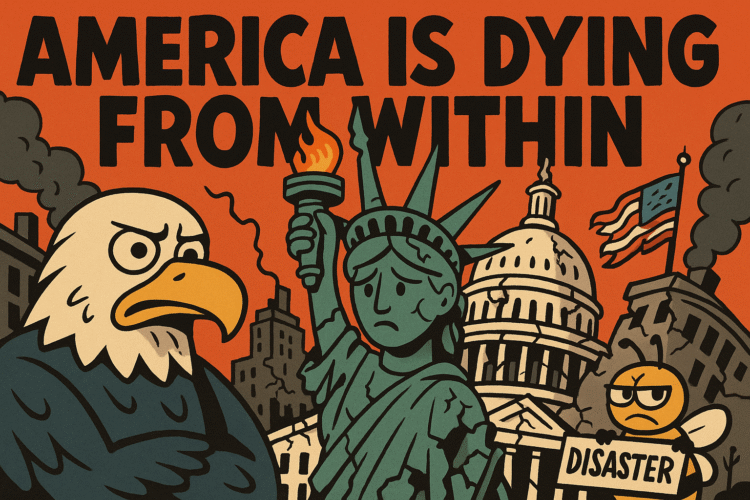
China has officially diagnosed the United States with “terminal democracy.” According to Chinese state media, America is “dying from within,” “a failed state,” and—if you believe the new string of editorials—just a few supply-chain snags away from the global hospice ward. The declaration arrived perfectly timed with the Chinese Communist Party’s closed-door Fourth Plenum, where party elites are drafting the 2026–2030 Five-Year Plan. It’s not subtle. Beijing’s message is clear: “We have five-year plans; you have five-alarm fires.”
And while the Chinese Politburo huddled in air-conditioned harmony, American headlines were doing their part to reinforce the script: tariff spats, sanctions that spooked oil markets, and social media wars that look less like discourse and more like televised therapy sessions with ads for apocalypse-prepper gear.
If statecraft were branding, China just rolled out its rebrand: Technocracy 3.0 — Stable, Orderly, Unbothered. Meanwhile, the United States is currently beta-testing Democracy 0.7 — Now with Even More Dysfunction!
Exhibit A: The Propaganda Buffet
Beijing’s editors don’t just write stories—they storyboard empires. This week’s front page served up an all-you-can-eat sampler of Western decay: inflation, protests, political chaos, gun deaths, and “tariff boomerangs.”
You could almost imagine the state-run news meetings:
“Comrade, the Americans are imposing tariffs again.”
“Excellent! Write headline: ‘U.S. shoots foot; complains about limp.’”
And that’s the genius of Chinese propaganda—it doesn’t need to lie. It just needs to curate, remix, and export America’s loudest self-humiliations back to the global south with a laugh track. Every protest, every filibuster, every viral video of someone screaming about gas prices becomes exhibit material in the argument that “the West is chaos, and chaos is contagious.”
The result? A narrative buffet where China plays the chef, and the United States—loud, distracted, perpetually online—is the entrée.
The Plenum: Bureaucracy as Theater
At the core of this messaging blitz is the CCP’s Fourth Plenum, a kind of policy séance where technocrats pretend they can predict the future by spreadsheet. This one focuses on “advanced manufacturing,” “chip sovereignty,” and “security-first growth”—phrases that sound suspiciously like “build tanks, but make them look like toasters.”
It’s not just economics. It’s ideological branding. The party’s internal line: Look how we plan for five years at a time while America can’t plan for five minutes without a shutdown.
Meanwhile, state broadcasters cut between footage of Xi Jinping gazing wisely at factory robots and clips of the U.S. Congress in verbal fisticuffs. The intended takeaway: Our leaders read policy documents; yours read each other’s indictments.
When Tariffs Become a Punchline
The centerpiece of China’s “America is dying” narrative is tariffs—a kind of economic slapstick routine that keeps writing its own punchlines.
In Beijing’s retelling, Trump’s trade war was the moment the world saw America pick a fight with gravity. The logic was pure Marxist theater: impose tariffs to hurt China, then realize American consumers pay them. Cue inflation, layoffs, and a global supply chain with PTSD.
So now, in propaganda land, tariffs are no longer fiscal policy—they’re America’s new national hobby. China’s newscasters even run side-by-side graphics: on one screen, a Texas farmer looking at unsold soybeans; on the other, Chinese officials cutting ribbons at new factories. The caption: “Efficiency: it’s not just for communists anymore.”
Sanctions, Spectacle, and Self-Sabotage
Then there are the sanctions. The United States recently unleashed another wave targeting Russian oil, hoping to starve Moscow’s war machine while keeping markets calm. Instead, prices spiked, refineries panicked, and Chinese commentators popped popcorn.
Their angle: “See? The Americans punish enemies by punishing themselves.” It’s a cynical narrative, but it resonates internationally. If you’re a trader in Jakarta or Lagos, what you see isn’t moral leadership—it’s volatility. And volatility doesn’t pay the rent.
So every sanction that ricochets into higher prices becomes a propaganda campaign for “Chinese stability.” It’s brilliant in its simplicity: America makes rules; China sells the workarounds.
The PR War for the Global South
Make no mistake—this “America is dying” routine isn’t for domestic morale. It’s a recruitment ad for the developing world. Beijing’s pitch to Africa, Latin America, and Southeast Asia goes something like this:
“You can have elections, protests, and inflation… or you can have bullet trains, industrial parks, and a consistent bedtime.”
It’s not democracy vs. autocracy anymore. It’s predictability vs. drama. And after watching Washington’s revolving door of policy reversals, more than a few countries are starting to eye “predictable” like it’s the last seat on the plane.
That’s the propaganda victory. Beijing doesn’t have to convince the world it’s perfect—just that it’s the adult in a house full of screaming toddlers.
The Feedback Loop: How America Helps the Story Along
The uncomfortable truth is that Chinese state media doesn’t invent America’s chaos—it just mirrors it. U.S. polarization, shutdown threats, social-media tribalism, and cable news flame wars are all open-source content for the CCP.
Every scandal becomes an export. Every viral meltdown is re-edited into a lesson on why democracy is obsolete.
When Trump escalates tariffs, Beijing airs it as proof of capitalist instability. When activists clash with police, it’s proof of civic decay. When Americans argue over whether facts are real, China just sits back, smiles, and whispers, “Case study confirmed.”
It’s narrative aikido—use your opponent’s energy to throw them off balance. And America, lately, has been supplying enough chaos to power an entire global media ecosystem.
The Five-Year Flex
The CCP’s Five-Year Plan is not just a policy instrument; it’s an aesthetic statement. It says: “We think ahead. We engineer outcomes.”
Contrast that with Washington’s political reality, where infrastructure bills die in committee and debt ceilings become hostage notes. Beijing’s planners know the comparison works. It doesn’t matter if their forecasts miss the mark; the point is to look methodical while your rival looks manic.
China’s new goals—chip autonomy, green-tech dominance, military modernization—come wrapped in the serene language of inevitability. America’s goals, by contrast, come wrapped in C-SPAN meltdowns and hashtag wars.
And so, the narrative writes itself: one system builds factories, the other builds committees.
What the Propaganda Misses
Here’s what China’s chest-thumping leaves out: its own economy is staggering. Youth unemployment data went missing—literally deleted from reports. Property giants are imploding. Local governments are broke. The “disciplined technocracy” has quietly started copying the West’s playbook: debt, stimulus, and PR gloss.
The difference? Beijing never admits failure—it rebrands it. When a sector collapses, it’s not a crisis; it’s a “strategic recalibration.” When protests flare up, it’s not unrest; it’s “localized enthusiasm.”
So while Chinese outlets beam out their “America dying” message, the domestic audience gets a curated newsfeed of victory parades and photo ops. It’s governance as theater, complete with costume changes and applause signs.
The Danger of Believing the Script
The problem with propaganda is not that it fools your enemies—it’s that it sedates your own side. When you convince yourself that your rival is dying, you stop preparing for their survival.
China’s overconfidence in America’s decline risks blinding it to its own stagnation. The same way American hubris blinded Washington to China’s rise twenty years ago. Every empire needs an adversary it can underestimate. It’s how decline begins: by assuming someone else’s decay is your destiny fulfilled.
So yes, the “America is dying” line plays well to Beijing’s internal choir. But the more they chant it, the more it sounds like projection therapy from a country whose GDP growth just fell below 4%.
The So-What
This propaganda volley isn’t about information—it’s about permission. Beijing’s elites need a global storyline that justifies their power at home and softens resistance abroad. America’s dysfunction makes that storyline easier to sell.
But the real test isn’t whether China’s talking points go viral. It’s whether the United States still remembers how to govern well enough that nobody believes them.
Democracy is messy, yes. But it’s supposed to be. The challenge now is proving that “messy” is not the same as “dying.” Because if America doesn’t fix its own chaos, China won’t need to topple it. The world will just stop betting on it.
Final Reflection: The View from the Mirror
Beijing’s “dying from within” claim says less about America’s mortality and more about China’s ambition. The plenum’s propaganda, the party’s media choreography, the smug state-TV commentators—all of it reveals a government desperate to crown itself history’s protagonist before the story’s even finished.
But beneath the bravado, both nations are wrestling with the same illness: insecurity dressed as confidence. America masks it with division; China masks it with control. Both call it strength.
In the end, propaganda may win headlines, but governance wins centuries. And if democracy really is dying from within, the cure won’t come from a rival’s gloating—it will come from the mirror America finally decides to clean.