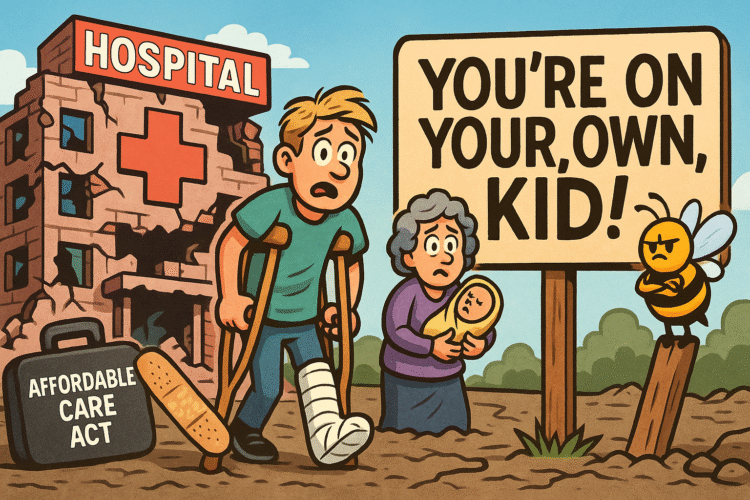
Picture it: You wake up tomorrow and the Affordable Care Act—the rickety scaffolding that keeps our health-care carnival from collapsing—has vanished overnight. No repeal-and-replace. No Medicare-for-All sequel. Just an empty folder where your coverage used to live, and a nation of 330 million people standing in line at CVS holding expired insurance cards and prayer candles.
It sounds dramatic because it is. The ACA is the duct tape, the bungee cords, the mismatched screws holding the collapsing American health system together. Pull it out, and the whole contraption drops like a bad IKEA shelf. But instead of a cheap bookcase, it’s your kid’s insulin, your mom’s chemo, your neighbor’s psych meds, and the emergency room that hasn’t been bulldozed yet.
Start with the most fragile miracle the ACA pulled off: banning insurers from rejecting people with preexisting conditions. That’s tens of millions of us—depending on the study, anywhere from 50 to 130 million non-elderly adults. Remove that clause, and the insurance industry reverts to its natural state: moral nihilism disguised as actuarial math.
It means your cancer history, your pregnancy, your high blood pressure, your depression, your child’s asthma, your acne (yes, acne)—all fair game again for denial. You’ll see glossy pamphlets full of “limited benefit plans” and “affordable basic coverage” that do nothing but cover the drive to the hospital, not the hospital itself. Insurance executives will smile on CNBC while announcing “innovative consumer choice models,” which is code for “try not to die too expensively.”
Remember lifetime and annual caps? The ones the ACA banned after discovering that people with cancer can, inconveniently, live past a billing cycle? Without the ACA, they come roaring back. Over 100 million Americans were once exposed to those caps—people who now, miraculously, haven’t gone bankrupt from simply surviving.
Your insurance company would again get to decide how many dollars your life is worth before declaring, “Congratulations, you’ve reached maximum existence capacity.” In the old world, children with cystic fibrosis and adults with multiple sclerosis often maxed out their coverage before finishing breakfast. The return of rescissions—insurers retroactively canceling policies because they “found an error” on your form—would follow close behind. A typo becomes a death sentence with paperwork.
Then there’s the policy that made Thanksgiving tolerable: young adults staying on their parents’ plan until 26. It’s not a “millennial handout.” It’s one of the most popular laws in U.S. history. Without it, twenty-somethings just starting jobs with no benefits go bare. The ones who get sick will crawl back home to GoFundMe campaigns and student-loan defaults.
The same moral logic applies: if we can’t make college affordable, we may as well make illness unaffordable, just for symmetry.
Meanwhile, Medicaid—the quiet backbone of modern health reform—collapses into a crater. Over twenty million low-income adults gained insurance through expansion. Pull that rug, and the hole swallows everything—diabetes management, addiction treatment, cancer care, rural hospitals. Those hospitals in expansion states saw uncompensated-care costs plummet. Without it, they’ll bleed red ink until they shutter.
That’s not theory. It’s arithmetic. CBO projections and rural-health data have already shown that without expansion, rural hospitals die first. Those facilities anchor entire counties. When they close, the next closest ER might be two hours away—assuming your car starts and your heart attack waits politely.
The ACA’s marketplaces, love them or hate them, exist because of subsidies and cost-sharing reductions. They make private plans even remotely buyable for 20 million people. Take them away and the market collapses. You’ll be told to “shop around,” only to find your “options” now include the resurrected zombie of pre-ACA junk plans—those miracle policies with premiums cheaper than a phone bill and coverage about as useful as a dreamcatcher in a hurricane.
These were the plans that denied maternity care, refused mental-health coverage, and paid about one-tenth of hospital bills. They will come back branded as “freedom.” Freedom to go bankrupt, freedom to die quietly.
The essential-benefits package—the ACA’s mandatory baseline for real insurance—would evaporate. No required hospitalization, maternity, mental-health, prescription, pediatric, preventive, or emergency coverage. You’d once again pay out of pocket for everything except prayers. Cancer screenings become boutique luxuries. Prenatal visits? “Optional.” Depression counseling? “Have you tried yoga and manifesting?”
Even gender-rating returns—charging women more for existing. Repeal the ACA and premiums rise simply because biology has ovaries. The same industry that once labeled pregnancy a “preexisting condition” would finally get to say “Welcome back, ladies!” with a 30 percent markup.
One of the ACA’s quietest triumphs—zero-dollar preventive care—would also disappear. Vaccines, mammograms, colonoscopies, and birth control all covered because prevention saves lives and money. Without it, screenings plummet. Cancers reappear later, deadlier, costlier. Contraception becomes a class privilege. And state legislatures will spend years arguing over which body parts are morally deductible.
The ripple doesn’t stop at insurance. Repealing the ACA detonates a decade of federal plumbing. CMMI—the Medicare innovation lab testing payment models—vanishes. PCORI—the research institute finding out which treatments actually work—evaporates. The Prevention and Public Health Fund—our immunization and outbreak backbone—dries up. Community health centers lose billions. Biosimilars, the cheaper alternatives to costly biologic drugs, get stuck in legal limbo. Even calorie counts on menus and workplace lactation rooms take a hit.
The ACA also closed the Medicare Part D “donut hole.” Without it, millions of seniors fall back into the gap, paying thousands more for prescriptions. Grandparents start splitting pills again, rationing insulin, dying quietly because ideology said compassion was too expensive.
Hospitals will hemorrhage billions in unpaid bills once patients lose coverage. Those costs won’t vanish—they’ll ricochet into premiums, taxes, and medical debt. Every dollar the uninsured can’t pay will be spread across those who can. Premiums rise, rural hospitals fold, urban ERs buckle, and the ER becomes the nation’s default primary-care system again.
Public health will get kneecapped right when we’ll need it most. The ACA’s funding streams for epidemiology and disease prevention keep local systems alive. Kill them, and the next outbreak response will come from a Facebook comment section. America already failed its pandemic stress test; this would destroy the lab.
Employers will also rediscover their favorite vintage cruelty—lifetime caps, benefit carve-outs, gender pricing. HR departments can’t wait to re-introduce “preexisting condition” checks at onboarding. Corporate America will call it “freedom of contract.” You’ll call it a panic attack in a waiting room.
And politically, the “repeal and replace” farce will resume. For over a decade, Republicans have promised a replacement that never materialized. Because to design one, they’d have to admit Americans actually like everything the ACA does. Preexisting-condition protections poll above 80 percent. Coverage for young adults? Around 90. Ban on lifetime caps? Same. The public just hates the name “Obamacare,” not the law itself.
Scrapping it isn’t reform—it’s nihilism. It’s health policy as performance art, ideology masquerading as governance. It’s cruelty disguised as fiscal prudence, where the moral victory is simply making someone else’s life harder.
The data, meanwhile, are unambiguous. The ACA drove uninsured rates to record lows, reduced medical bankruptcies, narrowed racial gaps, improved maternal outcomes, and stabilized markets. States that embraced expansion saw lives saved and hospitals survive. States that didn’t saw mortality rise.
And prudence—the Founders’ lost virtue—demands we learn from that evidence. They were many things, but they weren’t fools. None of them ever wrote, “Burn it all down and call it freedom.”
Repeal without replacement isn’t conservative or liberal. It’s cowardice with a press release. It’s the governing equivalent of yanking out the plane’s landing gear mid-flight because you think drag looks unmanly.
And here’s the bitter irony: even people who swear they hate the ACA still love its parts. Ask them, and they’ll tell you they support everything inside it—just not the politics attached. It’s the Nickelback of laws: everyone claims to despise it while quietly humming along.
The adult path forward is simple: improve it. Lower drug prices, add a public option, expand Medicaid to holdout states, tighten billing regulation, fix subsidy cliffs. Strengthen mental-health parity. Don’t tear down the only structure preventing medical Darwinism.
Because the ACA was never the ceiling—it was the floor. It banned the worst abuses and made coverage the rule, not the exception. It’s the scaffolding of decency in a system built on profit. Remove it, and you don’t get freedom. You get chaos. The invisible hand becomes a closed fist.
If repeal day ever comes, the morning will start quiet. Then the headlines: tens of millions uninsured overnight, hospitals swamped, families panicking. The call centers jam. The politicians shrug. And America learns, again, that “freedom” without infrastructure is just abandonment with branding.
When the dust settles, the last thing still affordable will be denial.