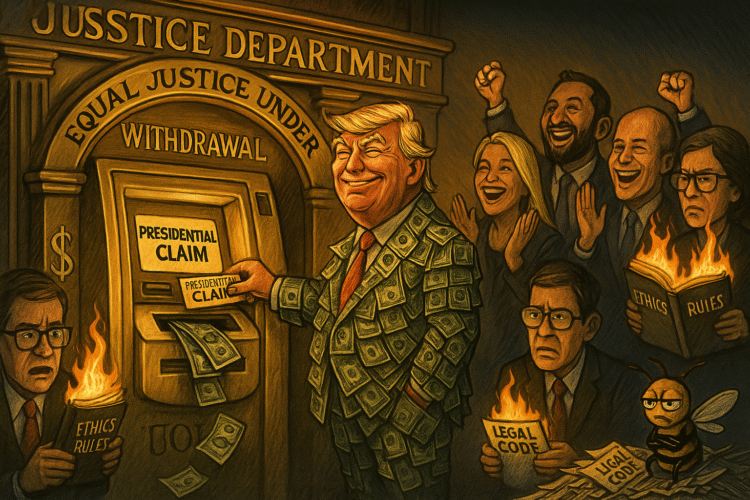
If late-stage empire ever needed a mascot, Donald Trump just nominated himself—and sent the bill to the Justice Department.
According to The New York Times (and verified by outlets that still remember what fact-checking is), the President of the United States is currently pressing his own Justice Department to pay him $230 million. Not for infrastructure. Not for veterans. For himself. The rationale? He claims the FBI and special counsel investigations into him were acts of “malicious prosecution” and “privacy violations.”
Yes, you read that correctly: the man who used the Oval Office to halt his own prosecutions now wants taxpayer restitution for the stress of being investigated in the first place. It’s like an arsonist billing the fire department for emotional damages.
The Self-Litigation Nation
The legal situation is breathtaking in its absurdity. Trump has filed two administrative claims with the very department he controls—effectively suing himself, while insisting he’d have “final say” over any payout. The sum: roughly $230 million, an oddly specific figure that suggests at least one of his lawyers owns a calculator, if not shame.
He’s floated the idea of donating the money to “charity,” which, in Trumpian dialect, means “an entity with my name on the check.” Alternately, he’s teased using it to fund his White House ballroom, which has now become the architectural embodiment of this presidency: gilded, gaudy, and financed by people who didn’t agree to it.
The whole thing would be funny if it weren’t also a direct challenge to the last remaining premise of American governance—that the Justice Department serves the public, not the president’s wallet.
The New Math of Justice
Let’s break this down. Trump’s claim rests on two arguments: first, that the FBI’s 2016 Russia investigation was a “witch hunt” that harmed his reputation (a reputation built largely on declaring bankruptcy and hosting beauty pageants). Second, that the Mar-a-Lago classified-documents case constituted “malicious prosecution,” even though the only reason it stopped is because he became president again and told everyone to stand down.
So, in essence, Trump is demanding compensation for being inconvenienced by the legal system he undermined, in investigations he derailed, using the authority he reclaimed. The circularity is poetic. He’s the plaintiff, the defendant, and the judge—America’s first self-contained lawsuit ecosystem.
If Kafka and Ponzi had a baby and made it president, this would be the baby’s favorite hobby.
The DOJ’s Dilemma: Ethics vs. Employment
The Justice Department, once the symbol of legal independence, now looks like the HR department at a mob front. Attorney General Pamela Bondi—Trump’s longtime loyalist and Florida crisis manager—heads an agency that’s supposed to enforce ethics screens against conflicts of interest. In practice, those screens are about as effective as a shower curtain in a hurricane.
Bondi’s deputies include Kash Patel, now FBI Director, and Todd Blanche, Deputy Attorney General—both of whom have represented or defended Trump in prior legal battles. That means the chain of command for approving Trump’s settlement runs through a network of his own former attorneys. It’s less a justice system than a reunion tour.
The Justice Manual, the DOJ’s own procedural gospel, requires that large settlements undergo multiple layers of review by career attorneys and the Office of Legal Counsel. But when the claimant is the boss, and the boss has already said “I’ll decide what’s fair,” every signature becomes a loyalty oath.
The department faces a choice: reject the claim and risk being purged, or approve it and redefine corruption as “administrative efficiency.”
The Charity Con
Of course, Trump insists that if he wins, he’ll donate the money to charity—perhaps one of the same “charities” that once paid his legal fees, bought his portrait, or funded a fountain shaped like his ego. His idea of philanthropy has always been a magic trick: take public funds, rebrand them as generosity, and disappear the receipts.
In this case, the “charitable” option could involve a renovation of the White House ballroom, that Versailles-by-Wayfair project he’s been dreaming about since before his second inauguration. “We need a space,” he reportedly told aides, “that reflects the success and beauty of this administration.” Translation: chandeliers big enough to distract from moral collapse.
Congress: The Sleepy Oversight Committee
One might expect Congress to intervene, given that the president is now openly attempting to extract personal money from the Justice Department. But this is an era when “checks and balances” means Venmo notifications between donors and lawmakers.
Republicans will call it “compensation for political persecution.” Democrats will issue sternly worded letters no one reads. Somewhere, an intern will design a #JusticeForTrump hashtag that trends for twelve minutes before collapsing under the weight of irony.
The only thing that might actually stop this grift is not ethics, but paperwork—career DOJ attorneys refusing to initial a form that would make them accessories to history’s weirdest self-settlement.
The Legal Precedent Nobody Asked For
Let’s assume, for the sake of dystopian completeness, that Trump succeeds. The DOJ cuts a check to its own boss. The precedent would be staggering: any future president could sue the federal government for “damages” caused by previous administrations or investigations.
Think about it: imagine Nixon billing the IRS for “emotional distress.” Imagine Reagan invoicing the FTC for hurt feelings over Iran-Contra. Imagine every cabinet secretary filing a tort claim every time a headline bruised their self-image. The United States would become a nation of litigants arguing with its own reflection.
And make no mistake, this isn’t some legal curiosity. It’s a template. Once the line between public duty and personal grievance disappears, governance becomes a customer-service hotline for narcissists.
The DOJ’s New Motto: “Equal Justice Upon Reelection”
What’s happening here isn’t just transactional corruption—it’s conceptual vandalism. The phrase carved above the Supreme Court, Equal Justice Under Law, is being rewritten in real time as Authorized Reimbursement Upon Reelection.
The mechanics are already in motion: a DOJ now structured around personal loyalty, a press corps trapped between exhaustion and disbelief, and a public so desensitized that billion-dollar self-compensation barely registers as scandal.
The irony, of course, is that Trump’s claim rests on being wronged by investigations he repeatedly bragged about surviving. He once called the Russia probe a “total vindication.” Now it’s an invoice.
When history finally processes this era, it’ll have to invent new verbs. You can’t simply say a president “won” against the law when he’s both plaintiff and paymaster. He didn’t win—he repossessed justice.
The Loyalty Paradox
The legal question at the heart of this fiasco—can a president settle claims in his own favor—is secondary to the moral one: will anyone stop him?
Inside the Justice Department, there are still career attorneys who believe in the law as something other than a decorative principle. They’re the ones being asked to review Trump’s settlement claim, and their options are bleak. Approve it, and they become accomplices. Deny it, and they become unemployed.
It’s the loyalty paradox of modern autocracy: if your virtue is independence, your reward is exile. If your virtue is obedience, your reward is complicity.
The Mar-a-Lago Twist: Prosecutor, Interrupted
The most galling part of this saga is that one of Trump’s claims stems from the Mar-a-Lago classified-documents case—the same investigation he halted upon taking office, effectively pardoning himself mid-process. Now he’s arguing that the very existence of that probe constituted “malicious prosecution.”
By this logic, any criminal inquiry that doesn’t end in conviction becomes evidence of government abuse. The more often the system clears him, the more he gets paid. It’s a feedback loop of absolution: the reward for being too powerful to indict is a government check for your trouble.
It’s not justice; it’s cashback authoritarianism.
The PR Spin: “Reparations for the Persecuted President”
Expect the right-wing media apparatus to frame this as reparations—an overdue repayment to a “wronged leader.” The talking points are already writing themselves:
- “If they can do it to Trump, they can do it to you.”
- “He’s just seeking fairness.”
- “The president deserves compensation for years of fake news.”
What they won’t mention is that “doing it to you” usually means being accountable for crimes you actually committed.
The optics will be surreal: a billionaire president cutting a check to himself from public coffers, surrounded by aides applauding his courage for “standing up to corruption.” Somewhere in a corner, the Constitution will be whispering, “I tried.”
The Career Lawyer Rebellion
There’s a small chance—small but real—that DOJ’s rank-and-file will resist. That a handful of attorneys will draft memos reminding the world that no one, not even a president, can be both claimant and adjudicator. That the Justice Department’s integrity depends on saying no even when it costs everything.
If that happens, expect firings. Expect resignations. Expect headlines about “deep state obstruction.” Because in this White House, loyalty isn’t measured by competence but by willingness to dissolve boundaries.
These lawyers will be vilified as traitors, accused of sabotage, and probably audited for good measure. But they’ll also be the last flicker of institutional sanity in a government now run like a reality show whose grand prize is public money.
The Ballad of the Self-Paying President
It’s tempting to laugh. After all, this is the same man who once declared bankruptcy six times, claimed net worth as a matter of “feelings,” and bragged about making money off other people’s losses. Of course he’d turn the Justice Department into an ATM. It’s his life’s work—monetizing disaster.
But the stakes are deadly serious. If Trump wins this settlement, he won’t just pocket a windfall. He’ll rewrite the relationship between power and accountability. Every future president will inherit a road map for self-enrichment disguised as grievance redress.
It’s monarchy by invoice.
Closing Section: The Empire of Receipts
Someday, historians will look back at this moment—the sitting president petitioning his own Justice Department for damages—and realize it was the purest expression of the age.
An empire so addicted to spectacle that corruption no longer shocks. A public so numbed by scandal that ethics become nostalgia. A government so self-referential that it literally starts paying itself to exist.
Maybe Trump will get his check. Maybe the DOJ will blink. Maybe Congress will yawn.
But even if the payment never clears, the message already has: in America’s new justice economy, the line between restitution and racket is just a memo away. The motto isn’t “In God We Trust.” It’s “In Myself I Bill.”
And somewhere in the background, the bee of history hovers—unimpressed, watching the golden dome of self-interest collapse into the ledger where all empires eventually settle their debts.