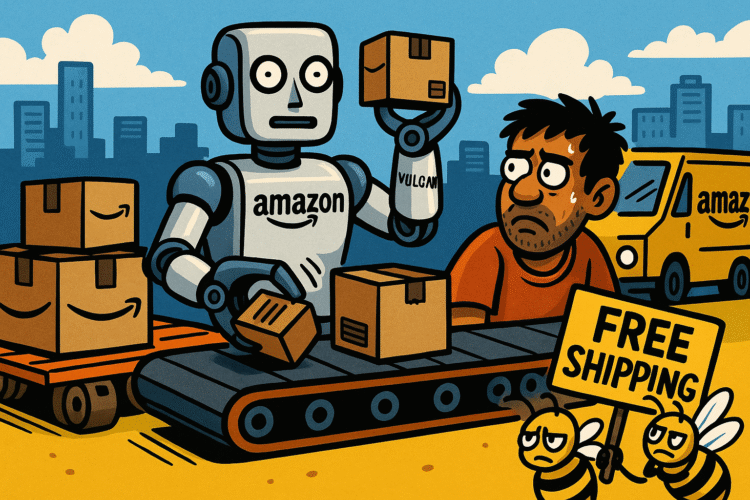
There’s a moment in every supposedly “innovative” company where the victory lap turns into a funeral procession—and for Amazon, the leaked plan to automate three-quarters of its operations and eliminate or avoid hiring over 600,000 U.S. jobs by 2033 marks the coffin nail. These aren’t little tweaks; internal strategy documents show the robotics team wants to avoid hiring and cut roughly 160,000 roles by 2027, saving an estimated $12.6 billion—about 30 ¢ per item shipped.
If you’d hoped the “customers first” rhetoric would mean a pause on turning humans into spare parts—well, you’re ten million pacers late. The hordes of bots—over one million already deployed—are issuing the memo: your job is optional. Behind the facade of “cobots” and “flow-control specialists,” the real message is clear: human labor is yesterday’s legacy cost.
Robots Save Money. People Save Lives.
In the leaked slide deck, Amazon’s robotics unit mapped a future where 75 % of its fulfillment network is dominated by machines, not humans. That’s not “augmented workforce”—that’s workforce elimination. One internal document bluntly refers to “avoid hiring” in its staffing plans. The spokesperson’s response? “That’s one team’s view.” The public script? “Robots free up employees for higher-value tasks.” Right. Value to whom?
It’s like your doctor saying “we’re switching you to batteries so we can upgrade your model.” But you’re still the body on the slab. The company claims seasonal hiring continues—and it does—but that’s like a firing squad offering you a T-shirt during the volley.
The Bot Arms Race: Vulcan, Logistics, and Labor Deficit
Let’s unpack the tech for a moment. Amazon is already deploying “Vulcan” tactile robotic arms, expanding what machines can stow and grab—tasks once considered too delicate for automation. Meanwhile, the bot fleet (over one million strong) propels 75 % of deliveries.
In logistic towns—those places that built tax maps and training tables around Amazon’s human workforce—the message just landed like a stone: “You’re optional.” And for gig workers around the country, the course correction starts with fewer boxes, fewer hands, fewer hours. The math on the front line is about to rewrite entire communities.
The Economics of “Efficiency” — And the Externalities
Here’s the investor pitch: fewer payroll entries = higher margins = cheaper delivery. The PR deck calls it “innovation.” The real term? Externalizing costs. Communities absorb the retraining, unemployment, and housing shocks. Unions brace for local tax-base collapses as staffing shrinks. City councils will have to fund the cost of robot-raw neighborhoods where jobs evaporate faster than lithium-ion batteries.
If Amazon flips from job creator to net job destroyer, the ripple runs beyond warehouse floors. Cargo-van hosts, cafeteria staff, temp turnovers—they all join the fast-track toward the exit ramp. Economists warn this shift is phasing in broad labor market risk: one of the biggest employers in the country becoming a net job destroyer instead of a job creator.
The Tech-Ology Euphemism Treadmill
Amazon’s leaked doc reveals the word “automation” is often avoided in favor of “flow control,” “cobots,” and “higher-value tasks.” Because “we’re replacing you” doesn’t sell as well as “we’re augmenting you.” The treadmill of euphemism keeps spinning: layoffs become “redeployment,” pink slips become “workforce evolution,” human redundancy becomes “operational agility.”
In the tech offices of the west coast and logistics hubs of the Midwest, the silent alarm is ringing. The real question becomes: if you’re calibrated as cargo now, when do you become obsolete?
What To Watch — The Checkpoints of Replacement
- When does staffing drop faster than automation language declines? If headcounts shrink and “hiring plans” are the only public-facing metric, the bots win.
- Will lawmakers attach “automation dividends” to social-safety contributions? If Amazon nets billions but regions face retraining bills, will Congress demand a tax on the robot premium?
- Will consumers benefit from lower prices—or just thinner staffing and more algorithm-driven labor that knows fewer rights? The question: is your Prime package fast because humans care, or because machines don’t clock out?
- Will regulatory frameworks adjust? If “efficiency” externalizes job loss, should antitrust and labor policy treat this as innovation—or as exploitation?
The Industry That Built Us Now Removes Us
Historically, Amazon prided itself as one of the largest U.S. employers. Now, by 2033, the plan is to hire much less by design. The workforce isn’t scaling—it’s shrinking. Communities built around Amazon’s human employment footprint will have to ask: What replaces the jobs? What replaces the tax base? What replaces the sense of purpose that employment once provided?
From logistics hubs reeling at shift eliminations to suburban trucking towns abruptly losing volume, the transition will be messy. The company hides behind language of “jobs changing” but the reality is: human jobs are becoming optional supply-chain nodes.
Safety, Outsourcing, and the “Robot at Work” Externality
Let’s talk safety. When machines handle more load, fewer humans are in the hazard loop—but fewer humans also means fewer eyes, less judgment, and perhaps more incidents that don’t make headlines. In warehouses built for human-machine synergy, the human still intervened. In the future, fewer humans stand ready. That’s not just efficiency—that’s risk migration.
The other metric: organizational loyalty. When your employer treats labor as variable staffing, when machines replace you faster than your lease updates, what happens to morale? What happens to long-tenure culture? What happens when you know you’re the next “optional”? Workplaces morph from careers into algorithm-driven gigs; safety nets shrink; workers become nodes in the supply network.
The Big Picture: Innovation or Privately Priced Public Fallout?
Automation is not new. But when the biggest logistics network in the country redefines human labor as temporary ballast, we shift into a different realm. The key is: whose cost? Amazon grabs the savings. Regions absorb the job loss. Workers lose not just wages but opportunities and community. When externalities become local legacies, there’s nothing “private” left—it becomes public ruin disguised as corporate progress.
When the company says “We’re hiring 250,000 this holiday,” it feels like a dumping bin of human bodies while the ink on the auto-layoff plan is still drying. The mantra of “jobs created” sounds hollow when jobs replaced are invisible.
Final Reflection: The Warehouse of Tomorrow—Where Humans Were Optional
We are at a touchstone moment. Amazon isn’t just shifting how many humans it employs. It’s shifting how work is defined, measured, managed. The plan leaked: avoid hiring, deploy robots, cut human cost per item shipped to 30 ¢. That number won’t land on phones—it will land on town budgets, union dues, and workers’ futures. The message to the workforce is clear: you’re optional.
If you believe in work as human dignity—not just cost centers—then the Amazon playbook demands scrutiny. The bots arrive. The jobs disappear. And the company keeps saying “innovation.” What they don’t say: “We saved billions while your community lost its middle class.”
Here’s the truth: if labor becomes a variable, then the variable becomes disposable. The only invincible node in the supply chain becomes the shareholder. And that means the human becomes the expense.
If we’re going to trust machines to do the work, then we should also expect systems to protect the people displaced. Because “automation wins” is not a civics slogan—it’s a civic crisis.