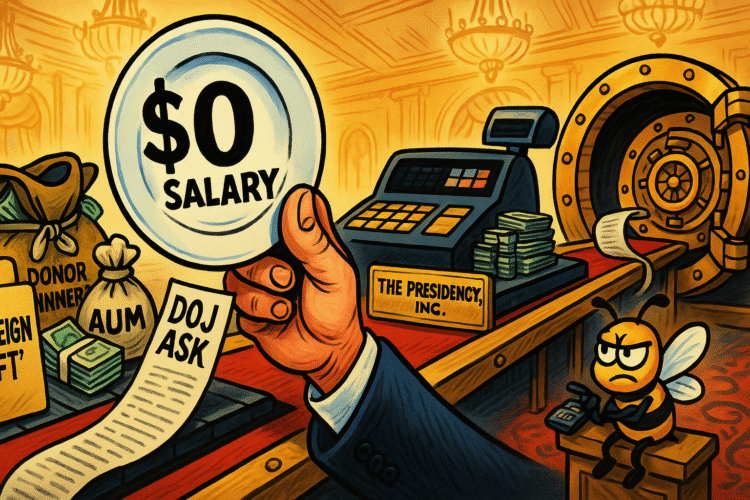
He brags he doesn’t take a salary, then turns the presidency into a cashback card with no limit—platform settlements, sovereign “gifts,” crypto windfalls, donor dinners, family funds, and hotel invoices humming like slot machines—daring the country to mistake a press release for ethics.
He wants the zero to glow like a halo. He holds it up the way a salesman holds up a loss leader: look here, not there; admire the price, ignore the margin. Zero is clean, photogenic, easy to tape to a lectern. It’s the moral equivalent of a white tuxedo—blinding in the flash, useless in the rain. What vanishes under that glare are the other numbers, the fat ones that change the climate of a country: the $24.5 million that slid across the table from YouTube, the ~$25 million from Meta, the $10 million from X, and the network pair—$16 million and $15 million—that arrived like two polite knocks on a private door. The checks don’t confess guilt; they confess leverage. A $0 paycheck waves on camera while the ledger behind it multiplies like a family of rabbits that never learned restraint.
The trick begins with distance as theater. He didn’t divest, he delegated. He announced that daily management was now a family heirloom, polished and displayed in a glass case labeled “Trust Me,” as if proximity were a disinfectant. Ethics in Washington once functioned like a thermostat—quiet, boring, keeping the temperature liveable. Under this arrangement, ethics are a scented candle: lovely, optional, and most effective once the smoke has already been absorbed by the curtains. If the president profits from his brand while his brand governs, the rest of the plot doesn’t require a spoiler; it unfolds like a recipe card you already stained with gravy.
Listen to the cash register bell inside the lawsuits. Our civic religion used to teach that courts are for truth and principle; he turned them into vending machines that accept publicity as currency. File, bluster, fundraise, settle. Out come the cans: YouTube $24.5 million, Meta ~25, X at 10, the two networks at 16 and 15. Doctrines change, sure, but not as fast as bank balances. The cases evaporate into statements about vindication, and the money becomes “mission support,” which is a lovely euphemism for marble, lighting, and the prestige that accrues to a leader who can point to a chandelier and say, “See? Free.” Free because “no taxpayer dollars,” which is like calling a thunderstorm dry because the rain landed on someone else’s roof.
Then the plane. A four-hundred-million-dollar luxury 747, a gift that blinks like a neon sign in a chapter of the Constitution written in candlelight. In the old stories, foreign emoluments were a dragon at the gate; in the new tale, the dragon shows up painted red, white, and blue and is welcomed with a ribbon and a photo op. We are told the jet will be retrofitted, that it serves national prestige, that friendship between nations sometimes wears aluminum. The real story is more ancient: a monarchy offered tribute to a man who hates to be told no. The tribute fit on a runway. The message fit on a bumper: what’s a little gratitude among friends.
And while the audience was still clapping, a new ask stepped onto the stage wearing the same tux: up to $230 million, not from a company this time but from the Department of Justice itself, as if independence were a paywall you can clear with a good lawyer and a louder microphone. The legal merits are beside the point; in show business, a loss is as good as a win if you can sell it as persecution. The $230 million is either a trophy or a premise; both convert cleanly into fuel. The result is the same: the zero on the paycheck watches as the commas in the ledger march in formation.
All this cash has a way of flowing through pipes that glow. Consider the prettiest circle in a town full of them: at least $22 million of the YouTube settlement routed to a “Trust for the National Mall” and a White House ballroom fund, precisely as demolition chewed at the East Wing while formal approvals were still stretching. Sue a platform, bank the settlement, pour the money into limestone and chandeliers, announce that no taxpayers were harmed, then invite donors to bless the light fixtures they effectively underwrote. Architects call a drawing that explains the soul of a building a parti; accountants, if they were poets, might call this one a perfect rhyme.
Before we roam the halls, we glance at the coin booth near the entrance. The $TRUMP memecoin debuts before the oath dries, a cartoon crown floating on a tide of promises, disclaimers, and winks. The World Liberty Financial token—its name so earnest it feels like a parody of patriotism—arrives to a fanfare of candlesticks and influencers. On good days the family’s paper gains stretch into the multiple billions, not because a product shipped or a factory hummed, but because the loudest microphone in the world is a weather system and markets bend toward weather. When critics ask who owns what, the answer toggles between “not us” and “definitely us” with the agility of a magician palming a coin while waving the other hand at the balcony. Policy warms, the sector blossoms, the chart hiccups north, and the $0 paycheck gazes skyward, pretending it knows nothing about thermals.
In the background—always the background, because discretion is the highest-end service—Affinity Partners swells past $4.8 billion and toward $5.4 billion in assets under management, a number that grows like a vine in rich light. A $2 billion anchor from one sovereign fund occupies pride of place in the greenhouse, and other Gulf neighbors send over watering cans labeled “partnership.” Performance is uneven, as performance in new funds often is; fees, however, are the tortoise that always wins the race. The son-in-law learned a sturdy lesson: if you cannot print money, you can at least staple a small receipt to every bill that moves past your desk. Meanwhile the father-in-law keeps supplying the weather that makes vines possible.
Parallel to the ledgers is the quiet toll of rooms, beds, greens, and tables. A nation’s map is pocked with properties that share a surname with the man who signs things on camera, and those properties dutifully transform statecraft into reservations. Dignitaries don’t book suites; they acquire adjacency. Delegations don’t pay for filet; they purchase proximity. A tee time for four becomes a diagram, a head table becomes an itinerary, a ballroom becomes a catwalk for policy. “Access” is never uttered because the invoice uses a different word: hospitality. The $0 salary smiles like a centerpiece while the true till sings in the back.
The comms shop understands the physics of scandal in the streaming era: volume beats virtue, and repetition is exoneration by fatigue. The formula is painfully elegant. Convert ethics alarms into brand fuel (“They can’t stop talking about us!”). Treat watchdogs as frenemies whose bark adds a beat to your soundtrack. Hold up every settlement check as an act of civil-rights theater, then route a slice of it to a “public” project linked intimately with your brand, so the moral looks like architecture and the architecture looks like inevitability. When “no taxpayer dollars” is the lullaby, precedent becomes the price no one remembers to count.
While cameras linger on renderings and ribbon colors, agencies quietly learn new yoga. General counsels practice writing memos that tie conflict-of-interest knots into bows. Procurement officers keep an ear out for the backhoe’s cough; if steel arrives early, “inevitability” becomes the doctrine of the day. Career staff, those dull saints, discover that a politely sharpened “no” now inspires press releases. Inspectors general find their warnings shelved under “politics,” then watch as the shelving unit is replaced with a mirror. Every time you hear “no taxpayer dollars,” translate as “public cost, deferred and disguised.”
Meanwhile, the press—wired for fireworks, allergic to spreadsheets—keeps trying to squeeze a ledger into a headline. A single bang earns a segment; an accumulation earns a sigh. He knows this and obliges with stunts that reset the clock. The scandal is never the event; it is the stack. No one likes to read stacks. Everyone likes to watch confetti. He throws confetti like a church of spectacle, then passes the plate.
Add the sovereigns again, because their jewelry catches the light. A $400 million jet entering the camera’s eye isn’t a legal footnote, it’s a language lesson: what used to be called tribute now goes by “strategic partnership.” The photo on the tarmac is the point, the way a signed menu is the point after the dessert has vanished. The Founders wrote a curse against gifts from foreign princes because they had tasted monarchy; we are asked to taste glamour and call it democratic calories. The $0 salary nods along, content to be the after-dinner mint.
Line up the numbers in a single breath, because breath is the only instrument that still blades through hype. $24.5 million, ~$25 million, $10 million, $16 million, $15 million, at least $22 million routed to a friendly “trust,” a $230 million request to the Department of Justice as if justice were a cash machine, a $400 million jet that sparkles like a compliment, multiple billions in crypto-adjacent paper wealth baptized by policy warmth, $4.8 to $5.4 billion in family assets under management fertilized by sovereign sunshine, and a slow, steady tributary of rooms, meals, and tee times where policy meets linen. Then place the $0 salary on top like a peppermint, and ask yourself whether the flavor has changed or only the garnish.
The defense, sturdy as an umbrella that only works indoors, is “no law forbids it.” Laws were written by people who still felt the heat of shame. Shame is not a universal element; it can be mined from a culture or paved over with a parking lot. When the culture shifts to applause-as-alibi, the statutes sound like bedtime stories and the loopholes sound like bus lanes. If the law does not prohibit sovereign planes, settlement routing, token moonshots, family fee streams, hotel adjacency, or a nine-figure ask to the justice system, then the defense will always win a game whose rules it authored. The public can either rewrite the game or pretend the score represents consent.
What would rewriting look like without a translator. Mandatory divestment with teeth sharp enough to leave marks. Blind trusts that deserve the word blind, not theatrical sunglasses. Public accounting of any settlement paid to or by a sitting official that breaches, say, $100,000, with a ban on redirecting those funds to vanity projects wrapped in civic ribbon. An emoluments regimen that counts planes and praise as the same currency if they arrive stamped by monarchs. A crypto firewall so blunt even a meme can understand it: if your name rides the token, your hands are off the policy. A family-office firewall that treats sovereign capital like high-voltage wire—not to be touched, not to be invited into the house, not to be decorated with euphemisms.
There will be pleading about unfairness—why us, why now, why punish success, why hate prosperity. The answer is old and dull. In a republic, we do not criminalize wealth; we quarantine it from public decision-making so that consent remains voluntary rather than purchasable. We do not banish success; we deny it the right to turn the Resolute Desk into a point-of-sale terminal. We do not scorn a zero salary; we scorn the spectacle of a man framing a souvenir banknote while the vault door swings behind him.
The metaphors multiply because the conduct does. He treats the presidency like a casino loyalty program: spend outrage, earn points, redeem for upgrades. He treats settlements like scratch-off tickets and holds the winners up in the press room with the solemnity of a priest. He treats sovereigns like VIP hosts who comp the suite because his presence fills the floor. He treats crypto like a confetti cannon that occasionally spits out gold. He treats donors like studio audiences and sells them the chance to clap at the right time. He treats agencies like stagehands and the law like a lighting cue.
You can feel the architecture groan under the redecoration of norms. What used to be sturdy—appearances matter, conflicts are avoided not explained away, divestment is a duty not a voluntary stunt—buckles under the weight of “nothing to see here.” Once upon a time Jimmy Carter sold a peanut farm because the appearance was the point; now appearance is the enemy, and shamelessness is a kind of Teflon. “I don’t take a salary” becomes the magic phrase, as if a zero could launder all other digits by association.
It keeps working because feelings outrun facts. Zero feels like sacrifice. Millions feel like math. Math is homework; sacrifice is story. He is a born storyteller of grievance and a tireless clerk of his own cash register, and the combination is a carnival: tilt-a-whirl headlines up front, counting in the back. We get dizzy. He gets paid. The $0 salary waves from its little pedestal like a bobblehead.
There is a way out, and it’s aggressively boring. Inventory the inflows like a shopkeeper. Add the platform checks—$24.5 + ~25 + 10 + 16 + 15. Add the $22 routed to the trust-and-ballroom constellation. Add the $230 ask to DOJ, the $400 in aviation gratitude, the multiple billions in token weather, the $4.8–$5.4B in family AUM, the steady hospitality tributaries that don’t fit in a headline. Then repeat the sum until the glamour leaks out and you’re left with arithmetic. Arithmetic has never cared who you voted for.
Because here is the secret the spectacle prays you forget: a grift is made of receipts, not rumors. The receipts are public. They are the press releases, the filings, the cameras rolling as men describe checks with a smile and call them vindication. The cost is public, too. Not just in dollars—though dollars will be spent to shore up crumpled norms—but in the more fragile currency of trust. People begin to believe nothing matters. That is the counterfeit the show wants to circulate. It spends everywhere, and it buys apathy.
So we reach for metaphors the way a sailor reaches for ropes in high wind. The $0 salary is a souvenir spoon; the silver service lives elsewhere. The settlements are a stack of chips you cash on the way out, grinning. The sovereign jet is a corsage pinned to a tux someone forgot to return. The crypto chart is a weather vane screwed to the roof while the man of the house boasts that he controls the breeze. The family fund is a silent metronome. The donor dinner is a mirror in which influence checks its tie. The hotels are the turnstiles. The law is a theater program with the wrong cast.
If it sounds cynical, it’s because the conduct recruited cynicism as a bodyguard. But cynicism isn’t a strategy; it’s a shrug in a borrowed tux. The strategy is cheaper and older. Restore the denominator. The job is service, not sales. Private gain is an allergy, not an appetite. Zero is only noble if it’s honest. If it’s a decoy, call it that without adjectives: a decoy. Then move your feet.
Imagine a briefing in which someone says, flatly, “No more hush of numbers.” Imagine a hearing that treats routing settlement money into pet projects as the conflict it obviously is. Imagine a rule that makes accepting a $400 million plane from a monarchy a joke on late-night television instead of a weeklong debate about optics. Imagine a crypto disclosure regime that requires names and wallets and a quarantine from policymaking for anyone whose family can move markets with a shrug. None of this is romantic. All of it is freedom maintenance.
He will keep selling the plate with the $0 stamped in the center. He will wave it at rallies. He will pose with it like an Olympic medal. He will hope you never flip it over and read the manufacturer’s mark: $24.5M + ~$25M + $10M + $16M + $15M + $22M routed + $230M asked + $400M accepted in spirit + multiple billions in token weather + ~$4.8–$5.4B managed beneath a family roof + a river of hospitality revenue that never asks hard questions. The mark doesn’t lie. Plates don’t have to.
If you need a final image to carry out of the theater, take this: a cashier’s tape from a megastore called The Presidency, Inc., running on and on until it curls at your feet. At the top, a promotional line—“$0 SALARY!”—decorated with patriotic stars. Beneath, the items: settlement, settlement, settlement, settlement, settlement, routed funds, sovereign plane, crypto surge, family AUM, DOJ ask, suites, steaks, tee times. At the bottom, a total you cannot read without blinking. The cashier asks whether you’d like to round up for democracy. You say yes. The register pauses. The cashier smiles gently and says, I’m sorry, sir, democracy doesn’t qualify for discounts today.
That is the punchline hiding in the prose. The $0 was never the point. The ledger was. And until the country loves its ledger more than it loves a story about a noble sacrifice, the machine keeps humming, printing, dazzling, daring us to call it what it is. Not a salary. A cut. Not a misunderstanding. A model. Not an accident. A choice.