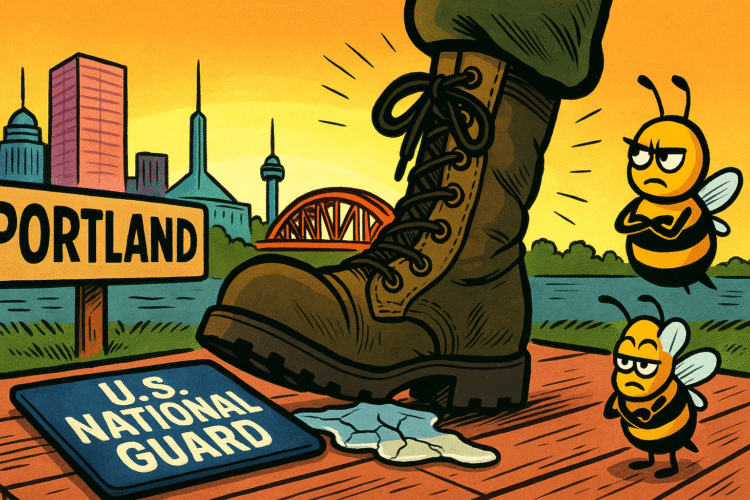
There’s a subtle tremor in civil society when the uniformed hand that writes the citation also carries the deployment order. A divided panel of the United States Court of Appeals for the Ninth Circuit has quietly given the green light to Donald J. Trump to federalize the Oregon National Guard—for now—and deploy it into downtown Portland, Oregon under the auspices of protecting “federal property.” Meanwhile, state and city officials are screaming “federal overreach,” and a single judge has already warned that the full circuit may re-open the case en banc, meaning the detonation timer hasn’t been set—it’s already blinking.
You don’t hear a lot of “this is about the law” when the law becomes the tool of escalation. What we’re watching isn’t just a jurisdictional spat—it’s a frontline of American civics where boots walk, courts nod, and trust drains out of the concrete faster than the National Guard’s baggage trucks roll in.
The Panel That Opened Version 2.0
The story begins with a panel of three judges deciding: yes, the president can federalize a state’s own National Guard under Title 10 for the purpose of protecting federal property. That ruling didn’t activate boots immediately—it flicked the ignition switch. And judicial dissent from Susan P. Graber called the move a “dangerous expansion of presidential power” that ought to make anyone who values separation of powers cringe.
Logistically, the order doesn’t dispatch troops—it authorizes the mission. The command relationships, actual target lists, patrol guidelines remain to be drawn. It’s the paperwork equivalent of handing someone the key to the engine room and saying “go ahead” while still designing the train tracks. The state’s guard becomes federal-activated; the city says “not so fast”; the courts say “maybe soon.”
When the City Says “No Thanks”
Mayor Ted Wheeler and Governor Kate Brown walked to the press podium and said something unheard-of: “We object.” Their anger was procedural, political and moral. They insisted policing remains a local responsibility, that the Guard’s role in domestic protest situations isn’t something you outsource to the federal executive branch, and that what this ruling signals is not protection—but escalation.
The city filed motions. Neighborhood groups mobilized. An attorney-general letter landed in the federal docket. All while the Ninth Circuit dropped a subtle cue: this order might get reheard en banc. The “for now” clause is the court’s way of saying: we sanctioned this… for now. The detonation hasn’t gone off—but the fuse is lit.
From Federal Property to the Sidewalks
Here’s where the logic creeks under weight. The administration’s argument: federal buildings were under threat. Based on that threat, the president may federalize the Guard in a state and declare a mission to protect said property. Fine. Until you realize that sidewalk bins, dusk-rising banners, protest lines—they border federal property. They adjacent it. They touch it. The moment you send in troops to protect a courthouse, you are also visibly protecting the city block. The property argument becomes the street-control argument.
And once the Guard hits the streets on a federal mission, the distinction between “we watch our federal building from the curb” and “we patrol the entire downtown” becomes academic. That’s why state most of all worries: the classic city ones who rely on the Guard for emergencies now watch them being positioned against their own streets.
Warning Signs You Didn’t Want to See
Here’s what to track:
- When the official activation order is published—watch for language “protect federal facilities and associated operations.” That phrase means everything.
- If the city accepts only perimeter control but the Guard seeks full urban patrol roles, you’ve moved halfway to martial-mode.
- If Oregon files for en-bank reconsideration—you’ll know they realize how big this is.
- If the Supreme Court eventually gets a brief saying “we already placed troops in cities under Title 10; is that legal?”—you’ve crossed from policy to precedent.
This isn’t just about Portland. It’s the test case for federalizing blue-city accountability when the visual of boots seems more important than the substance of peace.
A Mostly Peaceful City Meets Federal Mandate
Let’s not confuse matters: Portland has seen protests, yes. But many of them were peaceful. The city officials repeatedly stressed that local policing and community engagement—not federal troop presence—kept things under manageable control. And now the city is being told: we’re bringing boots anyway. Because federal property feels under threat. Which begs the question: if your city says “we got this,” why does the president send soldiers?
Assume Guard troops arrive. They stand perimeters around courts, set watch posts by federal buildings. Fine. Until someone asks: Why are they standing twenty yards from a church? Why did they cross the threshold into a residential block? When do they go from protecting assets to managing the block?
Because the people on the sidewalk don’t notice the statute. They notice the boots. And what they’ll wonder: are they safe, or under observation?
Invisible Consequences That Matter More Than the Uniforms
When you slip troops in for protest control, here’s what happens:
- A witness to police or Guard working in tandem stops calling 911.
- A neighborhood where immigrant families lived with tenuous trust begins to treat the badge as ambiguous.
- Domestic-violence reporting flattens because the “cop” they call might get you seen by federal agents.
- The Guard’s appearance changes the optics of the street—presence becomes enforcement by fashion, not by mission.
If policing relies on trust—“officer is my ally”—then wearing a different uniform or chain of command shifts the calculation. You don’t investigate because you can’t bet who’s watching you. That’s the first collapse of public safety that happens quietly.
The Cost of This Decision Isn’t in Dollars—It’s in Silence
You’ll hear about cost, reimbursement, federal dollars. But the cost here is trust. You can’t budget for a parent feeling safe. You can’t price the young man who once volunteered for neighborhood watch now declining to open his door. Yet that cost is real—and bigger than the overtime you hope the feds cover.
Remember: this is Title 10 activating the Guard. Not an emergency state activation under the governor. The difference? One remains under local and civilian oversight. The other answers to a federal chain. When you shift chains, you shift accountability.
Which provokes this thought: The ruling might pass, troops might go in—and months from now, we’ll ask: Why didn’t the city meet its goals? Because “deployment” did not equal “public safety”—it equaled “deployed presence.” The mission could succeed in the Pentagon while the street fails in the dark.
The Political Theater of Boots and Memoranda
Mayor Johnson’s memo talked “potential benefits,” “federal collaboration,” “financial opportunities.” Translation: let’s cost-offset, rebrand, and reorder by novelty. Town halls raised red flags. Council members didn’t call it “government surge”—they called it “trust erosion.”
Gov. Abbott, Trump’s border arts patron, and the White House rhetoric all converge: when cities aren’t performing like platforms for federal enforcement, the response is boots. When locality becomes judged by optics of passivity, deployment becomes the message. We’re tired of waiting. We bring the force.
But force is different from cooperation. In a city built on consent, you don’t muscle the watch—it’s invited. The bright uniforms hiding skulking authority are the opposite of civic partnership. They declare capability by intimidation—not community.
A Reality Check for the City We Want
The city we want doesn’t see human beings as variables to manage. It sees them as neighbors to protect. When you send armed, federal-controlled soldiers into your streets, you aren’t saying “we’re safe”—you’re saying “we’re locked down.” And the difference is civil life.
Today’s Portland is being used to test tomorrow’s default: if protests happen, federalize. If you feel unsafe, the Guard will be there. If you call for help, expect architecture built for control. That mindset rewrites what public service means.
Local policing is messy. It demands negotiation, empathy, patience, process. Federal deployments demand obedience, order, motion. The first builds trust—slowly. The second builds closure—quickly. What you’ll lose in the transition is what lasts.
Final Reflection: When the Boots Arrive, So Does the Question
This isn’t about whether Portland was perfect. It wasn’t. But think of what trust it still had. The next morning after a massive protest the neighbor still picks up the tab for the next-door family’s kid. The coffee shop still functions. The bus still runs. When you invite troops in you freeze that ecosystem. The coffee shop is still open—but people no longer talk because they don’t know who’s behind the badge.
When you federalize the Guard to a city that didn’t ask for it, you don’t just shift authority—you shift allegiance. The uniform remains the same—but the mission changes. And no amount of protocol will erase what feels different: the place becomes under control rather than part of control.
If you believe cities thrive on trust, then you’ll realize that command doesn’t scale. Consent does. The ruling that grants federal soldiers in Portland isn’t just a legal decision—it’s a civic one. It asks: will your city be policed by its people, or by your government? Because once you hand the streets to boots from inside the country, you lose the neighborhood—one unanswered call at a time.