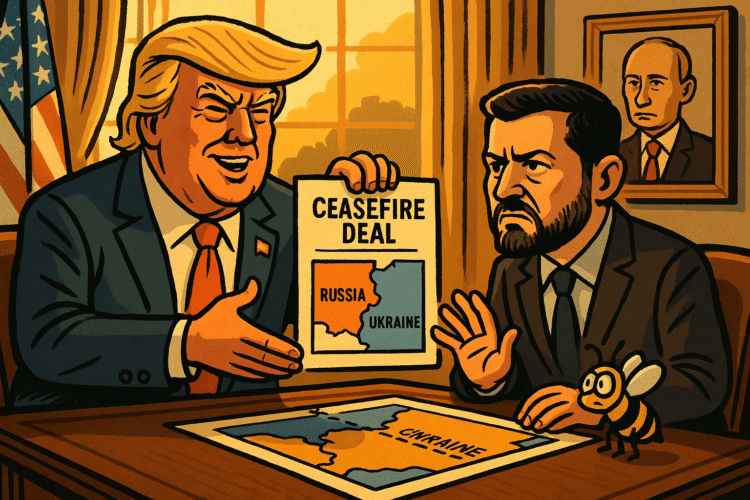
There’s something profound in watching the world’s guarantor of sovereignty sketch out the fine print of an occupier’s victory and call it diplomacy. In a charged White House session, Donald Trump pressed Volodymyr Zelenskyy to accept a cease-fire that freezes the war along current battle lines and floated a territorial swap handing Vladimir Putin the rest of Donetsk and Luhansk in exchange for fragments of Zaporizhzhia and Kherson. Meanwhile, Trump declined Ukraine’s request for long-range Tomahawk missiles and even raised “security guarantees” for both Kyiv and Moscow. The Ukrainian team, armed with maps, satellite imagery and survival stakes, left the meeting not relieved but alarmed. Sources described profanity, table-pounding and the unmistakable message that refusal might lead to Ukraine’s “destruction.”
A call with Putin preceded the meeting. Next up: talk of Marco Rubio and Sergey Lavrov prepping a future summit. Zelenskyy had hoped to walk out with long-range strike capacity; instead he walked through the Oval Office feeling like a defeated host at his own dinner. The public ending: Trump championing a “deal where we are,” while Kyiv signaled conditional openness to a front-line freeze, not outright concessions.
The question no one in the room asked—apparently by design—is why the world’s strongest advocate of rule-based order just softened for a dictator. So what: if the supply chain of deterrence is replaced by the banquet of capitulation, the war doesn’t end—it becomes a template. Every revanchist with artillery and a map now knows the terms: kill until freeze, occupy until recognition, negotiate until sanction-play. And the next capitals to be carved by “deals where we are” won’t be Kyiv alone.
The Meeting That Became a Bargain Bin
Zelenskyy entered the White House with a delegation of generals and mapmakers, expecting security guarantees and Tomahawks enough to keep Ukraine fighting. He left facing a proposal to hand over Donetsk and Luhansk—regions still held, still defended—just to secure a cease-fire. The territorial swap pitched: Russia gets the East, Ukraine gets a string of Zaporizhzhia and Kherson shards “for stability.” Ukraine’s negotiators called it insurance for Moscow’s permanent occupation.
When Trump dismissed their maps and accused Ukraine of “gambling with World War III,” the tone sharpened. Sources say multiple people stood, gesturing at the table, demanding clarity; the answer was “we’ll deal with both sides.” The message: expect the table to wobble, even collapse. This wasn’t realism—it was resignation.
Tomahawks Off the Menu, Seats at the Table Included
Zelenskyy’s case: the war isn’t frozen until Ukraine has the tools to contest it. He asked for Tomahawk missiles. The U.S. declined. Trump apparently said: we’ll guarantee your security—and the invader’s too. That’s not parity—it’s paralysis by policy.
The invite to Moscow’s guest list, meanwhile, became obligatory. A Rubio–Lavrov contact. A summit in Hungary. Ukraine was not invited. The settlers whose land might be traded were less “at the table” than watching the chairs swivel. Reality: the guarantor of Ukraine’s defense just bought a ticket to Putin’s peace concert.
Front-Line Freeze or Surrender Sign?
The phrase “freeze where you are” often means “accept what you hold but don’t advance.” For Ukrainians, holding doesn’t win—they need advancing. Yet the meeting proposed exactly that: hold your corners, concede your wings. The Donbas salient—among Ukraine’s most vital—is on the table. Not defending it means losing its value.
A cease-fire without verification is a stalemate. A territorial carve-up without the better parts is defeat. And both were whispered aloud: “we’ll freeze the line” but also “you’ll hand over ground.” Ukraine didn’t walk away—Kyiv still sat—yet the seat was now shaped like a noose.
Allies Left to Clean Up the Diplomatic Office
European partners and Congress watched from the lobby. Implicit questions hung in the air: if Washington formalizes a demarcation line that Kyiv sees as strategically suicidal, will the allies step in? If sanctions cannot be sprung when one side cheats, will this reset the rules?
Ukraine’s defenders in Congress must now ask: if the U.S. writes the script for a deal leaning on Moscow’s gains, do they lift the pen or toss it? If Berlin brokers the guards and Brussels funds the monitors, why didn’t Washington hold the map? Allies no longer see a partner—they see a pivot. And in war, a pivot becomes a punchline.
The Mechanics of What Comes Next
The steps ahead depend on whether this remains a “pause” or becomes a “precedent.”
Will Tomahawks remain off the table—or will the hedged “no decision yet” become precedent?
Will a formal U.S. demarcation-line plan emerge that Ukraine sees as strategically unviable for Donbas?
Will European partners and Congress rebuild verification and sanctions tools—or glide past them?
Will a rumored Trump–Putin summit try to sell a border map as peace?
Yes: the war might transform into policing a “truce zone” that rewards occupation by reward. That’s how metastasis begins.
Why the War Doesn’t End, It Mutates
If the guarantor of the rules-based order says “okay if you stop at this hedge” and the sword remains in its sheath, you don’t get peace. You get template. Every revisionist reads the waiver clause and says: “advance until freeze, then demand recognition.” The logic: you’ll freeze, we’ll redraw. The method: we’ll parcel the fortress while they hush.
When the ultimate act of diplomacy looks like negotiation in the invader’s favor, the 1919-style peace treaty becomes a sales contract for conquered land. It’s not victory—it’s business. The next aggressor sees not red lines but white gaps they can fill.
The Subtext in the Room
Trump’s posture: we’ll guarantee you—but also your enemy. He called for stop-the-war, while showing zero appetite to recalibrate your fight. He championed “deal where we are” at the podium, while handing Kyiv another question rather than a weapon. The doublespeak: you’ll get support—but only if you stand still. The error: you cannot win by waiting.
Zelenskyy may accept a cease-fire but not a sacrifice. His conditional openness doesn’t mean agreement—it means survival. The question isn’t whether the meeting ended—it’s how it ended. With Ukraine left to police a freeze while Russia holds the chips. With the U.S. retreating from arms and advancing into intermediaries. With Europe made uncomfortably relevant—but Washington made irrelevant.
The Reminder at the End
When the world’s superpower writes a concession and calls it peace, you don’t rewrite a war—you reschedule it. The map stays in color, but the stakes go grayscale. The guns may hush—but the countdown starts.
If a war ends with a handshake in which the defender gives up while the occupier still lists demands, it isn’t determined—it’s deferred. The next aggressor watches the tape. The next victim reads the memo: “Offer your line or be written off.”
The guarantors of peace used to say: never negotiate from weakness. Now they say: we’ll negotiate your weakness. The war won’t end—it will echo. In the trenches, in the diplomatic cables, and in the maps that still change. And when the next country capitulates, they won’t call it surrender—they’ll call it precedent.
If we brush off this meeting as another “hiccup” in diplomacy, we miss the script. The ally who came asking for missiles walked out with a border deal. The power that pledged defense is now brokering part-ownership of defeat. And the world is watching.
Because the next frontier won’t be a battlefield. It’ll be a drawing board. And the legs are still moving.