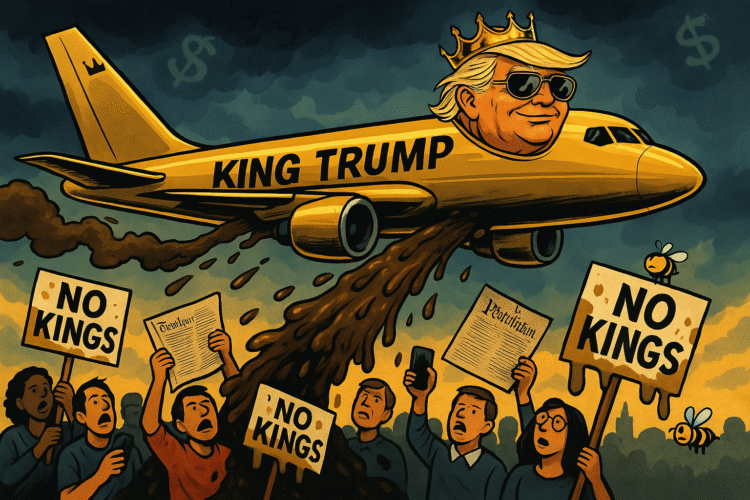
Some men crave legacy. Others crave power. And then there are those who crave the cinematic experience of dumping digital sewage on protesters while “Danger Zone” blares in the background. Donald J. Trump, patron saint of grievance and green screen, has once again redefined leadership—not as the art of governance, but as a content genre.
The latest entry in this running fever dream arrived in the form of a 19-second AI video posted to Truth Social. It shows “KING TRUMP,” crowned and triumphant, piloting a jet over the millions who joined “No Kings” protests across all 50 states. As he soars above, a brown sludge rains down on the demonstrators below. The music? Kenny Loggins. The tone? Dictator meets Dad Joke. The message? Absolute monarchy, but make it memeable.
In another timeline, this would be satire. In ours, it’s policy.
The video, according to verified coverage, stitches together real protest footage—people in the streets demanding democracy, accountability, maybe a livable country—and reimagines it as a fantasy sequence where the president personally humiliates them from the clouds. It’s trolling as governance, a kind of state-sponsored roast that treats dissent as raw material for digital performance art.
Within hours, it had ricocheted across social platforms. Trump allies called it “epic,” “based,” and “symbolic of dominance.” Organizers called it what it was: proof that the White House no longer sees Americans as citizens to be governed, but as extras to be edited. The clip became both a propaganda piece and a psychological profile—a 19-second X-ray of a presidency that believes mockery is management and authoritarian cosplay counts as a communications strategy.
It’s tempting to laugh. It’s harder to remember that this wasn’t posted by a fan account, but by the Commander-in-Chief.
Let’s linger on the imagery. A jet labeled “KING TRUMP.” A crown gleaming atop the orange coif. A rain of sludge falling on crowds who dared to gather. It’s the kind of tableau that would make Kim Jong Un’s media team blush. But the genius—or madness—of it lies in how deliberately unserious it is. It’s not a declaration of kingship; it’s the performance of one. A wink that says, you know I’m kidding—but also, you know I’m not.
This is how modern strongmen operate. They outsource the violence to metaphor until metaphor becomes normalization. Every AI-generated “joke” blurs the line between parody and policy. Every doctored clip becomes an experiment in conditioning. By the time the public realizes what’s been internalized, the absurdity has already metastasized into belief.
You don’t need tanks in the streets when you can algorithmically train people to cheer at the sight of digital sludge.
The White House, naturally, downplayed it. A senior aide dismissed the uproar as “satirical expression.” The same defense they used when Trump joked about “terminating” parts of the Constitution, or mused about being “president for life.” Humor, in this administration, is a utility. It softens the threat while amplifying the message.
Meanwhile, the machinery of actual governance sputters in the background. Court fights rage over National Guard deployments, civil liberties, and the right to protest. Municipal budgets buckle under federal pressure to “contain unrest.” The same week the sludge video dropped, legal filings revealed internal debates over surveillance thresholds for “mass gatherings.” But those stories are complicated and dull. They don’t trend. They don’t make you feel like a king in a cockpit.
The “No Kings” protests were meant to reclaim dignity—to remind the world that America, whatever its dysfunctions, does not do monarchs. Millions turned out. It was, briefly, a picture of what democracy could still look like: loud, messy, hopeful. And in return, the president responded with a cartoon.
Not a statement, not a policy, not even a lie dressed as leadership—just a pixelated revenge fantasy. The kind of thing an insecure teenager might make on an iPad between bans from Fortnite. Except this teenager controls the military and the nuclear codes.
The symbolism is grotesque and precise. Trump isn’t content to rule; he wants to humiliate. Not merely to silence opposition, but to digitally erase its humanity. In his world, the protesters aren’t citizens—they’re a backdrop, something to be flown over, mocked, and dumped on.
That’s the real tell. It’s not about belief; it’s about hierarchy. The point of monarchy isn’t divine right. It’s the joy of being above someone else.
Of course, the spectacle worked exactly as intended. MAGA influencers clipped it into tributes, reaction channels set it to trap beats, and right-wing accounts flooded X with #KingTrump memes. The sludge became a sacrament. Every frame of disgust became free advertising. Even mainstream outlets couldn’t resist the headline gravity: PRESIDENT POSTS AI VIDEO MOCKING PROTESTERS.
The outrage became oxygen. And in Trump’s media cosmology, oxygen is currency. Every condemnation feeds the brand. Every fact-check strengthens the fiction.
This is the feedback loop of the post-truth state: provocation creates coverage, coverage amplifies myth, myth reinforces identity. The man who once called himself “the chosen one” now role-plays it through machine learning.
It’s not propaganda in the old sense—it’s interactive narcissism.
The real-world consequences are less cinematic. Organizers report a measurable chill in protest turnout. People wonder if their faces will end up in the next doctored video, repurposed as content for the ruler’s highlight reel. Platform moderators scramble to decide whether distributing a president’s synthetic video violates their “disinformation” policies. And behind all the noise, a new normal takes root: the idea that political expression is not a civic right, but a personal insult to be avenged online.
Once upon a time, democracies had state media. Now, we have state meme engines. The effect is the same: ridicule replaces reasoning. When power performs absurdity long enough, absurdity becomes the operating system.
To watch this unfold is to understand how autocracy can be funny right up until it isn’t. The laughter is part of the anesthetic. It’s how the audience learns to accept the unacceptable. A jet dropping sludge becomes a joke, then a metaphor, then a vibe. The moral ground shifts one meme at a time.
Trump doesn’t need to outlaw dissent when he can meme it into futility. He doesn’t have to crush critics when he can humiliate them in 4K. It’s governance through spectacle—a kingdom ruled by engagement metrics.
And in that sense, “KING TRUMP” isn’t just trolling; it’s prophecy. A self-fulfilling visual of how fragile the democratic muscle has become. A reminder that what starts as performance art often ends as precedent.
Even the soundtrack choice matters. “Danger Zone.” A song synonymous with reckless bravado, with men who mistake speed for purpose. The Top Gun fantasy has always been about control—the illusion of mastery over the uncontrollable. But the difference between Tom Cruise and Trump is that one understands he’s acting.
There’s something almost tragic about it, if you squint. The old man in his gilded fortress, still trying to edit reality into a form that flatters him. The crown may be digital, but the insecurity is human. He has every microphone in the world and still needs validation from strangers with usernames like @PatriotMom420. He doesn’t want to be president anymore; he wants to be immortal. And immortality, in the algorithmic age, means never logging off.
Closing Section: The Sewage Monarchy
When future historians study this era, they may not fixate on the policies or the court rulings or even the coups that never quite happened. They’ll study the aesthetics—the imagery of power, the way it dressed itself in irony to evade accountability.
They’ll see a crowned man in a fake jet dropping digital sludge on his own people and call it a metaphor too perfect to invent. They’ll see the crowds below—angry, laughing, scrolling—and realize that no one knew where the performance ended and reality began.
That’s the cost of a culture that confuses satire for safety. The king doesn’t need to build gallows when he can upload them. The people don’t need to fear repression when they’ve learned to fear ridicule. The palace doesn’t need guards when it has followers.
The sludge, in the end, isn’t just the punchline—it’s the medium. A torrent of humiliation pouring from the sky, baptizing the country in its own exhaustion.
And somewhere, far below the fantasy cockpit, democracy stands with a bucket and a mop, wondering how to clean itself off.