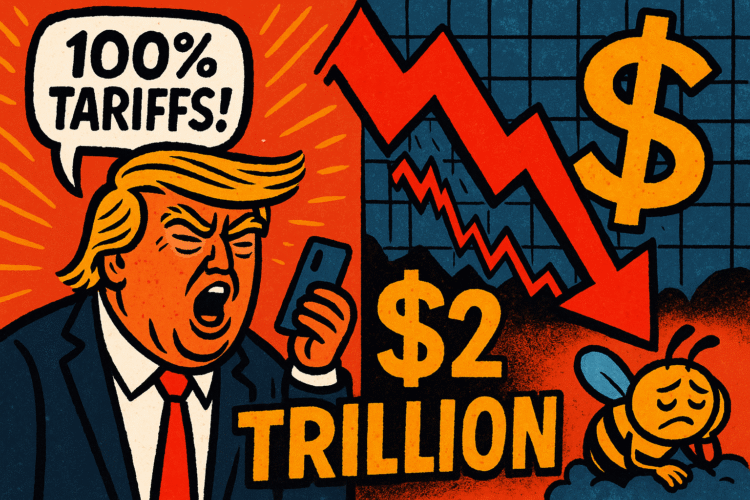
If the stock market had a safe word, it would’ve screamed it yesterday. In a single trading session, nearly $2 trillion in U.S. market value evaporated after President Donald Trump decided to use Truth Social like it was a nuclear launch console, announcing a 100% tariff on all Chinese imports and tighter export controls. CNBC says it wiped out record highs in about the time it takes to make a meme.
The S&P 500 fell 2.7%, the Dow dropped 1.9%, and the Nasdaq dove 3.6%, which, in Wall Street terms, means brokers went from “power lunch” to “emergency bourbon.” Semiconductor, EV, and tech stocks—basically everything that touches a microchip—collapsed faster than Trump’s attention span at a policy briefing. By the end of the day, the VIX (that’s the “uh-oh” index) spiked, traders were panic-texting their therapists, and America’s collective 401(k) had gone missing.
A Trillion-Dollar Tantrum
The day began like every other episode of “America’s Next Top Trade War.” Beijing had announced new export controls on rare earths—the minerals we use for everything from EV batteries to fighter jets. Trump, never one to underreact, responded by threatening to double tariffs and ban key U.S. exports, declaring there was “no reason” to meet Xi Jinping at the upcoming APEC summit (before clarifying that maybe there was a reason after all, but he’d decide later, depending on the vibes).
Markets, built on caffeine and denial, immediately went into free fall.
Imagine someone yanking the Jenga tower of global trade while yelling “art of the deal!” That’s roughly what happened. Every economist in Washington simultaneously updated their résumés.
Who Got Hit the Hardest
- Semiconductors: Nvidia, AMD, and the rest of the chip gang took a nosedive. You can’t exactly make GPUs without rare earths unless you want to carve them out of granite.
- EV Makers: Tesla and Rivian were spotted bleeding cash somewhere near Shanghai.
- Mega-Tech: Apple, Google, and Microsoft all faceplanting because “Made in China” doesn’t rewire itself overnight.
- Retail: If it has a barcode, it’s probably going to cost more next week.
By lunchtime, traders were watching their screens like meteorologists during a hurricane—except this storm came from a social media app.
Beijing: Calm, Petty, and Vengeful
China didn’t shout back. They did something worse: they smiled.
Officials quietly imposed new port fees on U.S. ships, tightened export licensing on rare-earth machinery, and began “reviewing” American chipmakers’ access to their market. It’s like getting ghosted by your largest trading partner.
And in a particularly poetic twist, Chinese state TV looped footage of Trump declaring victory while the Shanghai Composite surged. Because nothing says “we’re fine” like passive-aggressive glee.
The Chain Reaction
Economists call it “contagion.” Normal people call it “oh no.”
Here’s what the tariff nuke triggered:
- Supply Chain Chaos – Contracts shredded, shipments frozen, factories asking, “So… now what?”
- Inflation Panic – Prices rise before the tariffs even hit, because capitalism is just anxiety with a calculator.
- Fed Confusion – Jay Powell now has to choose between fighting inflation or saving jobs, and whichever one he picks, Twitter will hate him.
- Congressional Theater – Half of Congress wants to rein him in, the other half wants to rename the country “Tariffstan.”
- Diplomatic Fallout – The APEC summit might now involve two empty chairs, a buffet, and awkward small talk about supply chains.
The $2 Trillion Magic Trick
How does one man erase $2 trillion before lunch? Simple. By turning global trade into an improv show.
Markets depend on one thing—predictability. And Trump’s trademark style is the opposite. He’s the jazz musician of geopolitics: lots of noise, occasionally genius, always unexpected. One tweet and boom—retirement funds turn to dust, hedge funds cry into artisanal whiskey, and some guy in Florida buys a “Tariffs 2025” hat because he thinks this helps farmers.
Bespoke Investment Group estimated the market lost two trillion dollars of paper value in under six hours. To visualize that, imagine lighting every dollar bill in California on fire and then tossing in Texas for good measure.
How We Got Here
This wasn’t random. The U.S. and China have been playing economic chicken for years. The latest escalation came after Beijing tightened its grip on exports of rare materials critical to semiconductors and batteries. Washington responded with threats. Beijing retaliated with bureaucracy. Trump retaliated with tweets.
Each move ricochets into markets that are already exhausted. The “decoupling” fantasy—where America and China supposedly divorce peacefully—now looks more like a custody battle fought with hand grenades.
The Sound of Markets Screaming
CNBC aired live shots of the trading floor, where brokers had the same facial expression as people watching a loved one accidentally hit “Reply All.” The talking heads used words like “volatility event” and “macro reset,” which is finance-speak for “we don’t know either, please don’t sell everything yet.”
By 3 p.m., the S&P was down 2.7%, the Nasdaq nearly 3.6%. A collective “what the hell” rippled through Slack channels nationwide.
Meanwhile, the President reportedly told reporters he was “very proud” of the market correction, calling it “a strong correction, the best correction, maybe ever.”
Wall Street vs. Washington
Inside the Beltway, the reactions were predictable:
- Republicans split between praising his “tough stance on China” and begging him to delete Truth Social.
- Democrats called it “a kamikaze economic policy designed to impress Fox News.”
- The Federal Reserve quietly updated its recession probability models.
- Every lobbyist in D.C. booked an emergency flight to explain to Congress that tariffs don’t mean what they think they mean.
Business groups pleaded for calm, warning about “compliance whiplash” and “supply-chain seizures.” Translation: if this keeps up, we’re all going to pay $40 for a toaster.
The Butterfly Effect of Ego
Markets are fragile, but egos are nuclear. Trump’s tariff threat wasn’t just a policy—it was a performance.
In his mind, tariffs equal toughness. Negotiation equals weakness. It’s the geopolitical equivalent of taking your ball and going home, except your ball is the global economy and “home” is a recession.
China knows this. That’s why they’re waiting. They’ll retaliate slowly, surgically—long enough for U.S. firms to beg for stability while Beijing plays the adult in the room.
Recession Whispers and Fed Nightmares
Now, the whispers are growing louder: could this trigger a recession? Maybe not yet, but it’s flirting with the idea. A two-trillion-dollar haircut spooks credit markets, investment plans, hiring, and consumer confidence. If goods spike in price, the Fed will have to fight inflation while unemployment ticks up—a balancing act so impossible it should come with a safety harness.
For now, the central bank says it’s “monitoring developments closely,” which is bureaucrat for “we’re stress-eating croissants in the break room.”
The Moral of the Meltdown
Markets can forgive almost anything—greed, corruption, crypto—but not chaos. And this was chaos dressed in a red tie.
Trump’s tariff tantrum wasn’t just another policy move; it was proof that in 2025, governance can be performed entirely through trolling. Investors used to read the Wall Street Journal. Now they just check his feed.
The $2 trillion loss isn’t even the point—it’s the trust that vanished with it. The belief that adults are in charge. The confidence that tomorrow won’t be decided by who woke up cranky in the West Wing.
Final Section: THE SILENCE AFTER THE TWEET
The market crash of 2025 wasn’t an accident. It was a warning. Every index that tanked is a smoke alarm for a country playing with matches.
When one post can vaporize trillions, you realize capitalism has a new king—and he’s tweeting from a golf cart.
So here’s to 2025: a year where tweets are tariffs, policies are punchlines, and the global economy is just one bad Wi-Fi connection away from collapse.
And somewhere, in the background, the stock ticker scrolls on—bleeding red, humming softly, waiting for the next post.